
What's inside
- 1. What Is a Milwaukee Deep Cut Band Saw?
- 2. How to Choose the Right Milwaukee Deep Cut Band Saw Blade
- 3. How to Use a Milwaukee Deep Cut Band Saw
- 4. How to Change the Blade on a Milwaukee Deep Cut Band Saw
- 5. Milwaukee Deep Cut Band Saw Troubleshooting
- 6. Maintenance Tips for Longer Blade and Tool Life
- 7. Is the Milwaukee Deep Cut Band Saw Right for Your Work?
- Frequently Asked Questions
- Final Verdict
As an Amazon Associate I earn from qualifying purchases. This post may contain affiliate links at no extra cost to you.
A Milwaukee deep cut band saw is designed to cut metal stock, pipe, conduit, and compatible structural materials using a continuous moving blade. The Milwaukee M18 FUEL Deep Cut Band Saw (2729-20) has a stated cutting capacity of up to 5 × 5 inches, making it suitable for many plumbing, electrical, construction, and metal fabrication tasks.
To get accurate cuts, choose the correct blade, secure the workpiece, and allow the saw to cut without excessive pressure. This guide explains how to operate the saw, select replacement blades, change blades safely, troubleshoot common problems, and maintain the tool.
Specifications and operating instructions below refer specifically to model 2729-20 unless otherwise stated. Other Milwaukee band saw models may have different capacities, controls, and blade requirements.
1. What Is a Milwaukee Deep Cut Band Saw?
A deep cut band saw is a portable cutting tool that moves a continuous loop of toothed blade around wheels inside its frame. Unlike a circular saw, it cuts with a narrow blade that travels continuously through the material.
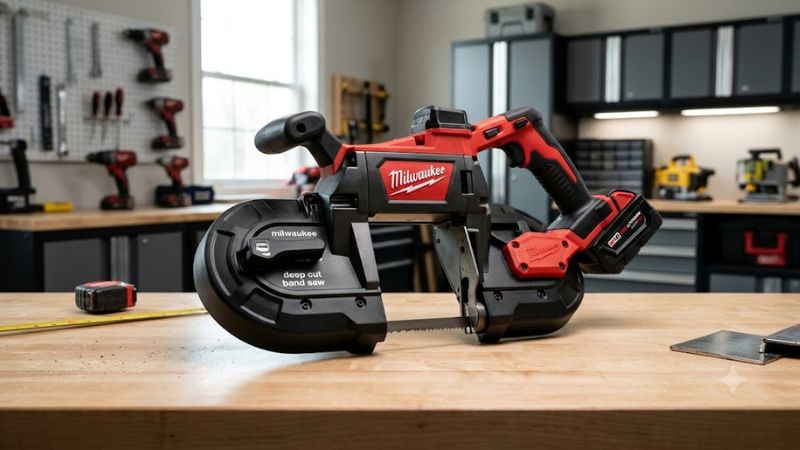
The Milwaukee M18 FUEL 2729-20 is a cordless metal-cutting band saw designed for jobsite and workshop use. Its deep-cut frame accommodates larger workpieces than many compact portable band saws.
Key Specifications of the Milwaukee 2729-20
| Specification | Details |
| Model | 2729-20 |
| Power source | Milwaukee M18 cordless battery platform |
| Motor | POWERSTATE brushless motor |
| Blade speed | 0–380 surface feet per minute (SFPM) |
| Maximum stated cutting capacity | 5 × 5 inches |
| Blade dimensions | 44-7/8 × 1/2 × 0.020 inches |
| Speed control | Variable-speed trigger and speed dial |
| Material guide | Adjustable, tool-free design |
| Additional features | LED work light, hang hook, and Jobsite Armor protection |
| Battery and charger | Sold separately in the bare-tool configuration |
These specifications apply to the 2729-20. The maximum cutting capacity describes the size of material the tool is designed to accommodate, not a guarantee that every material or shape can be cut under every condition.
What Jobs Is It Suitable For?
A Milwaukee deep cut band saw can be useful for:
- Cutting compatible metal pipe and electrical conduit.
- Cutting metal tubing, channel, and suitable structural stock.
- Trimming metal bars and other workpieces that fit within the saw’s capacity.
- Making repeated cuts during plumbing, electrical, mechanical, and fabrication work.
The appropriate blade depends on the material’s composition, thickness, and shape. Do not assume the saw can safely cut every metal, hardened material, or nonmetallic workpiece.
2. How to Choose the Right Milwaukee Deep Cut Band Saw Blade
Blade selection affects cutting speed, surface finish, blade life, and the likelihood of binding. The 2729-20 uses a blade measuring 44-7/8 inches long, 1/2 inch wide, and 0.020 inch thick.
Always check the operator’s manual for your exact model before purchasing a replacement blade.
Understand Teeth Per Inch (TPI)
TPI indicates the number of teeth along one inch of blade. A higher TPI generally provides closer tooth spacing, which can be useful for thinner materials. A coarser tooth pitch may be more suitable for thicker sections.
| Blade tooth pitch | Typical application |
| 7/8–10 TPI | Often suitable for thicker metal sections, depending on blade design |
| 14 TPI | A common starting point for general metal-cutting applications |
| 18–24 TPI | Often appropriate for thinner sections and thin-wall tubing |
These are general selection guidelines, not universal rules. Material composition, wall thickness, cross-sectional shape, and the blade manufacturer’s recommendations all influence the correct choice.
A useful general principle is to maintain at least three teeth in contact with the material when required by the blade manufacturer’s guidance. If the teeth are too coarse for thin-wall tubing, they may catch or strip. A blade that is too fine for thick material may cut slowly and clear chips less effectively.
Check Blade Compatibility Before Installation
Before purchasing a replacement, verify:
- The required blade length, width, and thickness.
- The blade’s intended material and tooth pitch.
- Compatibility with the exact saw model.
- Whether the blade has damaged teeth, cracks, distortion, or excessive wear.
A blade described as a deep cut band saw blade is not automatically compatible with every deep cut band saw.
3. How to Use a Milwaukee Deep Cut Band Saw
Before operating the tool, read the manual for your exact model. Prepare the correct blade, a compatible M18 battery, a secure workholding arrangement, and appropriate personal protective equipment.
Safety Equipment and Preparation
Wear safety glasses meeting the manual’s requirements and use hearing protection where appropriate. Select respiratory protection if the task creates hazardous airborne particles. Secure long hair, avoid loose clothing, and keep hands away from the blade path.
Metal chips can be sharp, and both the blade and workpiece can become hot. Cutting may also produce sparks, so keep flammable materials away from the work area and maintain suitable ventilation.
Step-by-Step Cutting Procedure
Step 1: Inspect the saw and blade
Remove the battery before inspecting or adjusting the tool. Check the blade for damage, confirm its dimensions, and inspect the blade guides and guards. Do not operate the saw with damaged components or an incorrectly installed blade.
Step 2: Secure the workpiece
Clamp the pipe, tube, or metal stock in a suitable vise or fixture. Support the offcut so it cannot fall, swing, or pinch the blade. Make sure the saw frame has sufficient clearance throughout the cut.
Step 3: Set the material guide and speed
With the battery removed, position the adjustable material guide according to the workpiece and the operator’s manual. Select an appropriate speed for the material and blade. The 2729-20 has a variable-speed trigger and speed dial; other models may use different controls.
Step 4: Start the cut carefully
Install the battery securely and hold the saw firmly by its intended handles. Start the blade clear of the workpiece and allow it to reach the selected speed. Position the material guide against the workpiece, then lower the blade into the cut under control.
Step 5: Maintain controlled cutting pressure
Let the blade do the work rather than forcing the saw through the metal. Keep the tool aligned and maintain a stable grip. Excessive pressure can cause binding, accelerate blade wear, and reduce control.
Step 6: Complete the cut and stop safely
Maintain control as the blade exits the material. Release the trigger and wait for the blade to stop completely before moving the saw or removing it from a partial cut. Remove the battery before clearing debris, inspecting the blade, or performing maintenance.
4. How to Change the Blade on a Milwaukee Deep Cut Band Saw
A worn or damaged blade can cause poor cutting performance, binding, and excessive heat. The following procedure summarizes the blade-changing process for model 2729-20. Check your model’s manual if its tension mechanism differs.
- Remove the battery. Ensure the trigger is released and the blade has stopped completely. Allow the blade to cool before handling it.
- Release blade tension. Turn the tension-lock handle approximately 180 degrees counterclockwise, as specified in the 2729-20 manual.
- Remove the old blade. Lift the blade from the pulleys and then remove it from the blade guides.
- Install the replacement blade. Position it correctly between the guide rollers and guide faces. Ensure the teeth face the direction specified in the manual.
- Seat the blade on both pulleys. Check that it is correctly aligned and sits properly within the blade path.
- Restore blade tension. Turn the tension-lock handle approximately 180 degrees clockwise to secure the blade.
- Inspect the installation. Check blade seating and the surrounding guard area before reinstalling the battery and starting the saw.
Never start the tool if the blade is incorrectly seated. Avoid touching a blade immediately after cutting because it may be hot.
5. Milwaukee Deep Cut Band Saw Troubleshooting
If the saw cuts poorly or stops during use, begin with the battery removed and the blade completely stationary. Never reach into the blade path while the tool is powered.
| Problem | Possible causes | Recommended action |
| Saw will not start | Discharged or improperly seated battery, trigger lock engaged, or tool fault | Check the battery charge and seating, then check the trigger lock. Seek service if the problem persists. |
| Slow cutting | Dull or incorrect blade, unsuitable speed, or excessive cutting pressure | Inspect the blade and verify the speed and blade selection against the manual. |
| Crooked cuts | Damaged blade, alignment problems, or unstable workpiece | Inspect the blade guides and secure the workpiece properly. |
| Blade binds in the cut | Workpiece movement, pinching, poor support, or unsuitable blade | Release the trigger, wait for the blade to stop, remove the battery, and investigate the cause. |
| Excessive heat or smoke | Dull blade, binding, unsuitable blade, or excessive pressure | Stop immediately. Allow the tool to cool and inspect the setup before further use. |
| Unusual noise or vibration | Damaged blade, loose components, or internal mechanical problems | Stop using the tool and arrange professional service if the cause cannot be safely identified. |
These are possible causes rather than confirmed diagnoses. Replacing a blade or battery will not correct an internal mechanical fault.
Stop using the saw if the blade repeatedly comes off its track, the guard or material guide is damaged, the trigger fails to operate correctly, or the tool develops persistent abnormal noise or vibration. Never bypass guards or attempt internal repairs while the tool is energized.
6. Maintenance Tips for Longer Blade and Tool Life
Regular inspection helps identify problems before they affect cut quality or create a safety risk.
- Clean after use: Remove accumulated metal chips and debris from accessible areas and ventilation openings using a method permitted by the manual.
- Inspect the blade: Check for damaged teeth, cracks, distortion, and uneven wear. Replace blades that are damaged or no longer cut properly.
- Check the guides and guards: Look for damage, misalignment, or parts that interfere with blade movement.
- Keep the handles clean: Oil and grease can reduce grip and control.
- Care for the battery: Use a compatible M18 battery and the specified charger. Follow the manufacturer’s charging and storage instructions.
- Store the tool securely: Remove the battery before storage, transport, or maintenance.
- Arrange service when needed: Persistent mechanical faults should be handled by an authorized service provider.
Follow the manufacturer’s instructions for cleaning, inspection, battery care, and servicing. Avoid applying universal maintenance intervals to tools used under different workloads and conditions.
7. Is the Milwaukee Deep Cut Band Saw Right for Your Work?
The Milwaukee M18 FUEL 2729-20 is worth considering if you regularly cut metal stock that benefits from a portable, deep-cut design and already own compatible M18 batteries. Its stated 5-inch round-stock and 5 × 5-inch rectangular-stock capacities cover many common jobsite applications.
It may be less suitable if you mainly cut small pieces in confined spaces, need a stationary production saw, or rarely cut metal. A compact band saw may be easier to handle for smaller stock, while a stationary machine may better suit repetitive workshop production.
Consider these factors before choosing:
- Material and dimensions: Confirm that the workpiece fits within the tool’s capacity and that the blade is suitable for its material and thickness.
- Cutting frequency: Frequent cutting may justify investing in a dedicated metal-cutting tool and replacement blades.
- Battery ownership: The 2729-20 bare-tool configuration does not include a battery or charger.
- Handling and control: A deep-cut frame provides greater capacity but may be cumbersome for small or awkwardly positioned workpieces.
- Safety and workholding: The tool requires secure material support, appropriate PPE, and controlled operation.
Milwaukee also offers the M18 FUEL Deep Cut Dual-Trigger Band Saw, model 2729S-20. Its two-handed trigger arrangement differs from the 2729-20, so verify the exact model and its operating instructions before comparing the two.
Frequently Asked Questions
1. What size blade does a Milwaukee deep cut band saw use?
The Milwaukee M18 FUEL 2729-20 uses a blade measuring 44-7/8 inches long, 1/2 inch wide, and 0.020 inch thick. Confirm the dimensions for your exact model before purchasing a replacement.
2. What is the cutting capacity of the Milwaukee 2729-20?
The 2729-20 is rated for round stock up to 5 inches in diameter and rectangular stock up to 5 × 5 inches. Actual suitability depends on the workpiece shape, clearance, material, and cutting setup.
3. Can a Milwaukee deep cut band saw cut stainless steel?
It can be suitable for stainless steel when the blade is specifically rated for that material and the workpiece is within the saw’s capacity. Follow the blade manufacturer’s guidance for tooth pitch and cutting conditions rather than assuming one blade works for every stainless-steel section.
4. Why is my Milwaukee deep cut band saw cutting slowly?
A dull or unsuitable blade, incorrect speed selection, poor workpiece support, or excessive cutting pressure can slow the cut. Inspect the blade and setup with the battery removed before resuming work. If the tool continues to perform abnormally, consult an authorized service provider.
Final Verdict
The Milwaukee deep cut band saw is a practical option for professionals and serious DIY users who need portable metal-cutting capacity. For the M18 FUEL 2729-20, the most important factors are selecting the correct blade, choosing an appropriate tooth pitch, securing the workpiece, and allowing the blade to cut without excessive force.
For safer operation and consistent results, identify the exact model before following setup or maintenance instructions. Keep the operator’s manual available, inspect the blade regularly, and stop work whenever the tool or cutting setup appears unsafe.

Write Your Review
No reviews yet. Be the first to share your experience!