What's inside
- Which Milwaukee 7 1/4 Circular Saw Do You Have?
- Milwaukee 7 1/4 Circular Saw Specifications
- How to Change a Milwaukee 7 1/4 Circular Saw Blade
- How to Adjust Cutting Depth and Bevel Angle
- How to Make a Straight, Accurate Cut
- Choosing the Right Blade for a Milwaukee 7 1/4 Circular Saw
- Troubleshooting Common Milwaukee Circular Saw Problems
- Milwaukee 7 1/4 Circular Saw Maintenance
- Frequently Asked Questions
- Final Verdict
As an Amazon Associate I earn from qualifying purchases. This post may contain affiliate links at no extra cost to you.
A Milwaukee 7 1/4 circular saw is a versatile tool for cutting framing lumber, plywood, dimensional lumber, and other approved materials. Milwaukee offers several saws in this size, including cordless M18 models and corded worm-drive designs. The right choice depends on your workload, available power source, battery platform, cutting capacity, and preferred handling style.
Before using a Milwaukee 7 1/4 circular saw, identify the exact model number, select a compatible blade, adjust the cutting depth, and secure the workpiece. These details affect cutting accuracy, tool performance, and operating safety. This guide explains the differences between common Milwaukee models, how to change a blade, how to adjust cutting depth and bevel, and how to address common cutting problems.
Which Milwaukee 7 1/4 Circular Saw Do You Have?
Milwaukee produces several circular saws with a nominal 7-1/4-inch blade diameter. Their power sources, drive systems, cutting capacities, and adjustment mechanisms differ, so always identify the catalog number printed on your tool before following model-specific instructions.
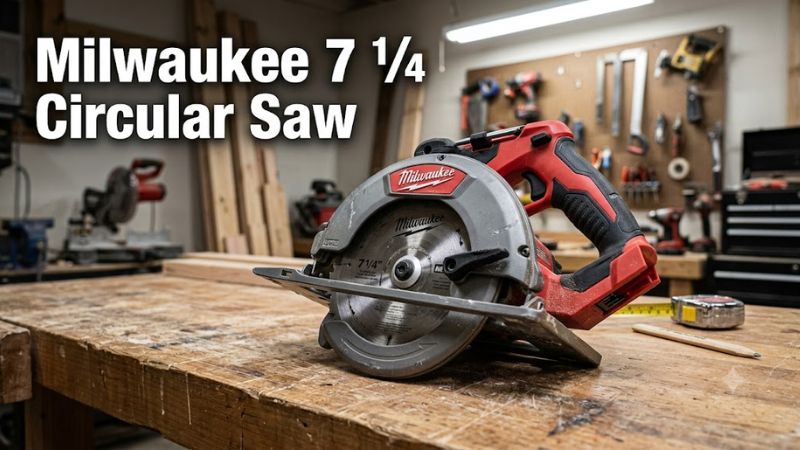
Milwaukee M18 FUEL 2834-20
The Milwaukee M18 FUEL 2834-20 is a cordless, brushless circular saw designed for framing, remodeling, and general construction. It operates on Milwaukee’s 18V M18 battery platform and has a manufacturer-rated no-load speed of 6,000 RPM.
Its maximum cutting depth is 2-5/8 inches at 90 degrees and 2 inches at 45 degrees. These specifications make it suitable for many common lumber and sheet-material cuts, provided the material, blade, and workpiece arrangement are appropriate.
The 2834-20 is a tool-only model designation, so buyers should check the package contents rather than assume a battery and charger are included. Its brushless motor and cordless design are useful for work areas where access to an electrical outlet is limited.
Milwaukee M18 Brushless 2631-20
The Milwaukee M18 Brushless 2631-20 is another cordless 7-1/4-inch circular saw. It belongs to the M18 battery family and uses a brushless motor with electronic tool protection.
Although it shares the general blade-size category with the 2834-20, the two models should not be treated as identical. Check the specific manual for cutting capacity, blade replacement instructions, adjustment controls, and supported accessories.
The 2631-20 may be worth considering for users who want a cordless saw within the M18 ecosystem. Its suitability depends on the required cutting performance, current package availability, and the user’s existing batteries.
Milwaukee 6477-20 Worm Drive
The Milwaukee 6477-20 is a corded worm-drive circular saw with a 15-amp motor and a rated no-load speed of 4,400 RPM. Its transmission design differs from the direct-drive arrangements found in many conventional circular saws.
A corded model can suit users who prefer continuous access to mains power without managing battery charge. However, the power cord restricts mobility, and the saw’s handling characteristics differ from those of cordless models.
Before purchasing, confirm regional electrical compatibility, the condition of the cord and plug, and the manufacturer’s instructions for operation and maintenance.
Milwaukee 7 1/4 Circular Saw Specifications
The following specifications apply to the Milwaukee M18 FUEL 2834-20, not every Milwaukee 7-1/4-inch circular saw.
| Specification | Milwaukee 2834-20 |
| Power source | 18V DC M18 battery |
| Motor type | Brushless |
| No-load speed | 6,000 RPM |
| Blade diameter | 7-1/4 inches |
| Arbor diameter | 5/8 inch |
| Maximum cutting depth at 90° | 2-5/8 inches |
| Maximum cutting depth at 45° | 2 inches |
| Maximum bevel angle | 50° |
| Blade brake | Electric |
| Model configuration | Tool only |
| Typical application | Framing, remodeling, and general construction |
The blade diameter indicates the nominal size of the blade the saw accepts. It does not represent the maximum depth of cut. Cutting capacity depends on the saw’s design, shoe position, blade geometry, and bevel angle.
The maximum cutting depth is a capacity rating rather than a recommended setting for every cut. For routine work, adjust the blade to suit the material thickness and the instructions in the operator’s manual.
How to Change a Milwaukee 7 1/4 Circular Saw Blade
Replace the blade when it becomes dull, damaged, or unsuitable for the material. A blade with the correct diameter but the wrong arbor, thickness, rotation direction, or speed rating may be incompatible with the saw.
Tools and preparation
You will generally need a compatible replacement blade and the wrench specified for the saw. Safety glasses and hearing protection are important, and suitable respiratory protection or dust extraction may be necessary depending on the material and working conditions.
Disconnect the power source before touching the blade. Remove the battery from a cordless saw or unplug a corded model. Wait for the blade to stop completely before beginning work.
Blade replacement steps
- Secure the saw. Place it on a stable surface with the power source disconnected. Make sure the trigger cannot be activated accidentally.
- Engage the spindle lock if provided. Use the wrench specified by the manufacturer to loosen the arbor bolt in the direction indicated in the manual. Do not force the fastener if it does not loosen as expected.
- Retract the lower blade guard using its designated lever. Remove the arbor bolt, outer flange, and old blade in the sequence specified for the model. Keep your fingers away from the teeth.
- Inspect the mounting components. Check the arbor, flanges, and surrounding area for damage or accumulated sawdust. Do not use a cracked, warped, or otherwise damaged blade.
- Install the replacement blade. Match the blade’s rotation arrow with the direction indicated on the saw. Confirm the diameter, arbor, thickness, and intended application are approved for the model.
- Reinstall the flange and arbor bolt. Tighten the fastener according to the operator’s manual. Do not substitute improvised washers or alter the mounting hardware.
- Check the lower guard. Confirm that it moves freely and returns to its closed position. Remove the wrench and other tools from the saw before restoring power.
If the blade guard sticks, the spindle lock is damaged, or the arbor bolt cannot be secured correctly, stop and arrange appropriate service rather than improvising a repair.
How to Adjust Cutting Depth and Bevel Angle
Correct adjustment helps the saw cut accurately while limiting unnecessary blade exposure below the workpiece.
Setting the cutting depth
- Remove the battery or unplug the saw.
- Place the shoe flat against the workpiece or a reference surface of equivalent thickness.
- Loosen the depth-adjustment lever or knob identified in the manual.
- Move the shoe until the blade extends slightly beyond the underside of the material.
- Tighten the adjustment and verify that the shoe remains secure.
A blade projection of approximately 1/8 to 1/4 inch beyond the material is a commonly recommended starting point for many circular-saw applications, but the exact manufacturer’s instructions take priority.
Setting the blade too deep exposes more of the blade than necessary. Setting it too shallow may prevent the cut from passing fully through the material.
Adjusting the bevel angle
A bevel cut angles the blade relative to the shoe. This is useful for angled joints, trim work, and other applications where a square cut is unsuitable.
- Disconnect the power source.
- Loosen the bevel-adjustment control.
- Align the indicator with the required angle on the scale.
- Tighten the control and check that the shoe is secure.
- Confirm that the available cutting depth is sufficient at the selected angle.
The M18 FUEL 2834-20 supports bevel cuts up to 50 degrees. Other Milwaukee models may have different maximum angles or adjustment features, so do not assume that their controls and capacities are identical.
How to Make a Straight, Accurate Cut
A clean, straight cut requires stable workpiece support, a suitable blade, accurate marking, and controlled movement of the saw.
1. Select the correct blade
A framing blade is suitable for many rough cuts in lumber. Plywood and finish work may benefit from a blade designed for a cleaner edge. The blade manufacturer should explicitly approve the material and application.
Tooth count is only one factor in blade selection. Tooth geometry, carbide design, blade thickness, and the material being cut also influence the result.
2. Measure and mark the cut
Use a pencil and square for crosscuts. For longer cuts, a compatible straightedge or cutting guide can help maintain alignment.
Account for the blade’s kerf, which is the width of material removed during cutting. Position the blade so the intended finished edge remains on the correct side of the cut line.
3. Support the workpiece
Place the material on a stable surface and clamp it where appropriate. Arrange the supports so the blade will not strike them and the offcut cannot pinch the blade as the cut progresses.
Keep your hands away from the cutting path. Never position a hand beneath the workpiece where the blade could pass through.
4. Inspect the saw before starting
Check that the blade is secure, the lower guard operates correctly, and the shoe is set to the intended angle and depth. Remove nails, screws, and other obstructions from the cutting path.
For corded saws, route the power cord away from the blade and the direction of travel. For cordless saws, verify that the battery is correctly installed and in suitable condition.
5. Make the cut steadily
Hold the designated handles with both hands where the tool design permits. Position yourself so you are not directly in the likely kickback path.
Start the saw before the blade contacts the material, allowing it to reach operating speed. Advance steadily while keeping the shoe flat against the workpiece. Do not twist the saw or force the blade through a cut that is slowing or binding.
6. Finish the cut safely
Maintain control as the offcut separates. Release the trigger and hold the saw still until the blade stops completely before setting it down.
If the blade binds, release the trigger and wait for the blade to stop. Disconnect the power source before inspecting or correcting the workpiece arrangement.
Choosing the Right Blade for a Milwaukee 7 1/4 Circular Saw
Blade selection depends on the material, desired finish, and saw specifications. A 7-1/4-inch diameter by itself does not establish compatibility.
| Blade type | Typical application | Important consideration |
| 24-tooth framing blade | Framing lumber and general construction | Designed for efficient rough cutting |
| Higher-tooth-count wood blade | Plywood, trim, and cleaner wood cuts | Confirm the blade is suitable for the material |
| Carbide-tipped multi-material blade | Materials specifically listed by the manufacturer | Verify the approved material and maximum RPM |
| Metal-cutting blade | Compatible metals and specified cutting applications | Confirm that the blade is approved for the saw and intended operation |
Before purchasing a replacement, check the blade diameter, arbor size, thickness, rotation direction, and maximum rated RPM against the saw’s documentation. The 2834-20 uses a 7-1/4-inch blade with a 5/8-inch arbor, but other models should be checked individually.
Do not install a blade simply because it fits the arbor. An unsuitable blade may create excessive vibration, bind during cutting, or operate outside its approved conditions. Never remove a required guard to accommodate a different blade.
Troubleshooting Common Milwaukee Circular Saw Problems
If the saw cuts poorly, stops unexpectedly, or behaves abnormally, begin with safe external checks rather than assuming the motor has failed.
Disconnect the power source before inspecting the blade, guard, shoe, or workpiece.
| Symptom | Possible causes | Recommended action |
| Rough or splintered cuts | Unsuitable blade, damaged teeth, incorrect cutting technique | Inspect the blade and choose one suited to the material |
| Saw binds during cutting | Pinched kerf, unsupported offcut, misalignment, dull blade | Stop the saw, disconnect power, and correct the setup |
| Cordless saw stops under load | Low battery charge, overload, excessive cutting resistance, or tool fault | Check the battery and workpiece arrangement, then follow the manual if the issue persists |
| Lower guard does not close | Debris, damage, or a mechanical fault | Stop using the saw until the guard operates correctly |
| Cuts are consistently out of square | Incorrect bevel setting, unstable shoe, or alignment problem | Check the zero-degree setting and follow the model’s calibration instructions |
| Excessive vibration | Damaged blade, incorrect installation, or loose components | Disconnect power and inspect the blade and mounting hardware |
Do not continue using a saw that repeatedly binds, vibrates excessively, or has a malfunctioning guard. Never bypass safety features or open energized equipment. If the problem remains after basic checks, contact an authorized service provider.
Milwaukee 7 1/4 Circular Saw Maintenance
Regular inspection helps identify problems before they affect cutting accuracy or safe operation. Follow the maintenance instructions for the exact model rather than applying one universal service schedule to every Milwaukee saw.
Clean the saw carefully
Disconnect the battery or unplug the tool before cleaning. Remove loose sawdust from accessible areas with a method permitted by the manufacturer. Avoid introducing moisture into electrical components or using cleaning agents that may damage the housing.
Check the lower guard for unobstructed movement. Do not operate the saw if the guard sticks or fails to return properly.
Inspect the blade and shoe
Look for damaged teeth, cracks, warping, and excessive buildup on the blade. Replace damaged blades rather than attempting to repair structural defects.
Check the shoe for damage and verify that the depth and bevel controls lock securely. A loose or bent shoe can affect cut accuracy and stability.
Care for cordless batteries
Use only batteries and chargers supported by the saw’s documentation. Inspect the battery housing and contacts for damage, and stop using a battery that is cracked, swollen, leaking, or unusually hot.
Store batteries according to Milwaukee’s instructions and keep them away from excessive heat, moisture, and conductive debris. Do not attempt to open or repair a damaged battery pack.
Inspect corded models
For a corded saw, check the power cord, plug, and strain relief for cuts, exposed conductors, crushing, or other damage. Disconnect the saw immediately if electrical damage is suspected, and have it repaired by qualified service personnel.
Frequently Asked Questions
1. What size blade does a Milwaukee 7 1/4 circular saw use?
A Milwaukee 7-1/4-inch circular saw uses a nominal 7-1/4-inch blade when that diameter is specified for the model. Check the arbor size, blade thickness, rotation direction, speed rating, and intended material before installing a replacement.
2. Is the Milwaukee 7 1/4 circular saw cordless or corded?
Milwaukee offers both cordless and corded 7-1/4-inch circular saws. The M18 FUEL 2834-20 is a cordless model that uses the M18 battery platform, while the 6477-20 is a corded worm-drive saw.
3. How deep can a Milwaukee 7 1/4 circular saw cut?
The maximum cutting depth depends on the model and bevel angle. The M18 FUEL 2834-20 has a maximum cutting depth of 2-5/8 inches at 90 degrees and 2 inches at 45 degrees.
4. Which battery fits the Milwaukee M18 7 1/4 circular saw?
The M18 FUEL 2834-20 uses Milwaukee’s M18 battery platform. Select a battery and charger supported by the specific model’s documentation; an M12 battery or a battery from an unrelated voltage platform is not a substitute.
Final Verdict
A Milwaukee 7 1/4 circular saw can be a practical choice for framing, remodeling, and general construction, but the best option depends on the power source, workload, and required cutting capacity.
The M18 FUEL 2834-20 is worth considering for users who want a cordless saw and already own compatible M18 batteries or are prepared to purchase the battery and charger separately. The corded 6477-20 is an alternative for users who prefer continuous mains power and a worm-drive design.
Before buying or operating either saw, confirm the exact model number, review the operator’s manual, choose an approved blade, and check the guard and adjustment mechanisms. Proper setup, secure workpiece support, and controlled cutting technique are essential to obtaining accurate results while reducing avoidable risks.