
Our Top Picks
 G & F Products Two-Strap Disposable Dust Masks1 Count (Pack of 50)4 x 12 x 5 Inches0 poundsCheck on Amazon

What's inside
As an Amazon Associate I earn from qualifying purchases. This post may contain affiliate links at no extra cost to you.
The short answer: for most people the best cordless router is a compact trim-style model with a fixed base, a smooth depth adjustment and a secure collet. It handles edge profiles, roundovers, flush trimming and hinge recesses, and it is light enough to control with one hand. If you plan to cut grooves, mortises or large profiles, look for a larger cordless router that accepts a plunge base. Be realistic about runtime: routing is a demanding job for a battery, so deep or wide cuts are best taken in several light passes.
Why go cordless with a router
A router spins a bit at very high speed to shape wood edges, cut grooves and recesses, and trim one surface flush to another. Traditionally that meant a mains-powered tool with a trailing cable that catches on the workpiece, the clamps and the bench. Cordless versions remove the cable and let you take the tool to the work: a door that is already hung, a worktop already in place, or a stair stringer in a half-built house.
The trade-off is power over time. A router is a high-load tool, and a battery has a finite supply. Light-duty edge work uses little energy, while a deep groove in dense hardwood can drain a pack quickly. Knowing which side of that line your projects sit on is the central buying question.
Types of cordless routers
Compact trim and palm routers
These small, one-handed tools are the most common cordless routers. They are made for light work: rounding over edges, small chamfers, trimming laminate, cutting hinge recesses and following templates. They are light, quick to set up, and easy to guide with a hand resting on the workpiece. Their smaller collets mean a narrower range of bits, and the motors are intended for light passes rather than heavy stock removal.
Full-size cordless routers
Larger cordless routers carry bigger motors, accept a wider range of bits and generally take the larger shank size. They are better for deep grooves, wide profiles, and work in dense timbers. They are heavier, need two hands in many operations and place greater demands on the battery.
Fixed-base versus plunge-base operation
With a fixed base, you set the bit depth first and the bit stays at that depth while you cut. It is simple, stable and ideal for edges. With a plunge base, the motor rides on spring-loaded posts, so you can lower a spinning bit into the middle of a board, which is how you cut stopped grooves, mortises and inlays. Some models are sold as kits with both bases, and some systems allow bases to be swapped. A plunge base is more complex but opens up a far wider range of joinery.
Comparison of router types
| Type | Typical strengths | Limitations | Ideal work |
|---|---|---|---|
| Compact fixed-base | Light, nimble, quick depth setting | Light passes only, smaller bit range | Roundovers, chamfers, laminate trimming |
| Compact with plunge accessory | Adds grooves and recesses | Extra parts, still light-duty | Hinge recesses, small inlays, stopped grooves |
| Full-size fixed-base | More power, larger bits | Heavier, shorter runtime under load | Larger profiles, edge work in hardwood |
| Full-size plunge | Deep and stopped cuts, versatile | Weight, battery demand, learning curve | Mortises, wide grooves, joinery |
How to choose
Pick the job first. If you mostly finish edges on shelves, tabletops and trim, a compact tool will serve you better than a heavy one, since light tools are easier to steer along a curve. If you cut dados, rebates or mortises, move toward a larger tool with a plunge option, and be ready to take multiple passes at increasing depth.
Consider the material. Softwood and sheet goods are relatively gentle. Dense hardwoods, laminate and solid surface materials demand more power and sharp bits. If you work in these regularly, choose a stronger motor and keep a spare battery.
Key features
Depth adjustment
This is the feature you will use most. Look for a mechanism that moves in fine, repeatable steps and locks without shifting the setting. Some use a ring that you twist; others use a lever or a rack. A scale that lets you make small, known changes is helpful, but always confirm depth with a test cut on scrap.
Collet quality
The collet grips the bit shank. A poor collet lets the bit slip or vibrate, which ruins cuts and is dangerous. Look for a collet that clamps cleanly, with a spindle lock that makes tightening easy. Make sure the collet sizes match the bits you plan to use, and never use a bit whose shank does not fit the collet exactly.
Speed control
Variable speed matters because larger bits should run slower than small ones. A dial or electronic control gives you flexibility, particularly with large diameter cutters and with materials that burn easily. Soft start, where the motor builds to speed gradually, reduces the jolt when switching on.
Base design and visibility
A clear sub-base lets you see the bit as it cuts. A flat, true base keeps the tool square to the surface. Some bases accept guide bushings or edge guides, which help with templates and parallel cuts. Check that the sub-base can be replaced if it becomes scratched.
Bits and collets
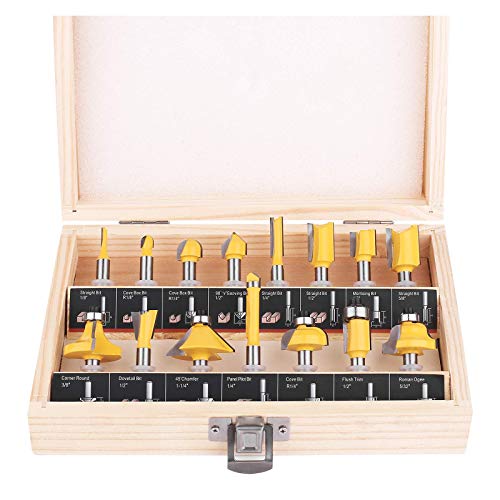
A router is only as capable as its bits. Beginners usually need only a few: a straight bit for grooves and rebates, a roundover bit for softening edges, a chamfer bit for angled edges, and a flush-trim bit with a bearing for following templates or trimming one board to another. A small set of quality bits is better than a huge assortment of cheap ones.
Bits are made from steel or are tipped with harder material. Tipped bits generally stay sharp longer and are the better choice for hardwood, sheet goods and laminate. Bits with a bearing follow an edge, while those without a bearing need a guide or fence.
Keep the bit clean. Pitch and resin build up on the cutting edges, causing burning and extra load. Wipe or soak them with a cleaner intended for the purpose, and avoid scraping with anything that could chip the cutting edge. Inspect bits for chips, bends or cracks before every use and discard any that are damaged.
Insert the shank fully into the collet, then pull it back out a small distance, as the manufacturer advises, to avoid the bit bottoming out. Tighten firmly with the correct wrench or spindle lock. Large-diameter bits should be fitted only to routers designed for them and run at the slower speeds recommended in the instructions.
Battery and platform considerations
Routing draws serious current. A compact router on a modest battery will manage edge profiles for a decent session, but a plunge router cutting a wide groove in hardwood can empty a battery within a short time. Larger batteries add runtime but also weight, which affects control. For full-size cordless routers, two batteries are practically essential if you work in long sessions.
Voltage classes differ between manufacturers, so rather than comparing numbers, think in families: lighter platforms for small, nimble tools, and higher-voltage platforms for heavier tools. A router is most useful when it shares batteries with your drill and other tools.
Handle batteries sensibly. Let a hot pack cool before recharging, charge on a hard, non-flammable surface in a ventilated area and use only the charger intended for that pack. Do not use or charge a damaged, swollen or leaking battery, and keep terminals away from metal objects. Remove the battery whenever you change bits, adjust the base or leave the tool unattended.
Use cases
Edge profiles
Roundovers and chamfers make furniture and shelves comfortable to handle and resist chipping. Take a shallow first pass, then deepen the cut if needed. Work the shaped edge in the correct direction, as explained in the technique section, and keep the base flat on the surface.
Flush trimming
Using a flush-trim bit, you can trim laminate to the edge of a substrate, or match a repaired piece to a template. Secure the template firmly and let the bearing ride the edge. Clean sawdust from the bearing path to avoid ride-up.
Hinge recesses and hardware
A compact router with a straight bit and a template makes tidy, consistent recesses for hinges and strike plates. A small plunge base is helpful here. Cut slowly, and finish the corners with a sharp chisel.
Grooves and rebates
Guide straight grooves with a clamped fence or straight edge, and cut in several passes of increasing depth. This reduces tear-out, saves the battery and spares the motor.
Setup and technique
- Remove the battery. Do all bit changes and depth settings with the pack off.
- Fit the bit into a clean collet, seat the shank properly and tighten firmly.
- Set the depth for a shallow first pass. Deeper cuts come later.
- Test on scrap of the same material. Check depth, profile and surface finish.
- Clamp the workpiece so both of your hands are free to hold the router. Add a backer board where a cut exits a board to prevent splintering.
- Position the router with the bit clear of the wood, insert the battery, switch on and wait for full speed.
- Feed steadily in the direction that makes the bit pull the router into the work against the cut. Listen to the motor; a steady note means a good feed rate.
For handheld edge work, move the router so the bit rotation pulls the base against the workpiece rather than away. Working the wrong way, a climb cut, can make the router grab and run. Light climb passes are sometimes used by experienced users to avoid tear-out at grain changes, but they require great care and are not recommended for beginners. On outside edges, you generally move counter-clockwise around the piece; inside edges are the reverse. Confirm the direction with the tool manual for your setup.
Safety
- Eye and ear protection. Wear safety glasses or a face shield and hearing protection. Routers are loud and throw chips.
- Dust protection. Fine wood and composite dust is harmful. Use extraction where possible and a suitable mask or respirator.
- Battery out for changes. Remove the pack for bit changes, depth adjustments and before cleaning.
- Workholding. Clamp the work, and keep fingers well away from the bit. Never try to rout small pieces freehand; use a jig, a sled or a router table setup with the right guards.
- Two hands on the tool. Hold firmly, and keep a stable stance. Do not start with the bit in contact with the work.
- Appropriate bit and speed. Use only undamaged bits, and run large bits at lower speeds.
- Wait for it to stop. The bit keeps spinning after the switch is off. Do not set the router down until it has stopped, and keep it away from your body.
- Clothing. Avoid loose sleeves, gloves that can catch in rotating parts, long hair and jewellery.
Care and common mistakes
Care
After use, remove the battery and clear chips from the base, vents and collet area with a brush, wearing eye protection. Clean the collet and the spindle taper with a suitable brush, since built-up dust prevents the collet from gripping. Check the sub-base for nicks, check depth locks for smooth operation and inspect the plunge posts for gum or dust; a very light wipe, as per the manual, is usually enough. Store bits in a case so the cutting edges do not touch. Keep batteries and the tool dry and out of extreme temperatures.
Common mistakes
- Cutting too deep in one pass. This overloads the motor, burns the wood and drains the battery. Take several shallow passes.
- Feeding too slowly. A bit that dwells in one place burns the wood. Keep a steady, moderate feed.
- Feeding in the wrong direction. The router tries to pull itself along the work.
- Using dull or dirty bits. Burn marks and tear-out are the symptoms; clean or replace the bit.
- Skipping the test cut. A few seconds on scrap can save a ruined board.
- Not clamping. A moving workpiece and a spinning bit make a dangerous combination.
- Ignoring grain direction. Routing against the grain at an edge can splinter it. Use a backer board and take light passes.
Who should choose what
Comparison by buyer
| Buyer | Suggested router | Priorities | Starter bits |
|---|---|---|---|
| Casual DIYer | Compact fixed-base | Light weight, simple depth control, shared battery | Roundover, chamfer, flush trim |
| Hobbyist furniture maker | Compact with plunge option, or full-size plunge | Precision depth, bases that swap | Straight bits, roundover, rebate |
| Carpenter or installer | Compact router with spare batteries | Portability, quick changes, dust shroud | Flush trim, hinge-recess straight bits |
| Joiner or cabinet maker | Full-size with plunge base | Power, repeatability, extraction | Straight bits in several sizes, profile bits |
| Sign maker and crafter | Compact with guide bushing support | Light handling, fine control | Small straight and V-groove bits |
If you cannot decide, start with a compact kit that includes both a fixed and a plunge base if available, and a small set of quality bits. That combination covers most home projects. You can compare options among cordless routers on Amazon and check the base options against your needs.
Checklist
- List your usual cuts: edges, recesses, grooves or joinery.
- Choose compact or full-size by the heaviest cut you do regularly.
- Decide whether you need a plunge base.
- Check the collet size against the bits you want.
- Look for variable speed and soft start.
- Confirm that depth adjustment is fine and locks securely.
- Choose a clear sub-base and dust connection.
- Match to your battery platform and plan a spare pack.
- Buy a small set of tipped bits including a flush-trim bit.
- Wear eye, ear and dust protection.
- Remove the battery for every bit and depth change.
- Clamp the workpiece and fit a backer board where needed.
- Test on scrap before cutting the real piece.
- Clean the collet, bits and base after use.
FAQ
Can a cordless router replace a corded one?
For edge work, trimming and light recesses, yes. For heavy, long grooving sessions in dense timber a corded router has the advantage of continuous power. Many workshops keep both.
What is the difference between a trim router and a full-size router?
A trim router is smaller, lighter and intended for light cuts with small bits. A full-size router has a stronger motor and accepts larger bits for deeper or wider cuts.
Do I need a plunge base?
You need it for cuts that begin in the middle of a board, such as mortises and stopped grooves. For edge profiles and trimming a fixed base is enough.
Which bits should I buy first?
A straight bit, a roundover bit, a chamfer bit and a flush-trim bit cover most early projects. Choose tipped bits where you can.
Why are my cuts burning the wood?
Common causes are a dull or dirty bit, a feed that is too slow, excessive speed for a large bit, or a cut that is too deep. Clean or replace the bit and take lighter, steadier passes.
Which direction should I move the router?
Move so the rotation of the bit pulls the router into the work: generally counter-clockwise around an outside edge. Check the manual for your setup, and practise on scrap.
How can I reduce tear-out?
Use sharp bits, take shallow passes, use a backer board where the bit exits, and cut across end grain first before the long edges.
How long will the battery last?
That depends on cut depth, material, bit sharpness and battery capacity. Light edge work can be long-lasting, while deep cuts drain a pack quickly. Plan for a spare.
Conclusion
Choosing among cordless routers comes down to honest assessment of the work. A compact fixed-base tool is the right answer for edges, trimming and recesses. A larger plunge-capable machine opens up joinery but demands bigger batteries and more care. Whichever you pick, insist on a good collet, fine depth adjustment and variable speed, and give bits as much attention as the tool itself. Take light passes, clamp everything, wear eye, ear and dust protection, and remove the battery for every change. A starter set of router bits and a dust mask or respirator are sensible companions to the tool.
As an Amazon Associate, we earn from qualifying purchases. Links marked as sponsored may earn a commission at no extra cost to you.
Related guides
More from Amazon
Programs that pair well with the guide above. Offers and eligibility are set by Amazon and may change.
A free business account with business pricing and bulk-buying tools for work, shop or home office.
Create a business accountFree shipping on eligible items, Prime Video and more. Eligible new members can start with a free trial.
Start a Prime free trialAudiobooks and podcasts to listen to on the go. Eligible new members can start with a free trial.
Try Audible freeAd-free music streaming. Eligible new subscribers can start with a free trial.
Try Music Unlimited freeAs an Amazon Associate we earn from qualifying purchases.






Write Your Review
No reviews yet. Be the first to share your experience!