
What's inside
- What Is a 1/2-Inch Cordless Impact Wrench?
- What Can a 1/2-Inch Cordless Impact Wrench Be Used For?
- Important Specifications to Check Before Buying
- Choosing the Right 1/2-Inch Impact Wrench for Your Workload
- Socket Compatibility and Accessories
- How to Use a 1/2-Inch Cordless Impact Wrench Safely
- Common Mistakes When Buying or Using a Cordless Impact Wrench
- Maintenance Tips for Longer Tool Life
- Frequently Asked Questions
- Final Thoughts
As an Amazon Associate I earn from qualifying purchases. This post may contain affiliate links at no extra cost to you.
A 1/2-inch cordless impact wrench is one of the most versatile power tools for automotive repairs, equipment maintenance, construction work, and demanding fastening jobs. Its square drive accepts compatible 1/2-inch impact sockets, making it suitable for removing lug nuts, loosening stubborn bolts, and tightening larger fasteners.
However, choosing the right model involves more than looking at its maximum torque rating. Battery voltage, motor design, fastening control, socket compatibility, tool weight, and the type of work you perform all affect its usefulness.
The most important distinction is that 1/2 inch describes the square drive size, not the wrench’s torque or maximum bolt capacity. Understanding this difference helps you select a tool that matches your workload without paying for unnecessary power.
This guide explains how 1/2-inch cordless impact wrenches work, which specifications matter, how to choose a suitable model, and what to consider when using one safely.
What Is a 1/2-Inch Cordless Impact Wrench?
A cordless impact wrench is a battery-powered fastening tool that combines rotational movement with repeated hammering impacts. Instead of relying entirely on continuous motor rotation, its internal impact mechanism delivers short bursts of rotational force to loosen or tighten fasteners.
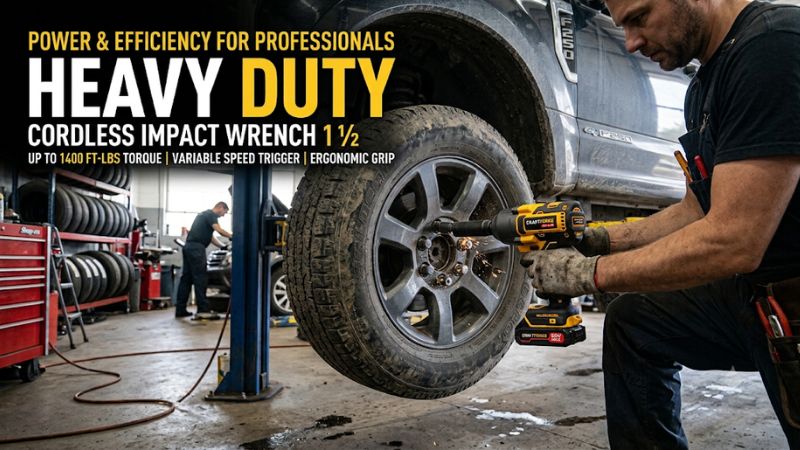
This mechanism makes an impact wrench particularly useful when dealing with tightly secured nuts, corroded bolts, and larger threaded fasteners.
Understanding the 1/2-Inch Square Drive
The 1/2-inch measurement refers to the square-shaped drive anvil at the front of the wrench. This is where the socket attaches.
A 1/2-inch drive is a popular choice because it provides a practical balance between socket availability, tool size, and fastening capability.
Impact wrenches commonly come with three drive sizes:
| Drive size | Typical applications | Main advantage |
| 3/8 inch | Engine work, smaller automotive fasteners | Compact and easier to maneuver |
| 1/2 inch | Lug nuts, suspension work, general automotive repairs | Versatile socket compatibility |
| 3/4 inch | Heavy trucks, industrial machinery, large fasteners | Designed for demanding fastening applications |
These are general application categories, not strict limits. The actual fastener size and workload must also match the manufacturer’s specifications.
A 1/2-inch wrench does not automatically have enough power for every 1/2-inch fastener. Two tools with identical drive sizes can have substantially different torque outputs.
How the Impact Mechanism Works
Inside the tool, a motor drives a rotating hammer mechanism. When the fastener encounters resistance, the mechanism delivers repeated impacts to the anvil.
This produces high rotational force in short bursts.
The operating process generally involves:
- The motor begins rotating when you press the trigger.
- The drive mechanism accelerates the socket.
- Resistance from the fastener causes the hammer mechanism to engage.
- Repeated impacts transfer rotational energy to the fastener.
- The fastener gradually loosens or tightens.
The impact mechanism makes the tool more effective for demanding fastening jobs than an ordinary drill/driver. However, it does not eliminate reaction forces, vibration, noise, or the possibility of losing control.
What Can a 1/2-Inch Cordless Impact Wrench Be Used For?
A 1/2-inch cordless impact wrench is suitable for many automotive, mechanical, construction, and workshop applications. Its usefulness depends on the tool’s actual torque capability and the manufacturer’s approved applications.
Automotive Maintenance
Automotive work is one of the most common reasons to purchase a 1/2-inch impact wrench.
Potential applications include:
- Removing vehicle wheel lug nuts.
- Removing suspension fasteners.
- Working on brake assemblies where the service procedure permits impact-tool removal.
- Removing stubborn bolts during vehicle maintenance.
- Performing general mechanical repairs.
For wheel removal, a suitable impact wrench can save considerable time compared with manually loosening every lug nut.
However, installation is different from removal. An impact wrench should not be treated as a precision torque wrench. Final wheel-fastener tightening must follow the vehicle manufacturer’s specified torque and tightening sequence, using an appropriately calibrated torque wrench.
Workshop and Equipment Maintenance
In workshops, a cordless impact wrench can help remove and install fasteners on machinery, metal assemblies, brackets, and equipment.
A high-torque model may be useful for larger fasteners, but the tool must be matched to the fastener’s grade, dimensions, and required tightening procedure.
Construction and Heavy DIY Projects
Some 1/2-inch impact wrenches can handle demanding fastening applications involving structural hardware and large bolts.
Nevertheless, an impact wrench is not automatically suitable for every construction fastener. Certain structural connections require controlled installation procedures, specified tightening methods, or specialized fastening equipment.
Always follow the fastener manufacturer’s instructions and relevant project specifications.
Important Specifications to Check Before Buying
Choosing a cordless impact wrench based solely on its advertised maximum torque can lead to an unsuitable purchase. Several specifications determine how effectively the tool performs.
1. Torque: Fastening vs. Nut-Busting
Torque measures rotational force. Manufacturers commonly advertise two different torque figures for cordless impact wrenches.
Maximum fastening torque describes the manufacturer’s stated maximum tightening capability under its specified measurement conditions.
Nut-busting torque, also called breakaway or loosening torque, describes the tool’s stated ability to loosen fasteners.
These figures are not interchangeable.
For example, Makita’s XWT08Z 18V LXT brushless impact wrench is specified at 740 ft-lbs of fastening torque and 1,180 ft-lbs of nut-busting torque. These are manufacturer specifications, not independent measurements under identical real-world conditions.
Product Details -XWT08Z+1
When comparing products, check:
- Whether the figure refers to tightening or loosening.
- The manufacturer’s measurement method.
- Whether the specification is a maximum or a controlled operating setting.
- Whether the stated output requires a particular battery configuration.
A higher advertised number does not automatically mean a tool is better for your particular application.
2. RPM: Rotational Speed
RPM means revolutions per minute.
It indicates how quickly the tool’s drive rotates without load. Higher RPM can help spin fasteners on or off more quickly when resistance is low.
However, RPM alone does not determine how effectively a wrench removes a seized bolt.
A useful impact wrench should combine appropriate rotational speed with sufficient impact energy and a controllable trigger.
3. IPM: Impacts Per Minute
IPM measures how many impact actions the mechanism delivers per minute.
A higher IPM rating indicates a greater potential impact frequency, but it does not independently establish how much torque the tool produces.
Torque, impact frequency, motor output, battery performance, and internal mechanism design work together.
Avoid comparing IPM figures without considering the operating speed and measurement conditions.
4. Battery Voltage and Capacity
Battery specifications influence the tool’s power delivery, runtime, and overall weight.
Most commonly available cordless impact wrenches belong to 18V or 20V MAX battery platforms.
In many tool systems, 18V nominal and 20V MAX describe the same general voltage class using different rating conventions. The exact platform and battery compatibility still need to be verified.
Battery capacity is measured in amp-hours (Ah).
| Battery capacity | General consideration |
| 2.0Ah | Lighter setup for occasional work |
| 4.0Ah | Practical balance between weight and runtime |
| 5.0Ah | More stored energy for longer work sessions |
| 6.0Ah or higher | Greater capacity, often with additional weight |
Amp-hours describe electrical charge capacity, not torque. A larger battery does not automatically make every impact wrench more powerful.
Battery condition, temperature, tool design, and workload also influence runtime.
Before purchasing, verify the exact battery model, supported voltage platform, charger compatibility, and whether the package includes batteries and a charger.
5. Brushed vs. Brushless Motors
A brushless motor is generally preferable for frequent or demanding workshop use.
Brushless designs eliminate the carbon brushes used in traditional brushed motors. This reduces one source of mechanical wear and can improve electrical efficiency.
Potential advantages include:
- Better energy efficiency.
- Reduced brush-related maintenance.
- More efficient heat management.
- Improved electronic control in compatible tool designs.
Brushed impact wrenches can still be suitable for occasional household projects. They may also cost less initially.
The right choice depends on purchase price, workload, serviceability, and the battery platform you already own.
6. Weight and Ergonomics
An impact wrench may appear manageable without a battery but become noticeably heavier when fully assembled.
Check whether the manufacturer’s weight specification includes the battery.
Also consider:
- Overall tool length.
- Grip diameter and handle shape.
- Trigger responsiveness.
- Forward/reverse switch accessibility.
- LED lighting.
- Battery position and balance.
- Vibration and noise characteristics.
A compact model is often easier to use in restricted spaces, while a high-torque model may provide greater capability at the expense of size and weight.
Choosing the Right 1/2-Inch Impact Wrench for Your Workload
Not every user needs a high-torque model. Choosing an appropriate power category helps balance performance, portability, and cost.
| User or application | Recommended tool category | Main consideration |
| Occasional household repairs | Compact or entry-level | Lower weight and cost |
| Passenger vehicle maintenance | Compact or mid-torque | Lug-nut removal and access |
| Regular automotive workshop use | Mid-torque | Power and control balance |
| Heavy equipment maintenance | High-torque | Demanding fasteners and workload |
| Industrial fastening | Application-specific model | Required fastening procedure and verified output |
These are selection guidelines rather than guaranteed torque requirements. Always check the manufacturer’s stated fastener capacity and the actual job specifications.
Compact Impact Wrenches
Compact models are useful when working inside engine compartments, around suspension components, or in restricted workshop spaces.
Their shorter bodies can make positioning easier.
The trade-off is generally lower maximum torque than comparable full-size high-torque models.
Choose a compact wrench when accessibility and handling matter more than maximum loosening capability.
Mid-Torque Impact Wrenches
Mid-torque models offer a useful compromise between power and portability.
They can be suitable for regular automotive maintenance, equipment assembly, and workshop repairs.
For many DIY users and mechanics, this category provides more capability than an entry-level model without the additional bulk of a high-torque wrench.
High-Torque Impact Wrenches
High-torque models are designed for more demanding fastening and loosening applications.
They can be useful for stubborn automotive fasteners, larger machinery, and heavy maintenance work.
However, additional torque is not always beneficial. Excessive tightening force can damage threads, stretch fasteners, or break bolts.
A high-torque wrench is most useful when the application genuinely requires its additional capability.
Socket Compatibility and Accessories
The socket is an important part of an impact wrench setup. Even a powerful cordless tool cannot perform properly if the socket is incorrectly sized or unsuitable for impact applications.
Use Impact-Rated Sockets
A 1/2-inch impact wrench requires sockets with a compatible 1/2-inch square drive.
However, not every 1/2-inch socket is suitable.
Impact-rated sockets are specifically designed to withstand the repeated forces produced by impact mechanisms. They commonly use tougher materials and different wall thicknesses than standard hand-tool sockets.
When choosing sockets, check:
- Square drive size: 1/2 inch.
- Socket size: Must match the fastener.
- Impact rating: Suitable for powered impact use.
- Material and construction: Designed for repeated impact loading.
- Profile: Appropriate for the fastener shape and available clearance.
Avoid using ordinary chrome hand sockets with an impact wrench. They are not designed for the same impact stresses and may crack or shatter.
Hog Ring vs. Pin Detent Anvil
The anvil is the square drive component that holds the socket.
Two common retention systems are:
Hog ring (friction ring): Uses a retaining ring to grip the socket. This design generally makes socket changes quick and convenient.
Pin detent: Uses a spring-loaded pin to secure the socket. It offers positive retention and can be useful when working overhead or where accidental socket loss is a concern.
Neither design is universally better. Choose based on socket-changing frequency, retention requirements, and personal preference.
Extensions and Adapters
Impact-rated extensions and adapters can help reach recessed fasteners.
However, additional connections may affect the tool’s performance and increase the risk of accessory failure.
Always check the accessory’s drive size, rated application, and compatibility with the wrench. Avoid using damaged extensions, improvised adapters, or accessories with inadequate speed and impact ratings.
How to Use a 1/2-Inch Cordless Impact Wrench Safely
Correct operating technique is important because an impact wrench can generate enough force to damage fasteners, workpieces, and accessories.
Follow the manufacturer’s manual for the exact tool model before operating it.
Step 1: Inspect the Tool and Battery
Check the housing, handle, trigger, anvil, and battery connection for visible damage.
Make sure the battery is compatible with the tool and properly seated.
Do not use a battery with a damaged casing, leaking electrolyte, or signs of overheating.
Step 2: Select the Correct Socket
Choose an impact-rated socket that matches the fastener.
Push the socket onto the square drive until its retention mechanism engages.
Check that it is securely attached before operating the tool.
Step 3: Prepare the Work Area
Secure the workpiece so it cannot move unexpectedly.
Remove unnecessary objects from the working area and make sure there is adequate lighting.
Wear appropriate eye protection and hearing protection. Depending on the application, additional PPE may be necessary.
Keep loose clothing, jewelry, and hair away from rotating components.
Step 4: Position the Wrench Correctly
Place the socket squarely over the fastener.
Keep the wrench aligned with the fastener axis rather than applying force at an angle.
A poorly aligned socket can slip, damage fastener corners, or place unnecessary stress on the accessory.
Step 5: Control the Trigger
Begin with a lower speed or power setting when the application allows it.
Apply the trigger gradually and monitor how the fastener responds.
Avoid holding the trigger continuously without checking whether the fastener is moving correctly.
Use the manufacturer’s recommended operating modes and avoid excessive impact time.
Step 6: Verify the Fastening Result
For critical fasteners, follow the specified tightening procedure.
On vehicle wheels, for example, use the impact wrench for removal or initial installation only where permitted by the service procedure. Complete final tightening with a suitable calibrated torque wrench using the vehicle manufacturer’s specified torque.
Do not assume that a fastener is correctly tightened because the impact wrench stopped turning.
Step 7: Shut Down and Store the Tool
Release the trigger, wait until the mechanism stops completely, and remove the battery before changing accessories or performing maintenance.
Clean the exterior and store the tool in a dry, protected location according to the manufacturer’s instructions.
Common Mistakes When Buying or Using a Cordless Impact Wrench
Several mistakes can reduce tool performance or create unnecessary safety risks.
Buying based only on maximum torque: Maximum advertised torque does not tell you everything about speed control, ergonomics, or suitability for your application.
Confusing an impact driver with an impact wrench: An impact driver typically uses a 1/4-inch hex collet and is designed primarily for driving screws and compatible bits. An impact wrench typically uses a square drive for sockets.
Assuming every battery from the same brand fits: Manufacturers may offer several battery families and voltage platforms. Verify exact compatibility rather than relying on brand names.
Using standard sockets: Ordinary hand sockets may fail under repeated impact loading. Use appropriate impact-rated accessories.
Using the impact wrench for final wheel tightening: An impact wrench is not a substitute for a calibrated torque wrench when a specified final torque is required.
Ignoring tool weight: A heavy tool and large battery can cause fatigue during extended overhead or repetitive work.
Applying excessive force: If a fastener does not loosen, investigate corrosion, thread damage, access, and the tool’s rated capability rather than repeatedly applying uncontrolled impacts.
Maintenance Tips for Longer Tool Life
A cordless impact wrench needs routine inspection and appropriate storage to remain reliable.
- Clean the exterior: Remove dust, dirt, and workshop debris using methods permitted by the manufacturer.
- Inspect the anvil: Check for visible wear, damage, or problems with the socket-retention mechanism.
- Check the battery: Inspect the casing and contacts. Keep damaged batteries out of service.
- Monitor unusual behavior: Stop using the tool if it develops abnormal vibration, excessive heat, unusual noises, or intermittent operation.
- Store batteries correctly: Follow the manufacturer’s recommendations for temperature, charging, and long-term storage.
- Use approved replacement parts: Do not modify the impact mechanism or install incompatible accessories.
Cordless impact wrenches have different maintenance requirements depending on their internal construction. Do not add lubricant, open the housing, or attempt internal repairs unless the manufacturer’s service documentation specifically permits the procedure.
Frequently Asked Questions
Is a 1/2-inch cordless impact wrench powerful enough for removing car lug nuts?
Yes, many 1/2-inch cordless impact wrenches are suitable for removing passenger-car lug nuts. However, actual capability depends on the tool’s torque output, battery configuration, fastener condition, and manufacturer specifications.
What battery size is best for a 1/2-inch cordless impact wrench?
A 4.0Ah or 5.0Ah battery can be a practical starting point for many 18V cordless impact wrench systems. The appropriate capacity depends on the tool, required runtime, and acceptable weight.
Can I use regular sockets with a cordless impact wrench?
You should use impact-rated sockets rather than ordinary chrome hand sockets. Impact-rated accessories are designed for the repeated loading generated by impact tools.
Can a 1/2-inch impact wrench replace a torque wrench?
No. An impact wrench is primarily designed for powered fastening and loosening, not precision final-torque verification. Use a suitable calibrated torque wrench when the application requires a specified tightening value.
Final Thoughts
A 1/2-inch cordless impact wrench is a versatile addition to an automotive workshop, construction setup, or DIY tool collection. Its square drive supports a widely used socket size, while its impact mechanism provides the rotational force needed for demanding fastening and loosening applications.
The best choice depends on your actual workload. Compact models prioritize access and handling, mid-torque models balance capability and portability, and high-torque models serve more demanding maintenance applications.
Before buying, compare fastening torque, nut-busting torque, RPM, IPM, battery compatibility, weight, socket retention, and available control modes. Most importantly, use impact-rated accessories and follow the manufacturer’s fastening and safety instructions.
Choosing a wrench that matches your workload is more useful than simply purchasing the model with the highest advertised torque.
Related guides
More from Amazon
Programs that pair well with the guide above. Offers and eligibility are set by Amazon and may change.
A free business account with business pricing and bulk-buying tools for work, shop or home office.
Create a business accountFree shipping on eligible items, Prime Video and more. Eligible new members can start with a free trial.
Start a Prime free trialAudiobooks and podcasts to listen to on the go. Eligible new members can start with a free trial.
Try Audible freeAd-free music streaming. Eligible new subscribers can start with a free trial.
Try Music Unlimited freeAs an Amazon Associate we earn from qualifying purchases.



Write Your Review
No reviews yet. Be the first to share your experience!