
What's inside
- What Is a Bosch Cordless Hedge Trimmer?
- Bosch Cordless Hedge Trimmer Models and Their Differences
- How to Choose the Right Bosch Cordless Hedge Trimmer
- Important Features to Look for in a Bosch Hedge Trimmer
- How to Use a Bosch Cordless Hedge Trimmer Safely
- Bosch Cordless Hedge Trimmer Maintenance
- Frequently Asked Questions
- Final Thoughts
As an Amazon Associate I earn from qualifying purchases. This post may contain affiliate links at no extra cost to you.
A Bosch cordless hedge trimmer is a practical choice for homeowners who want to maintain hedges without managing an extension cord or working around a nearby power outlet. However, choosing the right model involves more than comparing blade lengths or battery voltage. Cutting capacity, battery compatibility, tool weight, hedge thickness and intended workload all affect whether a trimmer is suitable for your garden.
Bosch offers several cordless hedge trimmers across its consumer and Professional ranges. Smaller models are designed for routine trimming and lighter growth, while larger models provide longer blades and greater cutting capacity for established hedges. There are also telescopic options for reaching elevated sections from ground level.
The best buying decision starts with identifying the type of hedge you maintain, how frequently you trim it and which Bosch battery platform you already own. This guide explains the important differences, specifications, compatibility considerations and maintenance requirements to help you choose confidently.
What Is a Bosch Cordless Hedge Trimmer?
A Bosch cordless hedge trimmer is a battery-powered garden tool that uses reciprocating cutting blades to trim hedge growth, shape shrubs and maintain garden boundaries. Unlike petrol-powered equipment, it does not require fuel mixing or engine maintenance. Unlike corded electric models, it can operate without a mains extension cable.
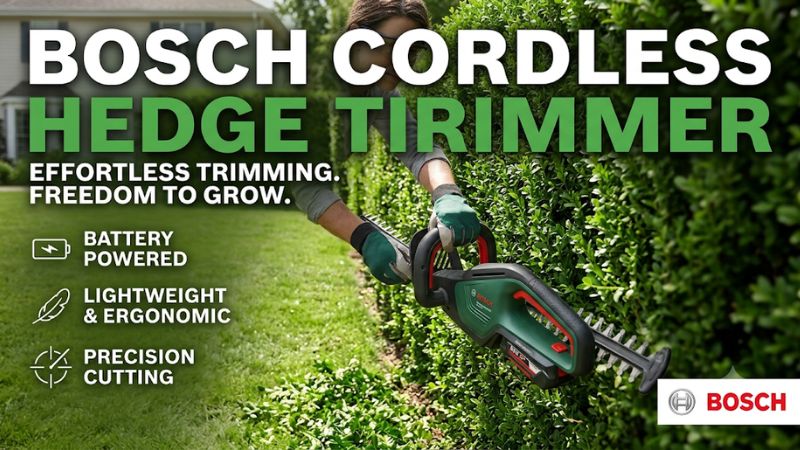
Bosch sells hedge trimmers under two main product families:
- Bosch DIY: Designed primarily for homeowners and routine garden maintenance. Models such as the EasyHedgeCut and UniversalHedgeCut emphasize manageable weight, straightforward operation and compatibility with the 18V POWER FOR ALL battery platform.
- Bosch Professional: Designed for more demanding applications. Models such as the GHE 18V series offer features including brushless motors, larger cutting capacities and compatibility with Bosch Professional batteries and AMPShare.
These product families should not be treated as one interchangeable battery system. Their intended workloads, accessories and battery compatibility differ.
A cordless model is particularly useful when trimming hedges around multiple sides of a property, working away from electrical outlets or moving between garden sections without repeatedly repositioning an extension cord.
However, cordless operation does not automatically mean unlimited runtime or enough cutting power for every branch. The blade design, tooth opening, battery capacity and condition of the hedge remain important.
Bosch Cordless Hedge Trimmer Models and Their Differences
Bosch model names can be confusing because similar-looking products may have different blade lengths, cutting capacities and battery requirements. The following examples illustrate the differences between several models documented in Bosch’s product information.
| Model | Battery platform | Blade length | Tooth opening | Intended application |
| EasyHedgeCut 18V-44-11 | 18V POWER FOR ALL | 44 cm | 15 mm | Light hedge maintenance |
| EasyHedgeCut 18V-52-13 | 18V POWER FOR ALL | 52 cm | 15 mm | Small and medium hedges |
| UniversalHedgeCut 18V-50 | 18V POWER FOR ALL | 50 cm | 20 mm | Established medium hedges |
| GHE 18V-50 | Professional 18V / AMPShare | 50 cm | 23 mm | Professional hedge maintenance |
| GHE 18V-60 | Professional 18V / AMPShare | 60 cm | 23 mm | Larger hedge sections |
| GHE18V-50TP | Professional 18V / AMPShare | 20 in (50 cm) | Model-specific cutting capacity | Elevated hedge maintenance |
Specifications are model-specific. Tooth opening and maximum stated cutting capacity are not necessarily identical. Regional versions and package configurations may differ.
The table highlights an important distinction: a longer blade provides more coverage per pass, but it does not necessarily indicate that the tool can cut thicker branches.
EasyHedgeCut: For Routine Garden Maintenance
The EasyHedgeCut range is aimed at homeowners maintaining smaller hedges and regularly trimmed shrubs.
For example, the EasyHedgeCut 18V-44-11 has a 44 cm blade, a 15 mm tooth opening and a stated no-load stroke rate of 2,400 strokes per minute. Its published tool weight without the battery is approximately 2.3 kg.
The EasyHedgeCut 18V-52-13 increases blade length to 52 cm while retaining a 15 mm tooth opening. Bosch specifies a recommended battery capacity of at least 2.0 Ah for this model.
These specifications make the Easy range more appropriate for thinner, relatively uniform growth than neglected hedges containing substantial woody branches.
Its main advantage is manageable handling for regular trimming. Its limitation is the smaller cutting clearance compared with heavier-duty models.
UniversalHedgeCut: A Middle Ground for Established Hedges
The UniversalHedgeCut range provides a step up for homeowners who regularly encounter thicker hedge growth.
The UniversalHedgeCut 18V-50, for example, has a 50 cm blade and a 20 mm tooth opening. Bosch’s consumer range also includes versions with longer blades, depending on the regional model.
Some Universal models feature Bosch’s Anti-Blocking System, which helps prevent the blades from becoming stuck when encountering difficult branches.
This range makes sense when a lightweight entry-level trimmer is no longer sufficient but purchasing a larger professional model would be unnecessary.
Before choosing one, check the exact product number. Features and cutting specifications should not be transferred between similarly named models.
Bosch Professional GHE 18V: For More Demanding Work
The Bosch Professional GHE 18V range targets users who need a more substantial cutting tool.
The GHE 18V-60 has a 60 cm blade, a 23 mm tooth opening, a brushless motor and a nominal no-load stroke rate of 3,000 strokes per minute. Bosch lists its weight at approximately 3.0 kg without the battery.
Its published battery recommendation is at least 4.0 Ah.
The brushless motor and Anti-Blocking System are useful features when maintaining established hedges. However, these specifications do not mean the trimmer can replace a chainsaw or dedicated pruning saw for large woody branches.
The Professional range is particularly worth considering when garden maintenance is frequent or when the user already owns compatible Bosch Professional batteries.
Bosch Cordless Pole Hedge Trimmers: For Elevated Sections
A pole hedge trimmer addresses a different problem: reaching tall hedge tops and difficult sections without manually holding a conventional trimmer overhead.
The Bosch GHE18V-50TP is an example of this category in the North American Professional range.
Its specifications include:
- 18V Bosch Professional battery platform.
- 20-inch (50 cm) cutting blade.
- 3,400 strokes per minute.
- Adjustable telescopic pole extending up to 8.2 feet.
- Pivoting cutting head adjustable from -45° to +90°.
- Published cutting capacity of up to ¾ inch.
- Up to 75 minutes of stated operating time with a CORE18V 4.0 Ah battery.
The runtime is a Bosch manufacturer claim, not a guaranteed result for every hedge or cutting condition. Dense growth, battery temperature and cutting technique can affect actual operating time.
The pole configuration also changes handling. Although it improves access, the extended tool can create additional leverage and fatigue. It should be operated from stable ground, following the manufacturer’s instructions rather than used as a reason to climb or work from an unstable ladder.
boschtools.com+1
How to Choose the Right Bosch Cordless Hedge Trimmer
Choosing the right model begins with the hedge itself, not the most powerful specification on the product packaging.
1. Match Cutting Capacity to Branch Thickness
Tooth opening describes the gap between adjacent cutting teeth. It helps indicate the size of branches that can enter the cutting area.
A larger opening generally accommodates thicker growth, but it should not be interpreted as permission to force any branch of that diameter through the blades.
As a practical starting point:
- Thin annual growth: A 15 mm tooth opening may be sufficient for regularly maintained hedges.
- Moderate established growth: Consider models with approximately 20–23 mm tooth openings.
- Thicker woody growth: Look for a suitable higher-capacity model, but check its actual cutting limit and the manufacturer’s recommendations.
The species and condition of the hedge also matter. Soft, fresh growth is different from dry, hard branches of the same diameter.
If a branch is too thick for the trimmer, use an appropriate pruning tool instead.
2. Select a Suitable Blade Length
Blade length affects how much hedge the tool can cover in one pass.
A shorter blade is generally easier to maneuver around narrow spaces, corners and decorative shrubs. A longer blade can reduce the number of passes required across broad, relatively straight hedge surfaces.
Consider the following:
| Blade length | Practical advantage | Potential limitation |
| 40–45 cm | Easier control around small hedges | More passes on wide surfaces |
| 50–55 cm | Balanced coverage and handling | May feel less convenient in tight spaces |
| 60–65 cm | Greater coverage on long hedge sections | Increased reach and handling demands |
Do not select a longer blade simply because it appears more powerful. The complete tool’s balance and weight are equally important.
3. Understand Battery Voltage and Capacity
Bosch cordless hedge trimmers use different battery systems depending on their product family.
The consumer 18V POWER FOR ALL range is designed around a shared battery platform. Compatible batteries can also operate supported products from participating alliance brands.
Bosch Professional 18V products use the Professional 18V battery system and AMPShare compatibility where specified.
These systems must be checked separately. An 18V rating alone does not establish battery compatibility.
Battery capacity is measured in amp-hours (Ah). A higher-capacity battery generally stores more energy and can support longer operation under comparable conditions.
For example:
- A 2.0 Ah battery may suit occasional trimming and lighter work.
- A 4.0 Ah battery provides a larger energy reserve for longer sessions.
- A higher-capacity pack may increase total tool weight.
Always check the exact trimmer’s recommended battery and approved charger. Never assume a battery is compatible simply because its voltage or physical appearance is similar.
4. Consider Tool Weight and Ergonomics
Hedge trimming involves repeated movements across different angles. A tool that feels manageable during a short session may become tiring when maintaining a long hedge.
Check whether the published weight includes the battery. Bosch commonly provides separate weights for the bare tool and complete configuration.
Important handling features include:
- Comfortable front and rear grips.
- Accessible two-handed operating controls.
- Balanced weight distribution.
- Manageable vibration.
- Suitable handle positions for vertical and horizontal trimming.
- A protective blade tip for trimming near walls or other hard surfaces.
If possible, compare the complete operating weight rather than relying exclusively on the bare-tool specification.
5. Decide Whether You Need a Brushless Motor
Brushless motors eliminate the conventional carbon brushes used in brushed motor designs.
Depending on the tool, this design can improve electrical efficiency, reduce routine motor maintenance and support more demanding operation.
Bosch includes brushless motors in selected Professional hedge trimmers and certain higher-tier consumer models.
However, brushless technology alone does not establish cutting performance. Blade geometry, motor control, battery condition and the material being cut remain important.
For occasional trimming of small hedges, paying extra for a brushless model may not provide enough practical value to justify the additional expense.
6. Check the Complete Package Before Buying
Bosch cordless hedge trimmers may be sold as bare tools or as battery-and-charger kits.
A bare-tool package can be economical if you already own the correct compatible battery and charger. However, a complete kit may offer better value when entering a battery platform for the first time.
Before purchasing, verify:
- Exact model and article number.
- Included battery capacity and quantity.
- Charger model.
- Blade cover and other supplied accessories.
- Warranty terms in your country.
- Availability of replacement blades and service parts.
Do not assume that every retailer sells the same package under an identical model name.
Important Features to Look for in a Bosch Hedge Trimmer
Beyond the basic specifications, several design features can make a noticeable difference during regular garden maintenance.
Anti-Blocking Technology
Bosch Anti-Blocking Technology is designed to reduce interruptions when the cutting blades encounter difficult branches.
When resistance prevents normal blade movement, the system can electronically detect the blockage and repeat the cutting movement to help clear it.
This feature is useful when trimming uneven growth, but it does not eliminate the need to match branch thickness to the tool’s rated cutting capacity.
Dual-Action Blades
Many Bosch hedge trimmers use reciprocating blades that move in opposite directions.
This arrangement helps cut vegetation while reducing some of the vibration associated with conventional single-moving-blade designs.
Blade condition still matters. Damaged, excessively worn or dirty cutting surfaces can reduce cutting quality and increase operating strain.
Blade Tip Protection
Some Bosch models include a protective feature around the blade tip.
This helps reduce damage when working near walls, fences and paved surfaces. It does not make contact with hard objects harmless, so careful positioning remains necessary.
Variable-Speed Control
Selected models offer variable-speed triggers that allow the operator to adjust cutting speed according to the application.
This can provide better control when working around delicate growth or changing hedge conditions. Check the exact model specifications because variable-speed control is not available across every Bosch cordless hedge trimmer.
How to Use a Bosch Cordless Hedge Trimmer Safely
A cordless hedge trimmer contains rapidly moving cutting teeth that can cause serious injuries. Battery operation removes the extension-cord hazard, but it does not eliminate mechanical risks.
Follow these precautions before starting:
- Inspect the hedge: Look for thick branches, wire, stones, fencing and other objects that could damage the blade.
- Check the tool: Inspect the cutting teeth, housing, handles, switches and protective components for visible damage.
- Wear appropriate PPE: Use safety glasses or suitable eye protection, protective gloves, sturdy footwear and hearing protection as recommended by the manual.
- Check the battery: Make sure the battery is compatible, correctly installed and free from visible damage.
- Clear the work area: Keep children, pets and other people away from the cutting zone.
- Maintain a stable position: Keep both hands on the designated grips and avoid overreaching.
- Control the cutting direction: Work carefully along the hedge and avoid positioning your body or hands near the moving blade.
Never hold branches with your free hand while cutting them with the trimmer.
If the blades become jammed, switch off the tool, remove the battery and wait until all movement has stopped before inspecting the obstruction. Do not attempt to clear a blockage while the battery remains installed.
Also avoid using a hedge trimmer in wet conditions unless the exact product manual explicitly permits the conditions in question.
Bosch Cordless Hedge Trimmer Maintenance
Regular maintenance helps preserve cutting performance and reduces unnecessary wear.
Clean the Cutting Blades
After use, remove plant residue, dirt and moisture according to the manufacturer’s instructions.
Use an appropriate cleaning method and avoid directing water into the motor housing, battery compartment or electrical components.
Inspect Blade Condition
Check for bent teeth, cracks, excessive wear and signs of corrosion.
Damaged cutting components should be inspected by an authorized service provider rather than straightened or modified without manufacturer approval.
Lubricate When Required
Follow the lubrication instructions in the specific Bosch manual. Use only an appropriate lubricant and avoid assuming that every model requires the same product or maintenance schedule.
Maintain the Battery
Remove the battery before cleaning or storing the trimmer.
Keep battery contacts clean and dry, protect the pack from excessive heat and moisture, and use a compatible Bosch charger.
Do not charge a damaged battery or continue using a pack that shows signs of swelling, leakage or unusual overheating.
Store the Tool Properly
Before storage:
- Switch off the trimmer and remove its battery.
- Clean the cutting assembly.
- Allow the tool to dry completely.
- Fit the blade cover.
- Store it in a dry location away from children.
- Keep the battery according to its manufacturer’s storage instructions.
Always consult the manual for model-specific cleaning, lubrication and storage requirements.
Frequently Asked Questions
1. Are Bosch cordless hedge trimmers worth buying?
Yes, Bosch cordless hedge trimmers are worth considering for homeowners who want convenient hedge maintenance without an extension cord. The EasyHedgeCut range suits lighter trimming, while UniversalHedgeCut and Professional GHE models provide options for more demanding work. The right purchase depends on hedge size, cutting requirements and battery compatibility.
2. Can I use any Bosch 18V battery with a Bosch cordless hedge trimmer?
No, not every Bosch 18V battery is automatically compatible with every Bosch hedge trimmer. Bosch DIY POWER FOR ALL and Bosch Professional 18V are separate battery platforms. Check the exact model’s compatibility information and recommended battery before purchasing or installing a battery.
3. What blade length is best for a Bosch cordless hedge trimmer?
A 45 cm blade is generally suitable for smaller hedges and detailed trimming, while 50–55 cm blades offer a practical balance for medium-sized hedges. Longer blades around 60–65 cm can cover larger hedge surfaces more efficiently but may require greater control. Branch thickness and tool weight should also influence the decision.
4. How long does a Bosch cordless hedge trimmer battery last?
Runtime depends on battery capacity, hedge density, branch thickness, cutting technique and operating conditions. Bosch publishes runtime claims for selected models under specified configurations, but actual results can vary. A higher-capacity compatible battery may extend operating time, although it can also increase the tool’s overall weight.
Final Thoughts
A Bosch cordless hedge trimmer can be a useful investment for maintaining residential gardens, shaping shrubs and trimming hedge growth without the restrictions of a mains cable. However, the best model depends on the actual cutting workload rather than the highest advertised specification.
For small, regularly maintained hedges, an EasyHedgeCut model with a manageable blade length and compatible 18V battery may be sufficient. The UniversalHedgeCut range offers a stronger option for established hedges, while Bosch Professional GHE models are worth considering for more frequent or demanding maintenance.
Before buying, prioritize cutting capacity, blade length, complete operating weight, battery compatibility and package contents. Matching these factors to your garden will help avoid paying for unnecessary features or purchasing a trimmer that cannot comfortably handle your workload.
For the best long-term value, choose a Bosch cordless hedge trimmer that matches both your hedge requirements and the battery platform you already own.
Related guides
More from Amazon
Programs that pair well with the guide above. Offers and eligibility are set by Amazon and may change.
A free business account with business pricing and bulk-buying tools for work, shop or home office.
Create a business accountFree shipping on eligible items, Prime Video and more. Eligible new members can start with a free trial.
Start a Prime free trialAudiobooks and podcasts to listen to on the go. Eligible new members can start with a free trial.
Try Audible freeAd-free music streaming. Eligible new subscribers can start with a free trial.
Try Music Unlimited freeAs an Amazon Associate we earn from qualifying purchases.


Write Your Review
No reviews yet. Be the first to share your experience!