
What's inside
- 1. Understanding Ryobi Battery Weed Eater Systems
- 2. Ryobi 18V vs. 40V: Which Battery Weed Eater Should You Choose?
- 3. How to Choose the Right Ryobi Battery Weed Eater
- 4. How to Use a Ryobi Battery Weed Eater Correctly
- 5. How to Improve Ryobi Weed Eater Battery Runtime
- 6. Common Ryobi Battery Weed Eater Problems and Solutions
- 7. Choosing and Replacing Ryobi Weed Eater Line
- 8. Ryobi Battery Weed Eater Maintenance and Storage
- 9. Frequently Asked Questions
- Conclusion
As an Amazon Associate I earn from qualifying purchases. This post may contain affiliate links at no extra cost to you.
A Ryobi battery weed eater offers a convenient way to trim grass, clean up lawn edges, and maintain areas that a lawn mower cannot easily reach. Without a gas engine or extension cord, these cordless tools are particularly useful for residential yards, sidewalks, fences, and garden borders. However, choosing the right model requires more than looking at battery voltage or advertised runtime.
Ryobi offers cordless string trimmers across two major battery platforms: 18V ONE+ and 40V. Both provide cordless convenience, but they are designed for different workloads, and their batteries are not interchangeable. Cutting width, motor design, trimmer line, battery capacity, and attachment compatibility also affect how well a particular model performs.
This guide explains how to choose the right Ryobi battery weed eater, get more usable runtime, operate it safely, and resolve common problems without unnecessary repairs.
1. Understanding Ryobi Battery Weed Eater Systems
Ryobi cordless weed eaters use rechargeable lithium-ion batteries to power an electric motor that rotates a cutting head. The head feeds nylon trimmer line, which cuts grass and light vegetation through rapid rotation.
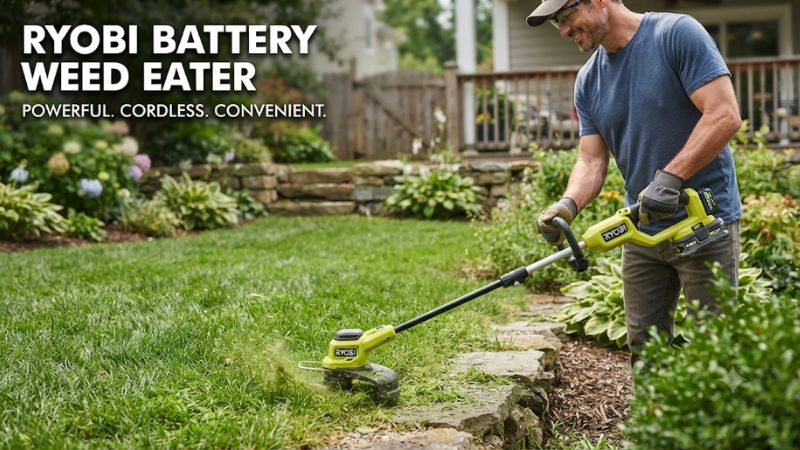
Unlike gas-powered trimmers, battery models do not require fuel mixing, engine starting procedures, or routine spark plug maintenance. They are also easier to store and generally produce less operating noise than comparable gasoline equipment.
Ryobi’s two main cordless platforms serve different needs.
Ryobi 18V ONE+ Weed Eaters
The 18V ONE+ platform is suitable for homeowners who need a lightweight trimmer for routine lawn maintenance.
Typical applications include:
- Trimming grass around trees, flower beds, and fences.
- Cleaning up lawn edges after mowing.
- Maintaining small and medium-sized yards.
- Reaching narrow spaces around outdoor structures.
- Performing occasional trimming without maintaining a gas engine.
Ryobi offers several 18V configurations, including compact string trimmers, trimmer-edger combinations, and brushless attachment-capable models.
For example, the P20018 is an 18V ONE+ string trimmer/edger with an adjustable 11-inch or 13-inch cutting swath and a specified 0.080-inch twisted cutting line.
Newer models have different features, so buyers should not assume that every 18V trimmer uses the same cutting head, line, or attachment system.
Ryobi 40V Weed Eaters
The 40V platform is designed for users who need more capability for demanding outdoor maintenance.
Depending on the model, these trimmers can handle:
- Larger residential lawns.
- Longer trimming sessions.
- Heavier grass growth.
- Wider cutting areas.
- Compatible outdoor power attachments.
The RY40ST01 is an example of a 40V attachment-capable string trimmer. Its specifications include an adjustable 13-inch to 15-inch cutting swath and compatibility with RYOBI EXPAND-IT attachments.
Ryobi also offers 40V HP brushless models, which provide another option for users prioritizing motor efficiency and performance.
The important distinction is that 40V does not automatically mean every model is more suitable for every job. Shaft design, motor configuration, cutting head, weight, and battery capacity still matter.
2. Ryobi 18V vs. 40V: Which Battery Weed Eater Should You Choose?
The main difference between the two systems is their intended workload and battery ecosystem.
| Feature | Ryobi 18V ONE+ | Ryobi 40V |
|---|---|---|
| Intended use | Routine residential trimming | More demanding outdoor maintenance |
| Battery platform | 18V ONE+ | Ryobi 40V |
| Typical applications | Small and medium yards | Medium and larger yards |
| Tool selection | Compact and full-size trimmers | Full-size and attachment-capable trimmers |
| Battery compatibility | Compatible ONE+ batteries, subject to model requirements | Compatible Ryobi 40V batteries, subject to model requirements |
| Main advantage | Shared battery ecosystem for many household tools | Dedicated outdoor equipment platform |
| Main limitation | Some models have limited cutting capacity | Battery and tool packages can cost more |
When to Choose an 18V Model
An 18V weed eater makes sense when you already own Ryobi ONE+ batteries and primarily maintain grass around a house.
It can also be a practical option for people who prefer a smaller tool for occasional trimming.
However, an entry-level 18V trimmer may struggle with consistently thick vegetation or extended heavy-duty use. The actual capability depends on the motor, cutting head, line, and battery configuration.
When to Choose a 40V Model
Consider a 40V model if you regularly maintain larger areas or encounter thicker grass.
The larger outdoor equipment platform also offers attachment-capable configurations that can expand the usefulness of a compatible power head.
Before purchasing, consider the additional cost of batteries and chargers if you do not already own compatible 40V equipment.
Important: Ryobi 18V ONE+ and 40V batteries are different platforms. An 18V battery cannot replace a 40V battery, or vice versa. Always check the exact tool model’s battery requirements.
3. How to Choose the Right Ryobi Battery Weed Eater
A suitable trimmer should match the size of your property, vegetation, and expected operating time.
Battery Capacity and Runtime
Battery capacity is measured in amp-hours (Ah). Within the same voltage platform, a higher Ah rating generally provides more stored energy and the potential for longer operation.
For example:
- A 2Ah battery provides less stored energy than a 4Ah battery on the same voltage platform.
- A 4Ah battery can be a practical choice for routine residential trimming.
- Larger-capacity batteries may suit longer sessions, depending on tool compatibility and handling requirements.
Battery voltage and amp-hours describe different things. Voltage identifies the electrical platform, while amp-hours describe battery capacity.
Runtime also depends on vegetation density, cutting width, line condition, trigger use, temperature, and motor design.
Ryobi advertises up to one hour of runtime for the RY40ST01 when using a 40V 4Ah battery. This is a manufacturer-stated figure, not a guarantee that every user will achieve the same operating time.
Cutting Width
Cutting width determines how much ground the trimmer can cover in one pass.
A wider cutting swath can reduce the number of passes needed for open areas. However, it can also increase the workload on the motor and battery.
For example, the RY40ST01 offers an adjustable 13-inch to 15-inch cutting swath.
A smaller cutting width may be preferable when working around delicate landscaping or when maximizing runtime is more important than covering a large area quickly.
Motor Type
Ryobi offers both brushed and brushless cordless trimmers.
A brushed motor uses carbon brushes to transfer electrical current to the rotating motor components. These brushes gradually wear and may eventually require service.
A brushless motor uses electronic controls rather than traditional carbon brushes. This design can improve motor efficiency and reduce brush-related maintenance.
However, brushless technology alone does not establish cutting performance. Battery output, motor design, cutting head, and operating conditions remain important.
Weight and Ergonomics
A weed eater can become uncomfortable during extended operation, especially when trimming around obstacles or working on uneven ground.
Check:
- Overall tool weight and whether the specification includes the battery.
- Front handle adjustment.
- Shaft length and configuration.
- Trigger accessibility.
- Shoulder strap compatibility, if supported.
- Cutting-head orientation.
A lighter model may be easier to maneuver, while a larger attachment-capable trimmer may provide more versatility at the expense of additional weight.
4. How to Use a Ryobi Battery Weed Eater Correctly
Proper operation helps maintain cutting efficiency, reduce unnecessary battery consumption, and prevent accidental injury.
Step 1: Prepare the Work Area
Remove objects that could become dangerous projectiles, including stones, branches, toys, and loose debris.
Keep children, pets, and other people away from the operating area. Ryobi manuals commonly specify a minimum separation of 50 feet for applicable string trimmers.
Inspect the grass for hidden obstacles before starting.
Step 2: Inspect the Trimmer
Before installing the battery, check the following components:
- Cutting head and nylon line.
- Grass deflector and protective guard.
- Front and rear handles.
- Trigger and lockout mechanism.
- Shaft connections.
- Battery compartment and electrical contacts.
Do not operate the trimmer if the guard is missing, damaged, or incorrectly installed.
Step 3: Install the Correct Battery
Confirm that the battery belongs to the correct Ryobi voltage platform and is approved for the exact trimmer model.
Slide the battery into its compartment until the locking mechanism engages.
If the battery does not fit properly, do not force it into position.
Step 4: Start the Trimmer
Follow the starting sequence in the model-specific operator’s manual.
Many Ryobi models use a safety lockout button and variable-speed trigger.
Hold the tool with both hands, maintain a stable stance, and keep the cutting head away from your body before activating the motor.
Step 5: Trim Grass Using Controlled Movements
Hold the cutting head approximately parallel to the ground.
Move the trimmer from side to side in controlled sweeping motions. Allow the rotating line to cut the vegetation rather than forcing the head into dense grass.
For particularly tall grass, work from the upper portion downward in several passes.
This reduces the likelihood of long grass wrapping around the cutting head and shaft housing.
Step 6: Stop and Inspect
Release the trigger and allow all moving parts to stop before inspecting the cutting head.
Remove the battery before cleaning, adjusting, or replacing the line.
Check whether the cutting head needs additional line and inspect the guard for accumulated grass.
5. How to Improve Ryobi Weed Eater Battery Runtime
Battery runtime is one of the biggest considerations when choosing a cordless trimmer.
Fortunately, several operating habits can help reduce unnecessary energy consumption.
Use an appropriate cutting width. A narrower cutting swath can reduce the amount of vegetation being processed during each pass. Ryobi specifically identifies this as a runtime consideration on adjustable-width models.
Avoid forcing the cutting head. Allow the nylon line to cut at its intended operating speed. Pushing aggressively into thick vegetation increases the workload.
Use variable-speed control when available. Lower trigger pressure can be sufficient for light grass, while heavier vegetation may require more power.
Keep the cutting head clean. Grass buildup can interfere with normal operation. Remove accumulated debris after use, following the manufacturer’s instructions.
Use a suitable battery capacity. A compatible higher-capacity battery may provide longer operating time, although it can also increase the tool’s total weight.
Store batteries correctly. Avoid prolonged exposure to extreme heat, moisture, and direct sunlight. Follow the battery manual for charging and storage temperature limits.
If your property requires more operating time than one battery provides, keeping a second compatible, charged battery available can help reduce interruptions.
6. Common Ryobi Battery Weed Eater Problems and Solutions
Not every operating problem means the trimmer needs replacement. Several common issues can be traced to battery installation, cutting-line problems, or accumulated vegetation.
| Problem | Possible cause | Recommended action |
|---|---|---|
| Trimmer will not start | Battery discharged or improperly installed | Check the battery charge and locking mechanism |
| Cutting line will not advance | Tangled line or obstructed feed mechanism | Remove the battery and inspect the cutting head |
| Weak cutting performance | Worn line or unsuitable operating technique | Check line condition and use controlled passes |
| Grass wraps around the head | Cutting tall grass too close to the ground | Work from the top downward |
| Short battery runtime | Heavy vegetation or excessive cutting width | Adjust the cutting width and operating technique |
| Excessive vibration | Damaged or incorrectly installed cutting components | Stop using the tool and inspect it |
Why Does a Ryobi Weed Eater Stop Working?
If the motor does not start, begin with basic external checks.
- Release the trigger and remove the battery.
- Check the battery charge indicator.
- Inspect the battery contacts for visible dirt or damage.
- Confirm that the battery is fully seated.
- Inspect the cutting head for tangled grass or debris.
- Reinstall the battery and follow the correct starting procedure.
If the tool still does not operate, consult the model-specific troubleshooting instructions.
Do not bypass the lockout mechanism or attempt to repair electrical components while the battery is installed.
Why Is the Cutting Line Not Advancing?
A line-feed problem may result from several causes:
- Line tangled inside the spool.
- Incorrectly wound replacement line.
- Line diameter incompatible with the cutting head.
- Debris obstructing the feed mechanism.
- Damaged spool or bump-feed components.
Remove the battery before inspecting the head.
For bump-feed models, follow the manual’s instructions for advancing line. Other models may use automatic or manual line-feed systems, so the procedure is not universal.
7. Choosing and Replacing Ryobi Weed Eater Line
Using the correct cutting line is essential for proper operation.
Ryobi trimmers support different line diameters and configurations depending on their model.
For example, the P20018 manual specifies 0.080-inch twisted line and also permits certain 0.065-inch line configurations. The RY40ST01 manual specifies a maximum line diameter of 0.080 inch.
These specifications should not be applied to every Ryobi trimmer.
Before purchasing replacement line, check:
- Required line diameter.
- Round or twisted line compatibility.
- Spool design.
- Maximum permitted line length.
- Whether the model uses a replacement spool or bulk line.
General Line Replacement Procedure
- Switch off the trimmer and remove the battery.
- Allow the cutting head to stop completely.
- Open the spool housing according to the manual.
- Remove old or tangled line.
- Install the specified replacement line.
- Wind it in the direction indicated on the spool.
- Reassemble the cutting head securely.
- Check that the line feeds correctly before returning to work.
Never substitute metal wire, rope, or an unapproved cutting attachment for the specified nylon line. An unsuitable cutting component can create a serious projectile hazard and may damage the tool.
8. Ryobi Battery Weed Eater Maintenance and Storage
Cordless trimmers generally require less routine maintenance than gasoline models, but they still need regular inspection.
After each use, remove the battery and clean grass clippings from the cutting head, guard, and accessible ventilation areas.
Use a clean cloth or a suitable soft brush. Avoid petroleum-based solvents and aggressive chemicals that can damage plastic components.
Periodically inspect:
- Cutting line and spool condition.
- Guard integrity.
- Handle fasteners.
- Shaft connections.
- Battery contacts.
- Trigger and lockout operation.
Replace damaged components with compatible manufacturer-approved parts.
Battery Storage
Remove the battery before storing the trimmer.
Keep lithium-ion batteries in a dry, sheltered location away from direct sunlight, excessive heat, and moisture.
Do not leave batteries in hot vehicles or store damaged, swollen, leaking, or unusually hot battery packs.
Use the charger specified for the battery platform and follow its charging instructions. Do not attempt to charge a battery that appears physically damaged.
Store the trimmer in a location inaccessible to children and protect the cutting head from accidental contact.
9. Frequently Asked Questions
Can You Use a Ryobi 40V Battery in an 18V Weed Eater?
No. Ryobi 40V and 18V ONE+ batteries belong to different electrical platforms. Always use a battery approved for the exact trimmer model.
How Long Does a Ryobi Battery Weed Eater Last on One Charge?
Runtime varies according to battery capacity, cutting width, vegetation density, motor design, and trigger use. Ryobi advertises up to one hour for the RY40ST01 with a 40V 4Ah battery, but actual results depend on operating conditions.
Is a Ryobi 18V Weed Eater Powerful Enough for Thick Grass?
Some 18V models can handle moderate grass growth, but their performance depends on the specific motor and cutting-head configuration. For consistently thick vegetation and larger workloads, consider an appropriate 40V model.
Can You Use Any Ryobi Trimmer Line in a Battery Weed Eater?
No. The correct line diameter and type depend on the cutting-head design and model specifications. Check the operator’s manual before installing replacement line.
Conclusion
A Ryobi battery weed eater can simplify routine lawn maintenance by combining cordless operation, rechargeable batteries, and relatively straightforward upkeep. The most important purchasing decision is choosing between the 18V ONE+ and 40V platforms based on your property size and trimming workload.
An 18V model is worth considering for routine residential trimming, particularly if you already own compatible ONE+ equipment. A 40V model may be more appropriate for larger areas, heavier vegetation, or compatible outdoor attachments.
Whichever platform you choose, verify battery compatibility, cutting-line requirements, cutting width, and tool weight before purchasing. Proper operating technique, battery care, and regular cutting-head inspections will help keep your Ryobi trimmer ready for everyday yard work.
FAQ
2. Ryobi 18V vs. 40V: Which Battery Weed Eater Should You Choose?
Why Does a Ryobi Weed Eater Stop Working?
Why Is the Cutting Line Not Advancing?
Can You Use a Ryobi 40V Battery in an 18V Weed Eater?
How Long Does a Ryobi Battery Weed Eater Last on One Charge?
Is a Ryobi 18V Weed Eater Powerful Enough for Thick Grass?
Can You Use Any Ryobi Trimmer Line in a Battery Weed Eater?
Related guides
More from Amazon
Programs that pair well with the guide above. Offers and eligibility are set by Amazon and may change.
A free business account with business pricing and bulk-buying tools for work, shop or home office.
Create a business accountFree shipping on eligible items, Prime Video and more. Eligible new members can start with a free trial.
Start a Prime free trialAudiobooks and podcasts to listen to on the go. Eligible new members can start with a free trial.
Try Audible freeAd-free music streaming. Eligible new subscribers can start with a free trial.
Try Music Unlimited freeAs an Amazon Associate we earn from qualifying purchases.








Write Your Review
No reviews yet. Be the first to share your experience!