
What's inside
- 1. Understanding Ryobi Electric Lawn Mowers
- 2. How to Choose the Right Ryobi Electric Lawn Mower
- 3. How to Prepare a Ryobi Electric Lawn Mower Before Use
- 4. How to Start and Operate a Ryobi Electric Lawn Mower
- 5. Getting Better Cutting Results
- 6. How to Maintain a Ryobi Electric Lawn Mower
- 7. Common Ryobi Electric Lawn Mower Problems and Solutions
- 8. Frequently Asked Questions
- Conclusion
As an Amazon Associate I earn from qualifying purchases. This post may contain affiliate links at no extra cost to you.
A Ryobi electric lawn mower can make routine lawn maintenance easier without the fuel, engine oil, and exhaust associated with traditional gas-powered equipment. Whether you are considering a cordless 18V ONE+ mower, a more powerful 40V model, or a corded electric mower, understanding the differences between these machines is essential before choosing one.
Ryobi offers several electric mower configurations designed for different lawn sizes, cutting requirements, and user preferences. However, not every model uses the same battery platform, starting mechanism, cutting system, or accessories. Choosing the right mower means looking beyond the brand name and understanding how the machine fits your property.
This guide explains how Ryobi electric lawn mowers work, how to select an appropriate model, how to operate them safely, and how to maintain performance over time. It also covers common operating problems and practical solutions for homeowners.
1. Understanding Ryobi Electric Lawn Mowers
Ryobi electric lawn mowers use an electric motor to rotate a cutting blade beneath the mower deck. Depending on the model, electrical power comes from a rechargeable battery or a household electrical outlet.
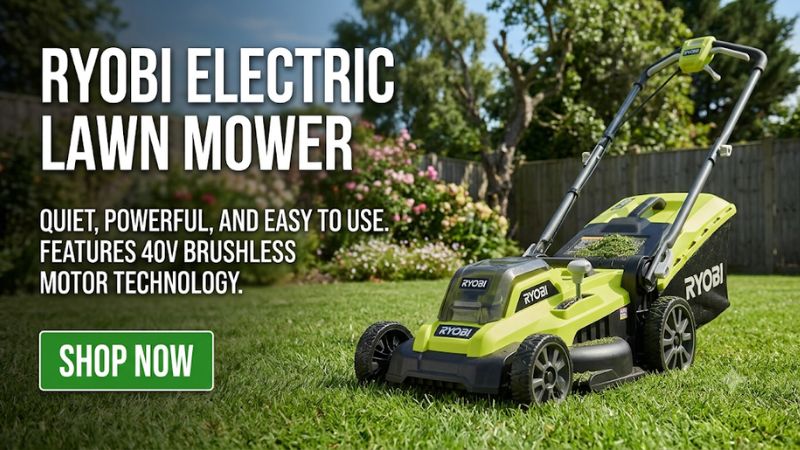
Unlike gas-powered equipment, electric mowers do not require gasoline, engine oil changes, spark plugs, or carburetor maintenance. They also generally produce less operating noise and eliminate direct exhaust emissions during mowing.
There are two main categories to understand.
Cordless battery-powered lawn mowers
Cordless Ryobi mowers operate using rechargeable lithium-ion battery packs. They are designed for homeowners who want freedom of movement without managing an extension cord.
Ryobi’s major battery platforms include:
- 18V ONE+: Designed primarily for lighter-duty outdoor equipment and smaller residential mowing applications.
- 40V: A dedicated outdoor power equipment platform offering configurations for more demanding lawn maintenance.
- 80V: A higher-voltage platform used in selected outdoor power equipment applications.
Battery voltage alone does not determine mowing performance. Cutting width, motor design, blade condition, battery capacity, grass density, and cutting height also influence how effectively a mower handles a lawn.
For example, a 40V mower may be a better fit for a larger property than a compact 18V model, but the actual suitability depends on the specific mower and battery configuration.
Corded electric lawn mowers
Corded Ryobi electric mowers receive power through an electrical cable connected to a suitable outlet.
Their primary advantage is continuous access to electrical power without waiting for batteries to recharge. They can be practical for smaller lawns where an appropriate outdoor electrical supply is available.
However, the power cord introduces additional operating considerations. Users must prevent the cable from entering the cutting path, avoid running over it, and maintain a safe connection throughout the mowing process.
Corded and cordless models therefore serve different requirements. The correct choice depends on lawn size, accessibility, available electrical infrastructure, and personal operating preferences.
2. How to Choose the Right Ryobi Electric Lawn Mower
Before purchasing a Ryobi electric lawn mower, evaluate the characteristics that directly affect your mowing requirements.
Match the mower to your lawn size
Lawn area is one of the most important selection factors.
A compact mower with a narrower cutting deck may be sufficient for a small residential lawn. Larger properties generally benefit from wider cutting decks, suitable battery capacity, and potentially self-propelled operation.
Consider the following general selection framework:
| Lawn characteristics | Features to prioritize |
| Small, relatively flat lawn | Compact mower, simple controls |
| Medium residential lawn | Wider cutting deck, suitable battery capacity |
| Large lawn | Higher-capacity battery configuration, wider deck |
| Sloped or uneven lawn | Appropriate traction and manageable weight |
| Frequently maintained lawn | Efficient collection or mulching system |
These are selection guidelines rather than guaranteed coverage ratings. Actual mowing area depends on grass conditions, terrain, battery condition, and operator technique.
Choose the appropriate battery platform
If you already own Ryobi cordless equipment, battery compatibility may influence your purchasing decision.
The 18V ONE+ and 40V systems are separate platforms. A battery from one platform should not be assumed compatible with a mower designed for the other.
Even within a platform, check the specific mower’s supported battery configurations and the manufacturer’s recommendations.
Before purchasing, verify:
- The mower’s exact model number.
- Supported battery voltage and platform.
- Recommended battery capacity.
- Whether the mower accepts one or multiple batteries.
- Whether batteries are included.
- Whether a compatible charger is included.
- Whether the product is a kit or a bare-tool package.
A mower advertised as a kit may include batteries and a charger, while a bare-tool configuration generally requires separately purchased compatible equipment.
Understand cutting width and height adjustment
Cutting width determines how much grass the mower can cover during each pass.
A wider deck can reduce the number of passes required, especially across open lawns. However, a larger mower may be less convenient around narrow pathways, landscaping features, and tight corners.
Cutting height is equally important.
Different Ryobi models offer different adjustment mechanisms and cutting-height ranges. Some use a centralized adjustment lever, while others have model-specific adjustment arrangements.
A higher cutting position is useful when grass has become unusually long. Lower settings are appropriate only when the lawn condition and grass type allow them.
Avoid removing too much grass in one pass. Gradual cutting generally produces a better result and reduces the load placed on the motor.
Decide whether self-propelled operation is necessary
Some Ryobi electric mowers use a self-propelled drive system that assists with forward movement.
This feature can make mowing more manageable on larger properties, particularly when the mower is relatively heavy or the operator needs to cover substantial ground.
Push mowers, by comparison, rely on the operator to provide forward movement.
Self-propelled operation is not automatically necessary for every homeowner. For small, flat lawns, a conventional push mower may be simpler and more economical.
3. How to Prepare a Ryobi Electric Lawn Mower Before Use
Proper preparation helps prevent starting problems and reduces unnecessary wear.
Begin by identifying the exact model number on the mower’s product label. Locate its operator’s manual and confirm the correct battery, charger, assembly instructions, and operating procedure.
Although many Ryobi cordless mowers share similar controls, the starting sequence is not identical across every generation.
Inspect the mower
Before each mowing session, examine the following components:
- Cutting blade for visible damage, excessive wear, or looseness.
- Mower deck for accumulated grass and debris.
- Wheels for damage or restricted movement.
- Handles and adjustment mechanisms for secure locking.
- Grass catcher, discharge components, and mulch plug for correct installation.
- Battery compartment and electrical contacts for visible contamination.
- Safety key and starting controls for proper condition.
Never operate a mower with a missing guard, damaged blade, loose component, or malfunctioning safety control.
Prepare the battery
For cordless models, charge the battery using the charger specified for the exact battery platform.
Allow the battery to charge according to the manufacturer’s instructions. Inspect its housing and terminals before installation.
Do not use a battery with a cracked case, damaged terminals, unusual swelling, or evidence of overheating.
Insert the battery into the designated compartment until it engages correctly. Never force a battery into a slot simply because it appears physically similar to the correct pack.
For corded models, inspect the power cable, plug, and extension cord requirements specified in the operator’s manual. Damaged electrical cables should not be used.
Prepare the mowing area
Walk across the lawn and remove objects that could be struck or thrown by the rotating blade.
Pay particular attention to:
- Stones and branches.
- Children’s toys.
- Garden tools.
- Loose wire.
- Sprinkler components.
- Other hard objects hidden in tall grass.
Keep children and pets away from the operating area.
Wear sturdy closed-toe footwear, eye protection, and appropriate hearing protection. Avoid loose clothing that could interfere with operating controls.
Do not mow during thunderstorms or when wet conditions make the terrain unsafe.
4. How to Start and Operate a Ryobi Electric Lawn Mower
The starting process depends on the specific model. Many cordless Ryobi walk-behind mowers use a safety key and a button-and-trigger arrangement.
For compatible models, the general starting procedure is as follows.
Step 1: Position the mower correctly
Place the mower on a stable, level surface with the cutting area clear.
Make sure the handle assembly is fully extended and locked into its operating position.
Some Ryobi models incorporate safety switches that prevent operation when the handle is not correctly positioned.
Step 2: Install the battery and safety key
Open the battery compartment and install the approved battery.
If the mower uses an isolator or start key, insert it into the designated position.
Close the battery cover securely before starting.
Step 3: Activate the starting controls
On models using a push-button starting system:
- Press and hold the start button.
- Pull and hold the designated operating trigger or bail lever.
- Release the start button while continuing to hold the operating control.
The motor should start if the battery is sufficiently charged and all safety interlocks are satisfied.
Other models may use a different control arrangement. Always follow the exact starting sequence in the applicable operator’s manual.
Step 4: Begin mowing gradually
Once the blade is operating, push the mower forward at a controlled pace.
Start with straight passes and slightly overlap each previous pass to avoid leaving uncut strips.
Avoid forcing the mower through dense grass. If the motor slows or the mower struggles, stop and investigate the cause rather than repeatedly pushing it harder.
Step 5: Stop the mower safely
Release the operating handle or trigger according to the model’s instructions.
Wait until the blade has completely stopped before approaching the cutting deck.
For inspection, cleaning, transportation, or maintenance, remove the battery and safety key when the manual specifies this procedure.
Important: Never assume that releasing the operating handle makes the mower safe to inspect immediately. The blade may continue rotating briefly after the motor stops.
5. Getting Better Cutting Results
A good mowing technique can improve the appearance of your lawn while reducing unnecessary battery consumption.
Set the cutting height appropriately
Grass should not be cut excessively short simply to reduce mowing frequency.
The appropriate cutting height depends on grass species, growing conditions, and seasonal requirements.
When grass becomes overgrown, raise the mower’s cutting height and make an initial pass. If necessary, lower the setting and complete a second pass after the mower has handled the taller growth.
This approach is generally more manageable than attempting to cut all the grass at once.
Choose suitable mowing conditions
Dry grass is usually easier to cut and collect than wet grass.
Wet clippings can accumulate beneath the mower deck, obstruct discharge openings, and interfere with mulching performance.
If the grass is wet, wait until conditions improve rather than forcing the mower to operate under excessive resistance.
Use the correct grass-management attachment
Depending on the model, Ryobi mowers may support different grass-management configurations.
Grass collection: A catcher gathers clippings for disposal. This option is useful when you want a cleaner-looking lawn without leaving substantial cut material behind.
Mulching: A compatible mulch plug allows clippings to circulate beneath the deck for further cutting. The resulting smaller pieces can return to the lawn.
Side discharge: Certain models support side-discharge configurations that direct clippings away from the mower.
Not every Ryobi mower supports all three functions. Confirm accessory compatibility before purchasing a replacement attachment.
6. How to Maintain a Ryobi Electric Lawn Mower
Regular maintenance helps preserve cutting performance, operating reliability, and battery efficiency.
Clean the mower deck after mowing
Grass residue can accumulate beneath the deck and around discharge openings.
Before cleaning:
- Switch off the mower.
- Wait for the blade to stop completely.
- Remove the battery and safety key as instructed.
- Wear protective gloves.
- Carefully remove accessible grass and debris using an appropriate brush or cloth.
Avoid directing water or a pressure washer toward electrical components, motor openings, battery compartments, or control assemblies.
Follow the specific cleaning instructions in the operator’s manual. Some models have different restrictions concerning deck orientation and cleaning methods.
Inspect the cutting blade
A dull or damaged blade can produce uneven cutting and place additional load on the mower.
Inspect the blade for:
- Dull cutting edges.
- Cracks or deformation.
- Missing material.
- Excessive corrosion.
- Loose mounting hardware.
If the blade is damaged, stop using the mower.
Blade sharpening, balancing, and replacement should follow the manufacturer’s procedures. Use only the specified replacement blade and mounting hardware.
If you are unfamiliar with blade servicing, use an authorized repair professional rather than attempting an improvised repair.
Maintain the battery properly
Battery care has a direct effect on the convenience and reliability of cordless mowing.
Follow these practices:
- Use the charger specified for the battery.
- Keep battery contacts clean and dry.
- Avoid exposing batteries to excessive heat.
- Do not leave damaged battery packs in service.
- Store batteries in the environmental conditions specified by Ryobi.
- Avoid prolonged exposure to moisture.
- Follow the manufacturer’s charging and long-term storage recommendations.
Never open a lithium-ion battery pack or attempt to repair damaged internal cells.
Inspect handles, wheels, and accessories
Check handle locks, fasteners, wheels, and grass collection components periodically.
Loose handles can make the mower difficult to control, while damaged wheels can affect cutting consistency.
Replace worn or damaged components with parts approved for the exact model.
7. Common Ryobi Electric Lawn Mower Problems and Solutions
Not every operating problem indicates a failed motor or battery. Several issues can result from incorrect setup, excessive grass buildup, or normal operating limitations.
| Problem | Possible cause | Recommended action |
| Mower will not start | Battery discharged or safety key missing | Check battery charge and key installation |
| Motor stops during mowing | Excessive cutting load | Stop and inspect grass conditions |
| Uneven cutting | Incorrect cutting height or damaged blade | Check deck adjustment and blade condition |
| Poor mulching | Wet grass or blocked deck | Allow grass to dry and clean the deck |
| Reduced runtime | Battery condition or demanding grass | Check battery condition and mowing technique |
| Excessive vibration | Damaged or unbalanced blade | Stop immediately and inspect |
Why won’t my Ryobi electric lawn mower start?
Start with the simplest external checks.
Verify that the battery is charged, properly installed, and compatible with the mower. Check that the safety key is correctly inserted and the handle is fully extended.
Inspect the battery contacts for visible dirt or debris.
If the mower still does not start, disconnect its power source and inspect the cutting area for obstructions.
A blade jammed by grass, leaves, or foreign objects can prevent some models from starting.
Never reach beneath the deck while the battery is installed.
Why does the mower stop while cutting grass?
A mower may stop when cutting resistance becomes excessive.
Tall, dense, or wet grass can place additional load on the motor. A low cutting-height setting can make this problem worse.
Stop the mower, remove the battery and safety key, and inspect the deck after the blade has stopped completely.
If the grass is particularly tall, raise the cutting height and divide the work into multiple passes.
Persistent shutdowns under normal conditions may indicate a battery, electrical, or mechanical fault that requires professional inspection.
Why does my Ryobi mower produce an uneven cut?
Uneven cutting can result from incorrect height adjustment, rough terrain, or a damaged blade.
Check that the mower is configured according to the manufacturer’s instructions and that its wheels and cutting components are in good condition.
If vibration accompanies uneven cutting, stop using the mower until the blade and motor assembly have been inspected.
Do not continue operating equipment with suspected blade damage.
8. Frequently Asked Questions
Are Ryobi electric lawn mowers worth buying?
Ryobi electric lawn mowers can be a practical choice for homeowners who want convenient lawn maintenance without gasoline-powered engine upkeep. Their suitability depends on lawn size, battery requirements, cutting performance, and the available model configuration.
How long does a Ryobi lawn mower battery last?
Battery runtime varies by mower, battery capacity, grass density, cutting height, terrain, and operating conditions. Larger-capacity batteries generally store more energy, but actual runtime must be evaluated using the manufacturer’s specifications and the intended workload.
Can I use any Ryobi battery in a Ryobi electric lawn mower?
No. You must use a battery compatible with the mower’s specific voltage platform and model requirements. The 18V ONE+ and 40V systems are separate and should not be treated as interchangeable.
How often should I clean my Ryobi electric lawn mower?
Clean accumulated grass and debris after mowing, following the model’s cleaning instructions. Regularly inspect the blade, deck, wheels, battery compartment, and grass collection system, and perform additional maintenance when the manufacturer recommends it.
Conclusion
A Ryobi electric lawn mower can simplify residential lawn maintenance when its power system, cutting width, battery configuration, and operating features match the property.
The 18V ONE+ platform may suit lighter mowing requirements, while selected 40V configurations offer options for more demanding residential applications. Corded models remain an alternative for smaller lawns with suitable electrical access.
The most important factors are choosing a compatible mower, preparing it correctly, maintaining a sharp and undamaged blade, and using appropriate mowing techniques.
Before purchasing or servicing any Ryobi mower, identify its exact model number and consult the corresponding operator’s manual. This ensures that battery selection, starting procedures, replacement parts, and maintenance practices match the equipment you actually own.
A properly selected and maintained electric mower can make routine lawn care more convenient while helping homeowners avoid unnecessary operating problems.
Related guides
More from Amazon
Programs that pair well with the guide above. Offers and eligibility are set by Amazon and may change.
A free business account with business pricing and bulk-buying tools for work, shop or home office.
Create a business accountFree shipping on eligible items, Prime Video and more. Eligible new members can start with a free trial.
Start a Prime free trialAudiobooks and podcasts to listen to on the go. Eligible new members can start with a free trial.
Try Audible freeAd-free music streaming. Eligible new subscribers can start with a free trial.
Try Music Unlimited freeAs an Amazon Associate we earn from qualifying purchases.






Write Your Review
No reviews yet. Be the first to share your experience!