What's inside
As an Amazon Associate I earn from qualifying purchases. This post may contain affiliate links at no extra cost to you.
Apartment maintenance does not require a full contractor’s arsenal. It requires a compact set of cordless tools that can handle loose hardware, anchors, shelving, furniture, minor plumbing access, and occasional repairs without taking over a closet. The best kit is built around one battery platform, not assembled one tool at a time from unrelated brands.
Choose a Battery Platform First
Your first decision is the battery ecosystem. Once you own two or three batteries and a charger, replacing a bare tool from the same brand is usually cheaper than starting over. Look for a platform with a useful range of drills, impact drivers, lights, vacuums, sanders, and compact saws. Availability of replacement batteries matters just as much as the tools.
For most apartment owners and renters, a compact 18V or 20V-max platform is the sensible middle ground. These tools have enough power for wood studs and occasional masonry drilling, but they are smaller and less expensive than heavy-duty systems. A 12V platform is easier to store and very good for furniture and cabinet work, though it may struggle with long screws, thick lumber, or repeated drilling.
| Platform type | Best for | Advantages | Limitations |
|---|---|---|---|
| 12V compact | Furniture, cabinets, fixtures | Light, quiet, small batteries | Less power and shorter runtime |
| 18V/20V compact | General apartment maintenance | Broad tool selection and good power | Heavier and more expensive |
| 18V/20V high-output | Frequent remodeling and masonry | Longer runtime and stronger performance | Bulky, costly, excessive for light work |
Do not choose based only on the number printed on the battery. “20V max” and “18V” systems are generally describing similar voltage classes. Compare the actual kit price, battery availability, warranty, charger speed, and the cost of bare tools.
Start With the Core Kit
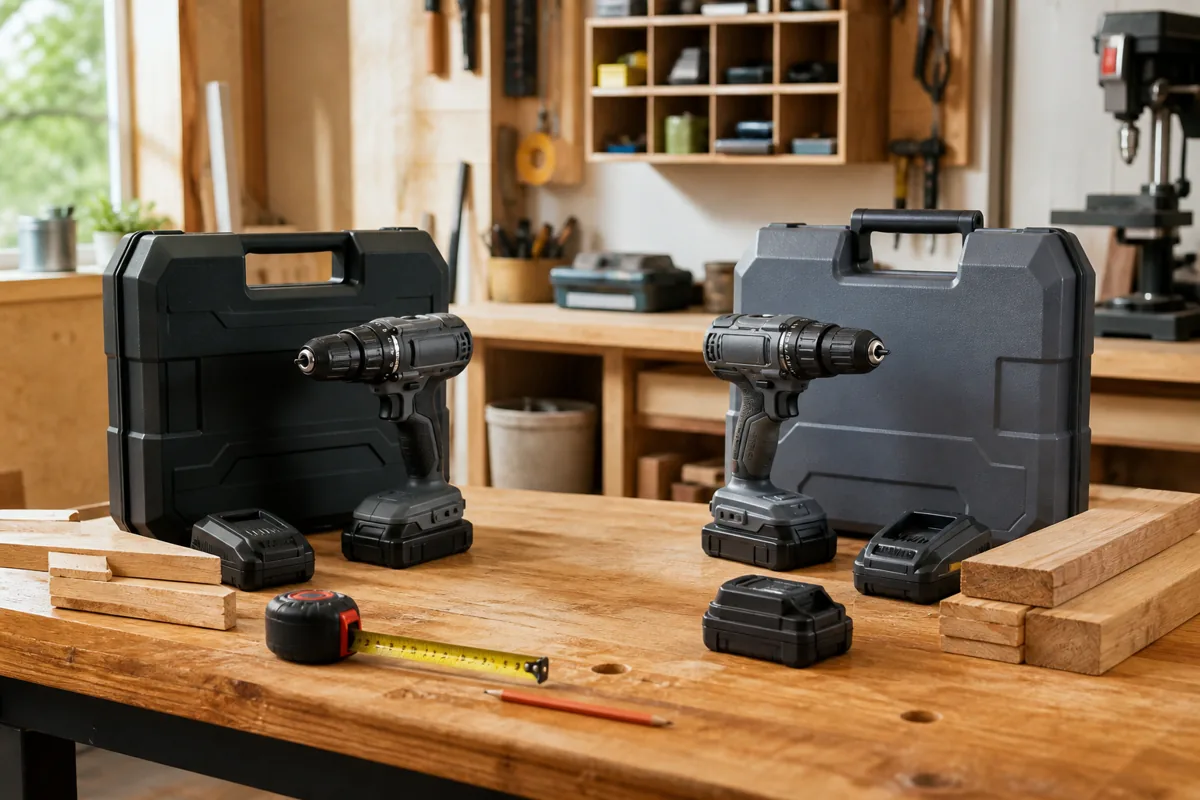
The foundation should be a cordless drill-driver kit containing the drill, two batteries, and a charger. Choose a compact brushless drill if the price is reasonable. It will usually run cooler and longer than a brushed model, but a brushed drill is perfectly adequate for hanging pictures and assembling furniture.
Two batteries are more useful than one large battery. Keep one charged while using the other, and reserve the larger pack for drilling or driving. For apartment work, batteries in the roughly 1.5Ah to 4Ah range balance runtime and weight. A 5Ah or larger pack can make a drill top-heavy and is rarely necessary unless you are working continuously.
Add a compact cordless impact driver if you regularly drive long screws, install shelving, or work with furniture fasteners. It delivers more torque with less wrist strain, but it is not a universal replacement for a drill. Its hammering action can strip small screws, damage soft wood, and annoy neighbors. Use the drill for small fasteners and delicate work; use the impact driver for long structural screws and stubborn hardware.
Budget for Bits and Accessories
A powerful tool with poor accessories is still a frustrating kit. Buy a mixed driver-bit set with Phillips, Pozidriv, Torx, square, and hex bits. Include 2-inch bits for recessed screws and a magnetic bit holder. Cheap bits are acceptable for occasional work, but discard them when the tip rounds over. A damaged bit can ruin a screw head and turn a five-minute job into a removal problem.
For drilling, use high-speed steel twist bits for metal and wood, brad-point bits for clean holes in wood, and carbide masonry bits for brick or concrete. Masonry drilling is one of the main failure points in apartment projects: a standard drill may spin without making progress, while a hammer drill can create dust and noise quickly. Check your lease and building rules before drilling into concrete, tile, or shared walls.
Keep a short extension, a right-angle bit adapter, and a small socket adapter in the case. These cost little and help with cabinet hinges, appliance panels, and fasteners hidden behind furniture.
Add Tools Only When a Job Justifies Them
An oscillating multi-tool is often the most useful second-wave purchase. With the right blade, it can undercut door trim, remove grout, trim plastic, and cut a damaged screw or nail flush. It is slower than a dedicated saw but easier to control in a small room. Buy a model with a variable-speed trigger or dial; full speed is too aggressive for plastic and finished wood.
A compact cordless oscillating multi-tool is worth considering before a circular saw. Apartment maintenance rarely calls for breaking down sheets of plywood. If you do need to cut lumber, a compact reciprocating saw handles demolition, while a circular saw makes cleaner straight cuts but produces more dust and needs more space.
A cordless vacuum is another practical addition, especially for drilling overhead or cleaning drywall dust. Runtime is less important than a good filter, a narrow nozzle, and easy emptying. For a few holes, a household vacuum with a crevice tool is cheaper and fine. Do not use a shop-style vacuum without checking its filter arrangement; fine drywall dust can quickly clog or damage an unsuitable machine.
Manage Batteries and Charging
Use the manufacturer’s charger and inspect packs for cracked cases, swelling, damaged contacts, or unusual heat. Stop using a battery that becomes excessively hot, smells chemical, or will not charge normally. Lithium-ion packs should be stored dry and away from radiators, direct sun, and metal objects that could bridge the contacts.
Do not leave batteries permanently on a charger unless the manufacturer specifically permits it. A charger with a clear status indicator is useful in a closet, and a two-port charger can reduce downtime if you use several tools. Labeling batteries by purchase date helps identify an aging pack before it fails during a job.
Buy for Your Actual Apartment
Start with the drill kit, a quality bit set, and a basic hand-tool set. Add an impact driver only if you drive long screws often. Choose an oscillating tool for repair and trimming work, or a vacuum if dust control is your immediate problem. The cheapest compatible bare tool is usually fine for occasional use, but avoid mixing platforms just to save $30; the extra charger and battery can erase that saving.
Keep the kit in a small tool bag rather than a large molded case. Store batteries separately from loose metal bits, and include safety glasses, hearing protection, a dust mask rated for fine particles, a tape measure, a level, and a stud finder. In an apartment, compact storage and controlled noise are not minor conveniences—they determine whether the tools get used correctly or remain buried in a closet.
Related guides
- Longest Lasting Lawn Mower Battery: AGM vs Lithium vs Flooded Lifespan and Cost per Season
- Duralast Gold Lawn Mower Battery Review: U1 Fit, CCA and When to Pay for AGM
- Greenworks Pro 80V 21-Inch Mower Review: Runtime Math, Push vs Self-Propelled and Yard Fit
- Bosch High Pressure Washer Gun Replacement: Fittings, Adapters and What Fits Your Model