
Key takeaways
- Compare the best powered wheelbarrows and electric garden carts by load capacity, battery system, slope rating and bed size to haul more with less effort.
What's inside
As an Amazon Associate I earn from qualifying purchases. This post may contain affiliate links at no extra cost to you.
- Top Pick: VEVOR EWB6414 Electric Wheelbarrow Cart
- Runner-up: VEVOR EWB9800 Electric Wheelbarrow Cart
- Also consider: Conclusion
The best cordless powered wheelbarrow for most yards is a 48V lithium-ion power wagon with a modular bed, because it carries several hundred pounds per trip, climbs moderate slopes, and swaps between a walled bed and a flatbed. If you already own 18V tool batteries, a power-assisted barrow on that platform is the smarter buy. Below are five confirmed models compared on load capacity, battery system, slope rating, and bed size, so you can match the machine to the loads you actually move.
As an Amazon Associate, we earn from qualifying purchases.
Table of Contents
- Quick Picks
- Makita XUC01PTX1 Power-Assisted Wheelbarrow Kit
- SuperHandy Utility Service Cart Power Wagon
- Landworks Utility Service Cart Power Wagon
- VEVOR EWB6414 Electric Wheelbarrow Cart
- VEVOR EWB9800 Electric Wheelbarrow Cart
- How to Choose
- FAQ
- Conclusion
- Product and ASIN Reference
Quick Picks
- Best for tool-battery owners: Makita XUC01PTX1, if your shop already runs on 18V LXT batteries.
- Best heavy hauler: SuperHandy Power Wagon, with the highest working load and hauling ratings here.
- Best all-round wagon: Landworks Power Wagon, with a faster top speed and a dump bed.
- Best budget tub barrow: VEVOR EWB6414, a classic single-tub shape with a driven wheel.
- Best lead-acid value: VEVOR EWB9800, with a big tub and long stated run time per charge.
Makita XUC01PTX1 Power-Assisted Wheelbarrow Kit
Makita builds this machine around its 18V LXT battery platform, which makes it the natural pick for anyone who already owns LXT drills, saws, and outdoor tools. The frame accepts two batteries but runs on one at a time, switching over when the first pack is spent, so a pair of packs delivers a long working session without a mid-job charge break. The brushless motor drives the front wheel, and the steel bucket can be swapped for an optional flatbed pipe frame when you need to carry lumber, pavers, or bagged goods that do not sit well in a tub.
Power assist matters most on grades, and Makita rates this barrow for inclines up to 12 degrees with two forward speeds plus reverse for backing out of tight spots. A hand lever brake and LED lights on both sides round out a design aimed at job sites as much as gardens. The trade-offs are capacity and weight: at 275 pounds of rated load it carries less per trip than the big 48V wagons, and the bare frame alone is a heavy lift into a truck bed. As a premium-tier machine it costs its keep through platform convenience rather than raw payload, so it suits landscapers and serious homeowners who are already invested in the battery system.
Specs
- Battery system: 18V X2 LXT, uses two 18V packs and runs on one at a time
- Kit contents: two 18V LXT 5.0Ah batteries and a dual-port rapid charger
- Motor: Makita-built brushless, front-wheel drive
- Maximum load capacity: 275 lb
- Bucket: steel wheelbarrow bucket, flatbed pipe frame available as an option
- Speeds: two forward speeds up to 2.5 mph, plus reverse
- Maximum climbing angle: 12 degrees
- Extras: LED headlights, hand brake, interchangeable carrier system
SuperHandy Utility Service Cart Power Wagon
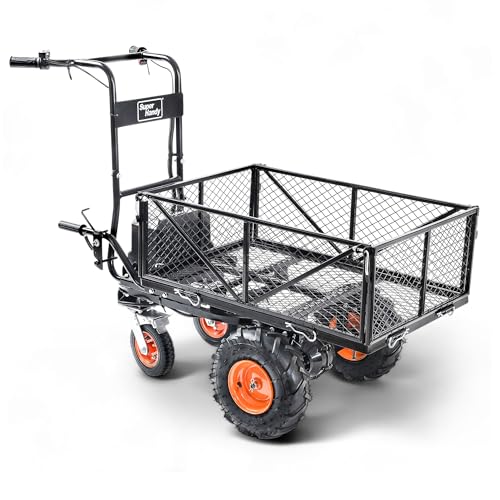
The SuperHandy Power Wagon is the heavy lifter of this group. Its 48V brushless system posts a 660 lb working load and a hauling capacity above 1,000 lb, which puts it in small utility-vehicle territory while staying walk-behind simple. The modular cargo bed is the other headline: side panels fit for loose material like soil and gravel, then fold down or come off to leave a flatbed for crates, feed sacks, and equipment.
SuperHandy sells this wagon with two 2Ah lithium-ion batteries, and it accepts one or two packs at a time, so a second pair of hands is not needed to keep it working through a long day. Variable speed control runs from a crawl to 3.1 mph forward and 2.2 mph in reverse, and the maker rates it for slopes up to 15 degrees, the steepest claim in this roundup. Large 13-inch pneumatic tires help on grass and gravel. The honest downsides are size and mass: at roughly 137 lb it is a mid-range to premium machine you store like equipment, not hang on a wall, and the four-wheel footprint turns wider than a two-wheel barrow. For farms, acreage, and contractors moving material all day, that bulk is the point.
Specs
- Battery system: 48V lithium-ion, one or two 2Ah or 4Ah packs
- Included: two 2Ah lithium-ion batteries
- Motor: 48V brushless drive
- Working load capacity: 660 lb
- Hauling capacity: 1,000 lb and above
- Bed: 6 cu ft modular cargo bed, converts to flatbed
- Speeds: forward 0 to 3.1 mph variable, reverse 0 to 2.2 mph
- Maximum slope: 15 degrees
- Wheels: 13-inch pneumatic tires
Landworks Utility Service Cart Power Wagon
Landworks is Great Circle’s sister brand to SuperHandy, and its lithium-ion power wagon follows the same recipe with a different balance of numbers. The rated load is 500 lb with hauling above 1,000 lb, the bed is the same 6 cu ft modular design that converts to a flatbed, and the dump function makes it easier to empty soil and debris without shoveling the last of it out by hand.
Where the Landworks pulls ahead is pace: its variable forward speed tops out at 4.4 mph, noticeably quicker than its sibling, which adds up over a long fence line or a big mulch job. Power comes from a single 4Ah lithium-ion battery rated at 177.6 watt-hours, and the system handles slopes up to 15 degrees. It sits in the mid-range tier for this category, undercutting the bigger SuperHandy while giving up some working load. Buyers choosing between the two should weigh trip count against walking speed: heavier loads per trip favor the SuperHandy, while longer distances per load favor the Landworks.
Specs
- Battery system: 48V lithium-ion, one 4Ah pack, 177.6 watt-hours
- Motor: 48V brushless drive
- Maximum load capacity: 500 lb
- Hauling capacity: 1,000 lb and above
- Bed: 6 cu ft modular cargo bed with dump function, converts to flatbed
- Speeds: forward 0 to 4.4 mph variable, reverse 0 to 2.2 mph
- Maximum slope: 15 degrees
- Wheels: 13-inch pneumatic tires
VEVOR EWB6414 Electric Wheelbarrow Cart

Not everyone wants a four-wheel wagon. The VEVOR EWB6414 keeps the classic wheelbarrow shape, with a single tub, two handles, and a driven front wheel, so it threads through garden gates and between raised beds the way a manual barrow does, only without the pushing strain. The 500W motor is strong for the class, and the tub carries 4 cu ft of material.
The rated load is 330 lb, which covers soil, compost, firewood, and bagged amendments for most home gardens. Wide 16-inch track wheels give it a stable stance on soft ground, and the whole machine weighs about 68 lb, making it the easiest model here to load into a vehicle or store in a shed corner. It is a budget-tier entry into powered hauling, so expect a simpler control layout and fewer convenience features than the wagons above. For gardeners whose loads are moderate and whose paths are narrow, that simplicity is a fair trade, and it is the pick that feels least like learning a new machine.
Specs
- Model: EWB6414
- Motor: 500W electric drive
- Maximum load capacity: 330 lb
- Tub capacity: 4 cu ft
- Wheels: 16-inch wide track wheels
- Handles: metal, two-handle barrow layout
- Net weight: about 68 lb
- Design: single-tub dump barrow with driven wheel
VEVOR EWB9800 Electric Wheelbarrow Cart

The EWB9800 is VEVOR’s bigger tub barrow, built around a 24V sealed lead-acid battery instead of lithium-ion. Lead-acid packs are heavier and slower to charge, but they are inexpensive to replace and tolerant of rough handling, which suits a machine that lives in a barn or site shed. The 288 watt-hour pack is rated for two to five hours of work per charge depending on load and terrain, the longest stated run time window in this roundup.
Capacity is the draw here: the hopper holds 4.5 cu ft and the rated maximum load is 573 lb, well beyond the smaller VEVOR and close to wagon territory, while keeping the two-wheel barrow format and 16-inch wheels that handle ruts and soft soil. The cost of that capacity is mass, at about 115 lb before you add a load, so plan on driving it where it needs to go rather than lifting it. In the budget tier it is the value play for owners who move dense material like gravel and wet soil and would rather spend on payload than on battery chemistry.
Specs
- Model: EWB9800
- Motor: 500W electric drive
- Battery: 24V 12Ah sealed lead-acid deep-cycle pack, 288 watt-hours
- Run time: 2 to 5 hours per charge, depending on load and terrain
- Maximum load capacity: 573 lb
- Hopper capacity: 4.5 cu ft
- Wheels: two 16-inch wheels
- Net weight: about 115 lb
How to Choose
Start with load weight, not bed volume. Soil, gravel, and wet compost are dense, so a barrow can hit its weight limit long before the tub looks full. Match the rated load to your heaviest regular material, then check that the bed volume suits bulky loads like brush and firewood.
Pick a format for your paths. A single-tub barrow with two handles turns in tight garden rows and fits through standard gates. A four-wheel power wagon carries more and never needs balancing, but it needs wider paths and more storage room, and it turns like the wagon it is.
Compare battery systems honestly. Lithium-ion packs are lighter, charge faster, and swap between tools on shared platforms like Makita’s 18V LXT line. Sealed lead-acid packs cost less to replace and shrug off cold storage, but add real weight and take longer to recharge. If you already own a tool platform, staying on it usually beats a small spec advantage elsewhere.
Check the slope rating against your ground. Ratings in this group run from 12 to 15 degrees under load. A flat suburban yard asks little of any of them; a terraced garden or a sloped driveway justifies the higher-rated wagons and their stronger motors.
Think about dumping and storage. A dump bed or tilting tub saves shoveling at the end of every trip. Also measure your shed door and storage bay: the wagons here weigh from about 115 to 137 lb and park like small equipment, while the lightest barrow is closer to 68 lb.
FAQ
How much weight can a cordless powered wheelbarrow actually carry?
Published ratings in this group run from 275 lb for the Makita up to a 660 lb working load for the SuperHandy wagon, with hauling ratings above 1,000 lb on the four-wheel wagons. Those figures assume firm, fairly level ground, so treat them as ceilings and plan to work below them on slopes or soft soil.
How long does the battery last on a powered wheelbarrow?
It depends on load, slope, and pack size. The VEVOR EWB9800 states two to five hours per charge from its lead-acid pack, and lithium-ion wagons that accept two packs can run one while the other charges. Heavy loads on grades drain any pack far faster than light loads on flat ground.
Can a powered wheelbarrow climb hills with a full load?
Yes, within its rating. The models here are rated for inclines between 12 and 15 degrees under load. Stay within the maker’s slope limit, keep the load centered and low, and walk beside the machine rather than behind it on steep ground so you can stop it safely.
Is a power wagon better than a powered wheelbarrow?
Neither is better outright; they suit different work. A power wagon carries more, stays stable on four wheels, and often adds a flatbed mode, but it is wider and heavier. A powered wheelbarrow carries less yet handles narrow paths, gates, and tight turns like the manual barrow it replaces.
Conclusion
For most buyers, a 48V lithium-ion power wagon is the sweet spot: the Landworks if your hauls are long and you value its higher travel speed, or the SuperHandy if every trip is as heavy as you can make it. Choose the Makita when 18V LXT batteries already fill your charger shelf, and look at the two VEVOR barrows when budget leads the decision, the EWB6414 for narrow garden paths and the EWB9800 for the biggest tub loads. Whichever format you pick, size the machine to your heaviest load and your steepest slope, and a powered barrow will quietly retire the hardest trips in your yard work.


Related guides
More from Amazon
Programs that pair well with the guide above. Offers and eligibility are set by Amazon and may change.
A free business account with business pricing and bulk-buying tools for work, shop or home office.
Create a business accountFree shipping on eligible items, Prime Video and more. Eligible new members can start with a free trial.
Start a Prime free trialAudiobooks and podcasts to listen to on the go. Eligible new members can start with a free trial.
Try Audible freeAd-free music streaming. Eligible new subscribers can start with a free trial.
Try Music Unlimited freeAs an Amazon Associate we earn from qualifying purchases.



Write Your Review
No reviews yet. Be the first to share your experience!