
Key takeaways
- Five beginner sander pads and starter kits compared: replacement pads, soft interface pads, a drill-powered disc set, and the grits to start with.
What's inside
As an Amazon Associate I earn from qualifying purchases. This post may contain affiliate links at no extra cost to you.
- Top Pick: NYXCL Replacement Pad Kit with Interface Pads and Discs
- Runner-up: Ladinka 4-Pack Foam Interface Pads
- Also consider: Mkobon 4-Pack Foam Interface Pads
The best sander pad for a beginner is the NYXCL starter kit, because one box covers what a first project needs: a 5-inch replacement pad, four soft interface pads, and 30 sanding discs from 100 to 400 grit. The EMVANV two-pack is the simpler buy if you only need spares, while the Ladinka and Mkobon foam pads suit curved edges and first-time finish work.
A sander pad is the part that grips the sanding disc and sets how the sander feels on the work. A hard pad cuts flat and fast, a soft interface pad forgives wobbles and follows curves, and a worn pad throws discs and leaves swirl marks no matter how good the sandpaper is. The five picks below are all 5-inch, hook-and-loop, and 8-hole, the most common beginner setup, and each one solves a different first-timer problem, from replacing a flattened pad to sanding without owning a sander at all.
As an Amazon Associate, we earn from qualifying purchases.
Table of Contents
- NYXCL Replacement Pad Kit with Interface Pads and Discs
- EMVANV 2-Pack Replacement Sander Pads
- Ladinka 4-Pack Foam Interface Pads
- Mkobon 4-Pack Foam Interface Pads
- AUTOTOOLHOME 80-Piece Drill Sanding Disc Kit
- How to Choose a Sander Pad
- Frequently Asked Questions
- Conclusion
- Product and ASIN Reference
NYXCL Replacement Pad Kit with Interface Pads and Discs

The NYXCL kit is the pick for a beginner who wants one box that covers the whole first project. The core is a single 5-inch, 8-hole replacement pad, plus four soft-density foam interface pads and 30 sanding discs: five each in 100, 150, 180, 240, 320, and 400 grit.
Fit matches the most common beginner sander family. The pad replaces the DeWalt DWE64233 pattern and fits the DWE6423 and DWE6423K variable-speed sanders, the DWE6421 and DWE6421K single-speed sanders, and the cordless DCW210B. The interface pads are 0.5 inches thick, enough foam to follow a rounded edge without digging in, and the discs are aluminum oxide, the standard abrasive for wood. Use the hard pad for flat panels, add an interface pad when the work curves, and work through the grits in order.
| Specs | Details |
|---|---|
| Diameter | 5 in |
| Attachment | Hook and loop |
| Dust holes | 8 |
| Pack contents | 1 replacement pad, 4 foam interface pads, 30 sanding discs |
| Disc grits | 100, 150, 180, 240, 320, 400 (5 each) |
| Interface pad thickness | 0.5 in |
| Abrasive | Aluminum oxide |
| Fits | DEWALT DWE6423, DWE6423K, DWE6421, DWE6421K, DCW210B |
| ASIN | B0C1GFYJVR |
EMVANV 2-Pack Replacement Sander Pads
The EMVANV two-pack is the straightforward pick for a beginner whose sander pad has gone flat and who only needs the pad itself. Two identical 5-inch pads arrive in the box, so a worn pad can be swapped the same afternoon and a spare stays on the shelf. Each pad is 8-hole, hook-and-loop, and made from PP plastic with a rubber layer, which resists cracking around the screws while damping vibration.
Fit is the whole point of this listing, so measure before ordering. The pads mount with four screws, reusing the originals, and the published spacing is about 1.25 inches between adjacent screw holes and 1.77 inches diagonally, with a center hole around 1.25 inches across. The pads are about 127 by 10 millimeters, or 4.84 by 0.39 inches, and suit most 5-inch orbital sanders and grinders with four screw holes, working with both 5-inch 4-hole and 8-hole discs. One crawl of this listing showed no featured offers available, so confirm a live offer before ordering.
| Specs | Details |
|---|---|
| Diameter | 5 in |
| Attachment | Hook and loop |
| Dust holes | 8 |
| Pack count | 2 pads |
| Material | PP plastic and rubber |
| Pad size | 127 x 10 mm (4.84 x 0.39 in) |
| Screw holes | 4, about 1.25 in apart, 1.77 in diagonal |
| Screws | Not included, reuse originals |
| ASIN |
Ladinka 4-Pack Foam Interface Pads

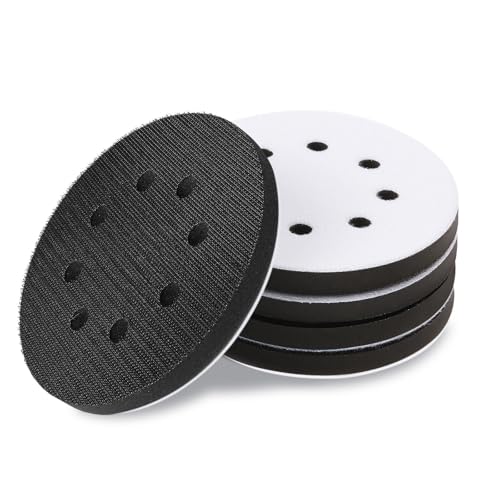
The Ladinka four-pack is the pick for a beginner who keeps gouging edges and rounded corners with a hard pad. These are soft-density foam interface pads, not replacement backing pads: they sit between the sander’s hard pad and the disc, adding a 0.5-inch cushion that lets the disc follow a curve instead of digging in. Four pads in the pack means a fresh one is always ready when the foam compresses or the hooks wear.
The construction is simple and beginner-proof. Each pad is 5 inches across with 8 dust holes and a hook-and-loop face on both sides, so it sticks to the sander pad on one side and holds the disc on the other. The foam reduces vibration passed to the hand, and the 8-hole pattern keeps dust extraction working when the disc holes line up. Keep one thing in mind: an interface pad softens the cut, so flat panels still want the hard pad underneath, with the foam saved for edges, roundovers, and contoured work.
| Specs | Details |
|---|---|
| Diameter | 5 in |
| Attachment | Hook and loop, both sides |
| Dust holes | 8 |
| Pack count | 4 pads |
| Material | Soft foam |
| Thickness | 0.5 in |
| Type | Interface pad, not a replacement backing pad |
| ASIN | B0DMWLT2K4 |
Mkobon 4-Pack Foam Interface Pads

The Mkobon four-pack is the pick for a beginner who wants the same forgiving foam as the Ladinka set with wet-or-dry use added. Each pad is 5-inch, 8-hole, soft-density foam, 0.5 inches thick, with hook-and-loop backing, suitable for dry and wet grinding.
In practice this set behaves like the Ladinka four-pack: four identical pads, a hook-and-loop face on each side, and enough cushion to keep a disc from burning through a curved edge. The difference is breadth: the Ladinka listing frames the pads around vibration reduction, the Mkobon listing around wet and dry versatility, so choose this set if a wet-sanded finish is in your plans. Either way, line the disc holes up with the pad holes, because a blocked dust hole loads the disc and shortens its life.
| Specs | Details |
|---|---|
| Diameter | 5 in |
| Attachment | Hook and loop |
| Dust holes | 8 |
| Pack count | 4 pads |
| Material | Soft density foam |
| Thickness | 0.5 in |
| Use | Dry and wet grinding |
| Type | Interface pad, not a replacement backing pad |
| ASIN | B0FBGQ6HVW |
AUTOTOOLHOME 80-Piece Drill Sanding Disc Kit
The AUTOTOOLHOME kit is the pick for a beginner who does not own a random orbital sander yet. Instead of a sander, it uses a drill: the box includes a 5-inch hook-and-loop backing pad with a hex shank that chucks into an electric drill, plus 80 sanding discs, ten each in 60, 80, 120, 180, 240, 400, 600, and 800 grit. That is the widest grit range in this roundup, from rough shaping at 60 to fine polishing at 800, and the discs also fit a 5-inch random orbital sander or an angle grinder.
Two honest warnings come with this pick. First, a drill spins a disc in a circle without the random orbit that keeps a dedicated sander from leaving swirl marks, so keep the drill moving, use light pressure, and finish the last passes by hand or with a finer grit. Second, one crawl of this listing showed no featured offers available, so confirm a live offer before ordering. The discs are aluminum oxide with a resin bond and an anti-clogging, anti-static coating. A drill setup has no dust collection, so wear a mask and work outside or with extraction nearby.
| Specs | Details |
|---|---|
| Diameter | 5 in |
| Attachment | Hook and loop |
| Dust holes | 8 |
| Pack contents | 1 backing pad with hex shank, 80 sanding discs (81 pieces total) |
| Disc grits | 60, 80, 120, 180, 240, 400, 600, 800 (10 each) |
| Abrasive | Aluminum oxide, resin bond |
| Fits | Electric drill, random orbital sander, angle grinder |
| ASIN | ⚠ B07SBG84C8 |
How to Choose a Sander Pad
Start with diameter, because a pad that does not match the sander is useless. Most beginner sanders are 5-inch, but 6-inch sanders exist, so check the sander body or manual first. Next, match the dust holes: an 8-hole pad needs 8-hole discs, or the dust has nowhere to go and the disc clogs. Then match the screw pattern on a replacement pad, because a pad with the wrong spacing will not mount at all, and the screws are almost never included, so keep the originals.
Choose hard or soft by the shape of the work. A hard replacement pad cuts flat panels fast and true. A soft interface pad goes between the hard pad and the disc when the work curves, rounds over, or meets an edge, and it forgives the heavy hand every beginner starts with. Do not use an interface pad as a replacement for a worn backing pad: the foam cannot hold a disc flat on a panel, and it will wear out fast under that job.
Learn the grit ladder. Start around 80 or 100 grit to shape and remove mill marks, move to 120 or 150 to smooth, then 180 or 220 before a finish, and only go finer when the finish calls for it. Never skip more than one grit step: each grit removes the scratches the previous one left. Let the sander do the work: press lightly, keep it moving, and let the weight of the machine and the grit do the cutting. Pressing hard does not sand faster, it heats the disc, clogs the abrasive, and burns the wood.
Frequently Asked Questions
What size sander pad should a beginner buy?
Start with 5-inch, the most common size on beginner random orbital sanders, with the widest range of discs and pads. A 6-inch sander needs a 6-inch pad, and the two sizes are not interchangeable.
What is the difference between a replacement pad and an interface pad?
A replacement pad is the hard backing pad that bolts to the sander and holds the disc. An interface pad is a soft foam cushion between the hard pad and the disc that follows curves and softens the cut. Interface pads do not replace a worn backing pad, and a hard pad alone will gouge rounded edges.
Which grit should a beginner start with?
Start at 80 or 100 grit for shaping and removing mill marks, then work up through 120 or 150 and 180 or 220 before finishing, one step at a time. Finer grits like 320 and 400 suit between-coat smoothing and fine finishes, not material removal.
Can I use a drill instead of a sander?
Yes, with a backing pad that has a hex shank, like the AUTOTOOLHOME kit. A drill spins in a circle without the random orbit of a dedicated sander, so it can leave swirl marks if held still, and it has no dust collection. Keep the drill moving, use light pressure, and finish the last passes by hand.
Conclusion
A beginner needs three ideas: a fitting pad, a soft interface pad for curves, and a grit ladder worked in order. The NYXCL kit covers all three and is the pick to start with, the EMVANV two-pack is the cheapest way to replace a worn pad, the Ladinka and Mkobon foam sets forgive the heavy hand on edges, and the AUTOTOOLHOME kit lets a drill do the job before a sander is bought. Measure the diameter, match the holes and screws, work through the grits one step at a time, and the finish will take care of itself.
Related guides
More from Amazon
Programs that pair well with the guide above. Offers and eligibility are set by Amazon and may change.
A free business account with business pricing and bulk-buying tools for work, shop or home office.
Create a business accountFree shipping on eligible items, Prime Video and more. Eligible new members can start with a free trial.
Start a Prime free trialAudiobooks and podcasts to listen to on the go. Eligible new members can start with a free trial.
Try Audible freeAd-free music streaming. Eligible new subscribers can start with a free trial.
Try Music Unlimited freeAs an Amazon Associate we earn from qualifying purchases.


Write Your Review
No reviews yet. Be the first to share your experience!