
Key takeaways
- Compare the best chainsaw sharpeners, from bench grinders to guided files, with pitch fit, wheel sizes and vise types for chainsaws and pole saws.
What's inside
As an Amazon Associate I earn from qualifying purchases. This post may contain affiliate links at no extra cost to you.
- Top Pick: Oregon 520-120 Professional Bench Grinder
- Runner-up: Sharp Pebble Electric Chainsaw Sharpener Kit
- Also consider: Oregon 410-120 Professional Compact Bench Grinder
The best chainsaw sharpener for most owners is a 120-volt bench grinder such as the Oregon 520-120, because it clamps the chain in a vise and grinds every cutter at the same set angle, removing the guesswork that makes hand filing uneven. Anyone who cuts firewood weekly or maintains several saws will get the most consistent edge from a bench grinder, while occasional users can do well with a guided file or a small handheld electric kit. Each works on standard saw chain, including the low-profile chain fitted to most cordless pole saws, as long as the wheel or file size matches the pitch.
As an Amazon Associate, we earn from qualifying purchases.
Table of Contents
- Quick Picks
- Oregon 520-120 Professional Bench Grinder
- Sharp Pebble Electric Chainsaw Sharpener Kit
- Oregon 410-120 Professional Compact Bench Grinder
- STIHL 2-in-1 Easy File .325 Inch
- Oregon 310-120 Compact Mini Bench Grinder
- How to Choose a Chainsaw Sharpener
- FAQ
- Conclusion
- Product and ASIN Reference
Quick Picks
- Best overall: Oregon 520-120 Professional Bench Grinder — a full-size 120-volt grinder with a self-centering vise and a large wheel for fast, repeatable sharpening.
- Best handheld electric: Sharp Pebble Electric Chainsaw Sharpener Kit — a corded handheld sharpener with four diamond wheels and an angle guide for sharpening at the woodpile.
- Best mid-range bench grinder: Oregon 410-120 Professional Compact Bench Grinder — near-professional adjustment in a smaller bench or wall-mount body.
- Best manual sharpener: STIHL 2-in-1 Easy File .325 Inch — a guided file holder that sharpens the cutter and files the depth gauge in a single operation.
- Best compact bench grinder: Oregon 310-120 Compact Mini Bench Grinder — a small occasional-use grinder with a manual clamping vise for tight workshops.
Oregon 520-120 Professional Bench Grinder

The Oregon 520-120 is the premium pick in this roundup and the sharpener aimed at owners who sharpen chains often. It is a full-size bench grinder that also mounts to a wall, and its chain vise self-centers the chain so left and right cutters sit at the same height before the wheel comes down. The large 5-3/4-inch grinding wheel covers more of the cutter face per pass than the wheels on the compact models, and the motor turns one way only, a safety design. A built-in work light helps when setting the grinding angle and depth stop for each pitch.
Three grinding wheels are included, covering chain pitches from 1/4 inch up to .404 inch, so the same machine handles a small pole saw chain and a full-size felling chain. For a firewood seller or a landowner with several saws, it keeps every chain at a factory-style angle with the least setup time per chain.
Specs
- Type: Bench or wall-mount electric chain grinder
- Power: 120-volt corded motor, one-way rotation
- Grinding wheel: 5-3/4-inch diameter, three wheels included
- Chain pitches: 1/4 inch, 3/8 inch low profile, .325 inch, 3/8 inch, .404 inch
- Vise: Self-centering chain vise
- Extras: Built-in work light, dressing brick, quick-check template
- Model number: 520-120
Sharp Pebble Electric Chainsaw Sharpener Kit

The Sharp Pebble kit is the budget handheld option, built around a corded electric sharpener body that works more like a rotary tool than a bench machine. Instead of clamping the chain in a vise, the sharpener is guided along each cutter with the included angle attachment, so the chain stays on the bar and the saw can stay at the woodpile or on a tailgate. That portability is the main reason to choose it over a bench grinder: no mounting, no bench space, and almost no setup beyond fitting the right wheel.
Four diamond wheels come in the kit, sized 5/32 inch, 3/16 inch, and 7/32 inch, matching the file sizes for the most common pitches, including the 3/8 inch low-profile chain used on many pole saws. The trade-off is consistency: a handheld tool depends on a steady hand, so results vary more from tooth to tooth than with a vise-mounted grinder. For one or two saws sharpened a few times a season, it is a practical step up from a plain round file.
Specs
- Type: Handheld corded electric sharpener kit
- Power: 120-volt corded motor
- Wheels: Four diamond sharpening wheels, 5/32 inch, 3/16 inch, 7/32 inch sizes
- Guidance: Angle attachment for setting the sharpening angle
- Included: Sharpener tool, four wheels, angle attachment, wrench, eBook guide
- Chain fit: Matches file sizes for common pitches including 3/8 inch low profile
Oregon 410-120 Professional Compact Bench Grinder

The Oregon 410-120 sits in the mid-range tier and is the bench grinder most home workshops should look at first. It keeps the core adjustments of the professional line — grinding angle, down angle, and a depth stop — in a smaller body that bolts to a bench or a wall with two bolts. Like the larger 520-120, it sharpens chain up to .404 inch pitch — everything from a pole saw’s low-profile chain to a large firewood saw — and three grinding wheels are included.
A dressing brick and a quick-check grinding template are in the box. What it gives up against the 520-120 is the self-centering vise and the built-in light, and its wheel is smaller, so each pass removes material a little more slowly. For an owner with two or three saws who sharpens every few weeks, those are reasonable trade-offs, and the compact footprint suits a crowded garage bench.
Specs
- Type: Bench or wall-mount electric chain grinder
- Power: 120-volt corded motor, one-way rotation
- Grinding wheels: Three included, for pitches up to .404 inch
- Chain pitches: 1/4 inch, 3/8 inch low profile, .325 inch, 3/8 inch, .404 inch
- Dimensions: 15 x 8 x 11 inches
- Weight: 17 pounds
- Extras: Dressing brick, quick-check grinding template
- Model number: 410-120
STIHL 2-in-1 Easy File .325 Inch
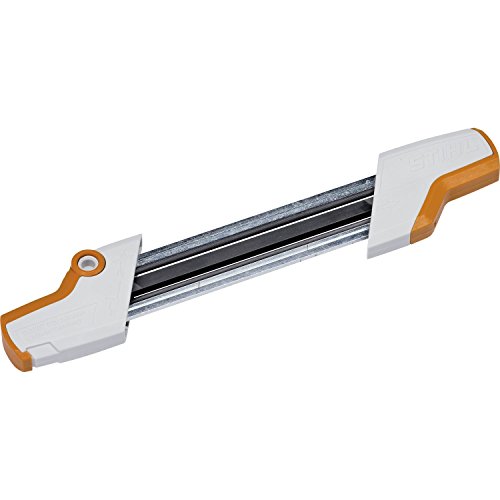
The STIHL 2-in-1 Easy File takes the opposite approach to the grinders: no motor, no wheels, and no bench. It is a file holder that carries two round files and one flat file in a fixed guide, so one stroke along each cutter sharpens the edge and lowers the depth gauge at the same time. That combined action is its main appeal, because depth gauges are the part of chain maintenance most owners skip, and sharp cutters with tall depth gauges still cut slowly.
This version is sized for .325 inch pitch chain, a common size on mid-range farm and ranch saws; matching versions exist for other pitches, so the pitch on the bar stamp has to match the tool. The files are replaceable when they wear, and the guide holds the file at the correct angle and height, which removes most of the skill barrier that puts people off hand filing. It needs no power and is light enough for a saw case, which makes it the natural field sharpener in this group. The limit is speed: filing a full chain tooth by tooth takes longer than grinding, and heavily rock-damaged cutters take many strokes to restore.
Specs
- Type: Manual 2-in-1 guided file holder
- Power: None, hand operated
- Chain pitch: .325 inch
- Function: Sharpens cutter and lowers depth gauge in one operation
- Files: Two round files and one flat file, replaceable
- Weight: 12.3 ounces
- Dimensions: 8.43 x 1.96 x 0.91 inches
- Model number: 56057504304
Oregon 310-120 Compact Mini Bench Grinder

The Oregon 310-120 is the entry point to bench grinding, a mini grinder built for occasional use in a small space. It uses a manual chain-clamping vise rather than the self-centering vise of the professional models, so the chain is locked down by hand before each pass, and the compact body stores on a shelf instead of occupying permanent bench space. Two grinding wheels are included, along with a dressing brick and a profile guide.
Coverage is still broad: it sharpens chain from 1/4 inch pitch through .404 inch, including the low-profile chains on pole saws and small electric saws. The smaller motor and wheel remove material more slowly than the larger grinders, and the manual vise asks for a little more care to keep cutter lengths even. For an owner with a single saw and a pole saw who sharpens a handful of times a year, it delivers the main benefit of a bench grinder — a fixed, repeatable angle — at the budget end of the category.
Specs
- Type: Mini bench-mount electric chain grinder
- Power: 120-volt corded motor
- Grinding wheels: Two included
- Chain pitches: 1/4 inch, 3/8 inch low profile, 3/8 inch, .404 inch
- Vise: Manual chain-clamping vise
- Extras: Dressing brick, profile guide
- Model number: 310-120
How to Choose a Chainsaw Sharpener
Match the sharpener to your chain pitch first. Every sharpener, wheel, and file is sized to chain pitch — the common sizes are 1/4 inch, 3/8 inch low profile, .325 inch, 3/8 inch, and .404 inch. The pitch is stamped on the guide bar and printed on the chain box. A bench grinder covers all of these by swapping wheels, while a guided file such as the STIHL 2-in-1 is built for one pitch only, so check the stamp before ordering a manual tool. Pole saw chains are usually 3/8 inch low profile or 1/4 inch, and any sharpener here handles them with the correct wheel fitted.
Decide between grinding and filing. Bench grinders are the fastest route to a uniform edge and the easiest way to rescue a chain that has hit dirt or a rock, because the vise holds every cutter at the same angle and length. The risk is heat: heavy passes can overheat a cutter and soften it, so light passes matter. Guided files are slower but remove very little metal, which extends chain life, and they work anywhere without power. Handheld electric kits sit between the two, trading some consistency for portability.
Think about volume and workspace. Sharpening one chain a month does not justify a full-size grinder; a mini grinder, a handheld kit, or a guided file covers it. Sharpening several chains a week points to the 520-120 class of machine, where the self-centering vise and larger wheel cut setup time. Also consider where the work happens: bench grinders need a bench or wall space near an outlet, while files and handheld kits work at the woodpile.
Do not forget depth gauges. Grinders in this roundup focus on the cutter, so depth gauge height still needs a flat file and a gauge tool from time to time. The STIHL 2-in-1 handles both in one pass, which is its main advantage. A dressing brick keeps a grinding wheel cutting cleanly, and a quick-check template confirms the wheel profile matches the chain.
FAQ
Can these sharpeners sharpen a pole saw chain?
Yes. Pole saws use standard saw chain, most often 3/8 inch low profile or 1/4 inch pitch, and every bench grinder in this roundup covers those pitches with the correct wheel fitted. The chain can be removed and ground on the bench, or touched up on the bar with the Sharp Pebble kit or a guided file of the matching size.
How often should a chain be sharpened?
A chain should be touched up as soon as it starts throwing dust instead of chips, forcing the saw to be pushed into the cut, or cutting crooked because one side is duller than the other. Light, frequent sharpening removes less metal than occasional heavy grinding, so a few file strokes or one light grinder pass per cutter at the first sign of dullness keeps the chain cutting well longer.
Is a bench grinder better than a file?
A bench grinder is better for speed and for restoring damaged or uneven cutters, because the vise repeats the same angle on every tooth. A guided file is better for routine touch-ups, for field use without power, and for chain life, since it removes very little metal. Many owners use both: a file for quick touch-ups during a cutting session and a grinder for a full reset at the bench.
What wheel or file size does my chain need?
The size follows the chain pitch. As a general guide, 1/4 inch and 3/8 inch low-profile chains use a 5/32 inch file size, .325 inch chains use 3/16 inch, and 3/8 inch and .404 inch chains use 7/32 inch. Confirm against the chain manufacturer’s specification before the first sharpening.
Conclusion
For most saw owners, the Oregon 410-120 is the balanced choice: real bench-grinder consistency, broad pitch coverage, and a footprint that fits a home workshop. Owners who sharpen constantly should step up to the Oregon 520-120 for its self-centering vise and larger wheel, while the Oregon 310-120 covers occasional use at the budget end. The Sharp Pebble kit is the pick for sharpening away from the bench, and the STIHL 2-in-1 Easy File remains the simplest no-power option, with the bonus of handling depth gauges in the same pass. Match the tool to your chain pitch and your sharpening volume, and any of the five will keep a dull chain from slowing down tree work, firewood cutting, and pole saw trimming.
Related guides
More from Amazon
Programs that pair well with the guide above. Offers and eligibility are set by Amazon and may change.
A free business account with business pricing and bulk-buying tools for work, shop or home office.
Create a business accountFree shipping on eligible items, Prime Video and more. Eligible new members can start with a free trial.
Start a Prime free trialAudiobooks and podcasts to listen to on the go. Eligible new members can start with a free trial.
Try Audible freeAd-free music streaming. Eligible new subscribers can start with a free trial.
Try Music Unlimited freeAs an Amazon Associate we earn from qualifying purchases.


Write Your Review
No reviews yet. Be the first to share your experience!