
Key takeaways
- Compare five corded soldering stations for electronics and repair work, from a budget dial unit to digital stations and a 2-in-1 hot air rework model.
What's inside
As an Amazon Associate I earn from qualifying purchases. This post may contain affiliate links at no extra cost to you.
- Top Pick: Weller WE1010NA Digital Soldering Station
- Runner-up: YIHUA 862BD+ 2-in-1 Soldering and Hot Air Rework Station
- Also consider: X-Tronic 3020-XTS Soldering Station Kit
A bench soldering station earns its space by holding a steady tip temperature joint after joint, something a basic plug-in iron with no control loop cannot promise. Corded stations pair a handpiece with a base unit that regulates heat, parks the iron safely between joints, and accepts replacement tips sized for fine board pads or heavier wire terminals.
The five stations below cover the main buying angles: two proven digital benches from Hakko and Weller, a 2-in-1 model that adds hot air for surface-mount rework, a bundled kit with the accessories a new bench needs, and a simple analog unit for light hobby work. All five are corded bench models, chosen for published temperature ranges, tip support, and parts availability.
As an Amazon Associate, we earn from qualifying purchases.
Quick answer
For most benches, the Hakko FX888D is the safest pick: 70 watts, digital control and a deep tip catalog. The Weller WE1010NA matches it with a clearer display and a standby mode. The YIHUA 862BD+ adds hot air for surface-mount rework, the X-Tronic 3020-XTS bundles the most accessories, and the Weller WLC100 covers light hobby work on a budget.
Hakko FX888D Digital Soldering Station
The FX888D has been a default recommendation for electronics benches for years, and the published figures explain why. Its 70-watt station drives the FX-8801 handpiece across a 200 to 480 degree Celsius range, with Hakko rating temperature stability at plus or minus 1 degree at idle. A digital display shows the set temperature, and the control pad stores five preset temperatures for repeat jobs.
Tip support is the long-term argument for this station. It uses Hakko T18 series tips, a family with conical, chisel, and bent shapes in many sizes, and genuine replacements are sold widely. The handpiece uses a ceramic heating element, the station is rated for work around static-sensitive parts, and the iron holder includes a cleaning wire and sponge. This is the premium pick for buyers who solder several times a week, across through-hole and surface-mount board work. It is less suited to very heavy terminals, where tip mass matters more than fine control.
Specs
– Power: 70 W station, corded AC
– Temperature range: 200 to 480 degrees Celsius (392 to 896 degrees Fahrenheit)
– Control: digital display, two-button adjustment, five preset temperatures
– Handpiece: FX-8801 with ceramic heating element
– Tips: Hakko T18 series, replaceable
– Extras: iron holder with cleaning wire and sponge, rated for static-sensitive work
Weller WE1010NA Digital Soldering Station
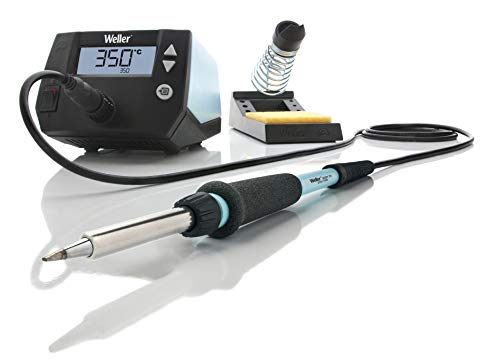
Weller’s WE1010NA is the direct rival to the Hakko, built around a 70-watt station and the WEP 70 handpiece. The published range runs from 200 to 850 degrees Fahrenheit, shown on a front LCD with push-button setting. Weller adds two features the Hakko lacks: a password lock that protects a chosen setting, and a standby mode that drops tip temperature when the iron sits idle, slowing tip oxidation.
The station takes Weller ET series tips, another deep catalog with genuine replacements from many sellers, and the build is rated for static-sensitive work. The slim handpiece and separate safety rest suit a bench that runs daily: repair shops, school labs, and serious hobby rooms. Choose it over the FX888D if the clearer screen, the lock, and the standby behavior matter to you; choose the Hakko if you prefer its tip shapes or preset memory. For occasional weekend use, both are more station than the work demands.
Specs
– Power: 70 W station, 120 V corded AC
– Temperature range: 200 to 850 degrees Fahrenheit (100 to 450 degrees Celsius)
– Control: digital LCD display, push-button setting, password lock, standby mode
– Handpiece: WEP 70 soldering iron
– Tips: Weller ET series, replaceable
– Extras: separate safety rest, rated for static-sensitive work
YIHUA 862BD+ 2-in-1 Soldering and Hot Air Rework Station
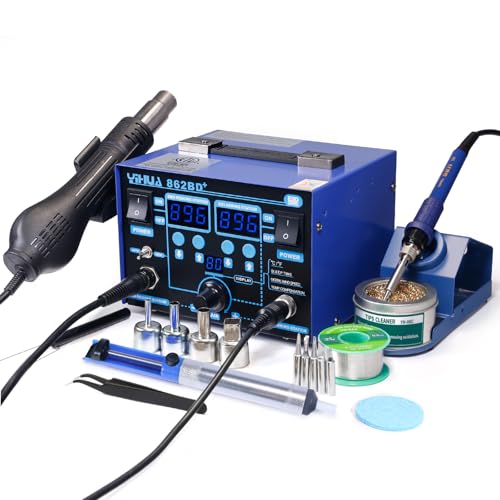
The 862BD+ answers a different need: removing and refitting surface-mount parts. One bench unit combines a 75-watt soldering iron with a hot air gun, each with its own display and controls, so both tools can run at the same time. YIHUA rates the iron at 200 to 480 degrees Celsius and the hot air side at 100 to 480 degrees Celsius, with PID control on both channels.
The box includes five soldering tips and four hot air nozzles, covering common chip packages such as SOIC, QFP, PLCC, and BGA work at hobby scale. The iron has a sleep function, the hot air side has a failure protection mode, and the unit carries an ETL listing and is built to be safe around static-sensitive components. This is the mid-range pick for phone, console, and board-level repair, where lifting a chip with hot air and soldering its replacement with the same unit saves real bench space. Buyers who only solder through-hole parts gain nothing from the air channel and should spend the same money on a better iron-only station.
Specs
– Power: 75 W soldering iron plus hot air gun, corded AC
– Soldering range: 200 to 480 degrees Celsius (392 to 896 degrees Fahrenheit)
– Hot air range: 100 to 480 degrees Celsius (212 to 896 degrees Fahrenheit), maker rating
– Control: PID on both channels, three digital displays, Fahrenheit or Celsius readout
– Included: 5 soldering tips, 4 hot air nozzles
– Extras: iron sleep function, hot air failure protection, ETL listed, built for static-sensitive work
X-Tronic 3020-XTS Soldering Station Kit
The 3020-XTS sells the whole bench setup in one box. The station is a 75-watt unit (60 watts at the iron, per the maker manual) with an LED display, a 200 to 480 degree Celsius range, a Celsius or Fahrenheit switch, and a sleep feature that engages after 10 idle minutes. Around it, the kit packs two helping hands, five extra tips, a roll of lead-free solder, a brass sponge with cleaning flux, a wet sponge, a solder sucker, and tweezers.
That bundle is the reason to buy it: a first bench usually needs every one of those extras, and sourcing them one by one adds up. The trade-offs are the ones expected at the budget tier: the handpiece and stand are lighter than the Hakko or Weller hardware, and long-term tip supply depends on one maker rather than an industry tip family. X-Tronic backs the station with a published 3-year warranty, which softens that concern. Pick this kit if you are setting up a bench from nothing for hobby electronics, model work, or light repair. Skip it if you already own the accessories, since the iron-only stations above then put more of the budget into the tool itself.
Specs
– Power: 75 W total (60 W at the iron), 110 V corded AC
– Temperature range: 200 to 480 degrees Celsius (392 to 896 degrees Fahrenheit)
– Control: LED display, Celsius or Fahrenheit switch, 10-minute sleep feature
– Included: 2 helping hands, 5 extra tips, 50 g roll of lead-free solder, brass sponge with cleaning flux, wet sponge, solder sucker, tweezers
– Warranty: 3 years, per the maker manual
– Model: 3020-XTS
Weller WLC100 40-Watt Soldering Station
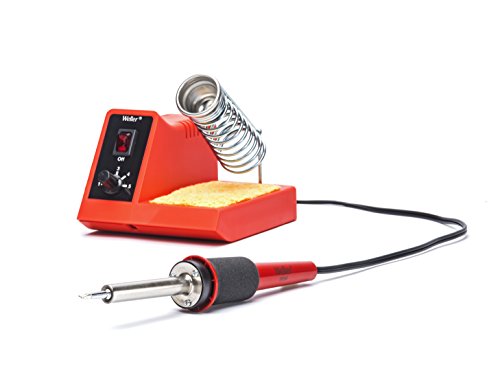
The WLC100 is the simplest station here, and its spec sheet is honest about it. Instead of a temperature sensor and control loop, it uses a variable power dial that adjusts output from 5 to 40 watts; the tip runs hotter or cooler with the dial, but nothing holds a set temperature. For stained glass, basic wire joints, and occasional hobby boards, that simpler approach has served buyers for years.
The lightweight pencil iron has a cushioned foam grip, a replaceable heating element, and an ST3 iron-plated copper tip in a 1/8-inch screwdriver shape. The station includes a safety guard iron holder and a natural sponge cleaning pad. This is the budget pick for light, infrequent work where joints are forgiving. It is the wrong tool for temperature-sensitive components or lead-free solder on dense boards, because heat recovery and control are limited. Buyers who expect to solder weekly should step up to the digital stations above.
Specs
– Power: 40 W maximum, variable dial from 5 to 40 W, corded AC
– Control: analog power dial, no digital temperature readout
– Tip: ST3 iron-plated copper tip, 1/8-inch screwdriver shape
– Handpiece: lightweight pencil iron, cushioned foam grip, replaceable heating element
– Included: safety guard iron holder, natural sponge tip cleaning pad
How to choose
Begin with the work, not the wattage. Through-hole boards, wire splices, and connector repairs need an iron-only station with good heat recovery; surface-mount rework needs hot air as well, which is the one reason to pick the 2-in-1 YIHUA. Next, look at temperature control. A digital station holds a set temperature as the joint draws heat away, which protects pads and gives repeatable joints; an analog power dial only sets output, so tip temperature drifts with the load.
Tip support decides how long the station stays useful. Hakko T18 and Weller ET tips are stocked by many sellers in many shapes, so a worn tip is a small purchase years later. Check that a chisel tip around 2 mm wide is available, since that shape covers most board and wire work. Then weigh the extras honestly: standby modes slow tip wear, preset memory speeds repeat jobs, and a bundled kit only saves money if you need the pieces. Finally, match the tier to your pace: weekly soldering justifies a premium digital station, while a few repairs a year point to the budget tier.
Who should skip
Skip the analog WLC100 if your work involves lead-free solder, small surface-mount pads, or parts that a few extra seconds of heat can damage; its dial cannot hold a temperature. Skip the 2-in-1 YIHUA if you never remove surface-mount chips, because the air channel adds cost and bulk you will not use. Skip the X-Tronic kit if your bench already has helping hands, spare tips, and cleaning supplies. And skip every station here if your repairs happen away from an outlet, in vehicles, or inside installed equipment; a corded station only works where it can sit near power.
FAQ
What temperature should I set for electronics soldering?
Most leaded electronics joints flow well between 320 and 350 degrees Celsius, while lead-free solder usually needs 350 to 380 degrees. Use the lowest setting that melts the joint in a few seconds, and raise it for large terminals rather than pressing longer on small pads.
Is 40 watts enough for a soldering station?
Forty watts handles light wire joints, small boards, and hobby work, but recovers slowly after large joints. A 70 to 75 watt digital station holds temperature better on connectors and ground planes, so frequent or mixed work is better served by the higher tier.
Do I need a hot air station for surface-mount parts?
Hot air is the practical way to remove multi-pin chips and reflow small surface-mount parts without prying at pads. If you only fit new through-hole components, an iron alone is enough; if you plan to replace chips, a 2-in-1 station like the YIHUA earns its place.
How long do soldering tips last?
A plated tip lasts through many months of regular use when kept tinned, cleaned on a sponge or brass wire, and parked at a sensible temperature. A tip that no longer wets with solder, or has pitted through its plating, should be replaced rather than filed back into shape.
Final verdict
For a single-station bench, the Hakko FX888D remains the balanced premium choice, with the Weller WE1010NA beside it for buyers who want the lock and standby features. The YIHUA 862BD+ is the pick when surface-mount removal is part of the work. New benches on a budget should take the X-Tronic kit for its bundled tools, while the Weller WLC100 covers light, occasional jobs. Match the station to your joints, and any of the five will serve well.

Related guides
More from Amazon
Programs that pair well with the guide above. Offers and eligibility are set by Amazon and may change.
A free business account with business pricing and bulk-buying tools for work, shop or home office.
Create a business accountFree shipping on eligible items, Prime Video and more. Eligible new members can start with a free trial.
Start a Prime free trialAudiobooks and podcasts to listen to on the go. Eligible new members can start with a free trial.
Try Audible freeAd-free music streaming. Eligible new subscribers can start with a free trial.
Try Music Unlimited freeAs an Amazon Associate we earn from qualifying purchases.


Write Your Review
No reviews yet. Be the first to share your experience!