What's inside
As an Amazon Associate I earn from qualifying purchases. This post may contain affiliate links at no extra cost to you.
Comparing cordless tool ecosystems by drill count alone is a poor way to choose a platform. A brand may offer dozens of drills and impact drivers but few useful options for plumbing, automotive work, outdoor maintenance, or finish carpentry. The better question is whether the platform has the hand tools you will actually use, with batteries and chargers that fit your work.
Start by listing the jobs ahead of you, then check each brand’s current tool range and battery requirements. A tool that looks like a bargain can cost more if it needs a large battery you do not own, while a smaller ecosystem may be a better buy if it covers your specific tasks.
Define the work before counting tools
Write down the next five or six cordless tools you might buy—not every tool you could imagine owning. For home repair, that might mean a drill, impact driver, oscillating multi-tool, circular saw, and light. For a mechanic, it could be an impact wrench, ratchet, work light, and inflator. A landscaping list may include a trimmer, blower, hedge trimmer, and chainsaw.
Separate essential tools from occasional conveniences. A tool used every week is a stronger reason to enter an ecosystem than a specialty tool you might use once a year. If a corded tool already handles an occasional job well, keeping it may be cheaper and more reliable than buying a battery version, spare battery, and charger.
Compare useful hand tools, not catalog totals
Make a shortlist of tools that match your jobs and compare equivalent categories. “Impact wrench” is not specific enough: compact 3/8-inch models, mid-torque 1/2-inch models, and high-torque models serve different fasteners and workloads. Likewise, a compact circular saw and a full-size saw are not interchangeable just because both cut wood.
| Tool category | What to check | Common trade-off |
|---|---|---|
| Drill and impact driver | Chuck capacity, clutch settings, speed control, weight, and available compact batteries | Small models are easier overhead; larger ones usually handle sustained heavy work better |
| Saws | Blade size, cutting depth, bevel capacity, and battery recommendations | A lower-cost small saw can suit sheet goods but may struggle in thick stock |
| Oscillating multi-tool | Blade-change system, speed adjustment, and vibration control | Useful for awkward cuts, but blades are consumables and can add ongoing cost |
| Automotive tools | Drive size, torque class, trigger control, and socket compatibility | Compact tools are easier in tight spaces; they may not loosen rusted fasteners |
| Outdoor equipment | Run time, tool balance, cutting capacity, and battery size | One battery may be convenient, but heavy work can require multiple large packs |
Check whether the tool is sold bare or as a kit. Bare tools are usually the sensible choice once you own compatible batteries, but a kit can be cheaper when it includes a useful charger and a battery that suits the tool. Compare the complete cost, not just the lowest tool-only price. You can compare current cordless oscillating multi-tools or 1/2-inch cordless impact wrenches by intended use and included accessories.
Match battery size to the tool
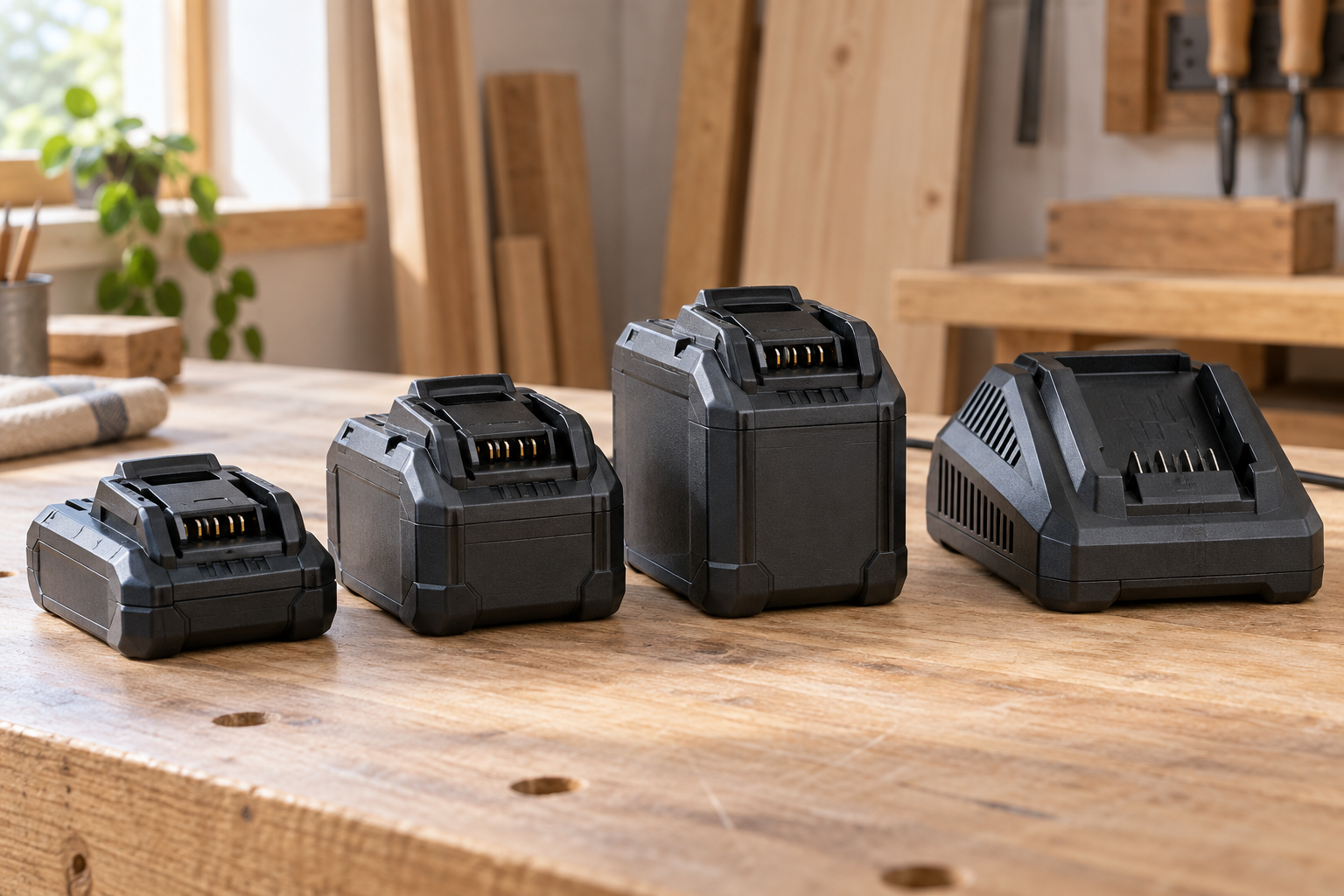
Battery voltage and amp-hour ratings describe different things. Voltage indicates the platform’s electrical class; amp-hours (Ah) describe capacity. Within a platform, a 5 Ah battery generally stores more energy than a 2 Ah battery, but it is also larger and heavier. The extra weight can be welcome on a saw and annoying on a drill used overhead.
Check the manufacturer’s guidance for each tool. High-draw tools such as saws, grinders, and outdoor equipment may perform better with larger or higher-output battery packs. A small pack can run the tool, yet drain quickly or limit performance under load. For a light or compact drill, that same small pack may be the comfortable, economical choice.
Runtime depends on workload, material, temperature, battery age, and how hard you press the tool. Treat advertised runtime as a comparison point, not a promise for your job. If you expect to cut several sheets of plywood or trim a large hedge in one session, budget for a second battery rather than assuming one pack will last the whole task.
Look for gaps and compatibility limits
Search the brand’s official catalog for each item on your shortlist, then check local availability for replacement batteries, chargers, blades, and accessories. A tool listed online but rarely stocked nearby can be inconvenient when you need a replacement quickly. Confirm battery compatibility by platform and generation; similar-looking packs from different voltage families or product lines may not fit.
Do not assume every tool uses the same battery size. Some ecosystems include compact platforms, higher-voltage equipment, or specialist packs that are not interchangeable with the everyday drill batteries. Adapters may exist, but they can add bulk, limit features, or be unsuitable for demanding loads. Treat an adapter as a narrow workaround, not proof that two platforms are equivalent.
Also check the tool’s controls and consumables. A multi-tool with a quick blade-change system can save time, but proprietary accessories may cost more or be harder to find. For saws, verify standard blade sizes and arbor compatibility. For automotive tools, check drive size and whether the tool offers enough control for delicate fasteners.
Calculate the cost of entering a platform
For each brand, price a realistic starter setup: two or three bare tools, one suitable battery per tool where needed, one spare battery for longer jobs, and a charger. Then compare that total with a bundle that includes the tools and batteries you need. A low bare-tool price is not a bargain if the compatible batteries are expensive or the kit batteries are too small for the main workload.
Battery ownership changes the calculation. If you already have several healthy packs and a charger in one ecosystem, a bare tool from that platform may be the cheapest sensible choice. If you are starting from zero, a bundle can reduce upfront cost. Avoid buying more batteries than your routine requires; for occasional household work, one or two packs and a basic charger may be enough.
Choose for the next few years, not every possible job
Give the most weight to tools you expect to buy soon, batteries that suit their workloads, and reliable access to replacements. A broad ecosystem matters if your needs are varied, but catalog size alone does not justify paying more. If two platforms cover your shortlist equally well, compare kit pricing, service access, battery weight, and how each tool feels in hand.
The cheaper option is fine when it covers the jobs you have, its batteries are available, and you do not need specialist tools outside its range. You can also keep a corded saw, grinder, or shop tool for occasional heavy use and build a smaller cordless setup around the jobs where portability saves real time. The goal is not to own one brand’s entire catalog; it is to buy a battery system that supports the work you actually do.
Related guides
- Longest Lasting Lawn Mower Battery: AGM vs Lithium vs Flooded Lifespan and Cost per Season
- Duralast Gold Lawn Mower Battery Review: U1 Fit, CCA and When to Pay for AGM
- Greenworks Pro 80V 21-Inch Mower Review: Runtime Math, Push vs Self-Propelled and Yard Fit
- Bosch High Pressure Washer Gun Replacement: Fittings, Adapters and What Fits Your Model