
Key takeaways
- Compare the best manual tile cutters for porcelain and ceramic work, from a compact 17 inch pro cutter to a 40 inch large format model, with specs.
What's inside
As an Amazon Associate I earn from qualifying purchases. This post may contain affiliate links at no extra cost to you.
A manual tile cutter does two jobs with one tool: a small carbide wheel scores the glazed face of the tile, and a breaker foot then snaps the tile cleanly along that scored line. There is no water tray, no slurry and no silica dust cloud, which is why score-and-snap cutters remain the fastest way to make straight cuts on ceramic and porcelain during a floor or bathroom install. The five picks below span 17 to 40 inches of cutting length, so they cover everything from a small backsplash to large-format floor panels.
Each pick is a current Amazon listing from a maker with a record in the tile trades, and each one is described from its published specifications only. Cutting length, diagonal capacity, thickness range, wheel size and breaking power come straight from the maker’s published data, and any figure the maker does not publish is marked as not stated rather than filled in from a sibling model.
As an Amazon Associate, we earn from qualifying purchases.
Quick answer
The QEP 10630 is the main pick for most floors and bathrooms: 24 inches of rip capacity, a ball-bearing slide and a titanium-coated carbide wheel. The VEVOR 32 inch cutter is the budget route into large-format tile, the Sigma 2G is the premium compact pick, and the two RUBI cutters cover small pro work and 40 inch panels.
The picks
QEP 10630 24-Inch Manual Tile Cutter

This is the mid-range workhorse of the lineup and the size most home tile jobs actually need. The 24 inch rip capacity handles 12 x 24 inch planks lengthwise, and the published diagonal capacity covers square tile laid on point. The scoring head runs on a ball-bearing slide over chrome-plated steel rails, which keeps the score line even from edge to edge, and the 7/8 inch titanium-coated tungsten carbide wheel is replaceable when it dulls. Fold-out side arm extensions support tile that overhangs the aluminum base, and the adjustable straight-edge guide locks in repeat cuts for a full row of identical pieces.
Specs
- Rip cut capacity: 24 in
- Diagonal cut capacity: 17.5 in
- Maximum tile thickness: 1/2 in
- Scoring wheel: 7/8 in titanium-coated tungsten carbide, ball bearing
- Rails: Chrome-plated steel
- Base: Aluminum with side arm extensions
- Weight: 18.3 lb
- Dimensions: 33 x 8 x 6 in
Sigma 2G 37 cm Tile Cutter
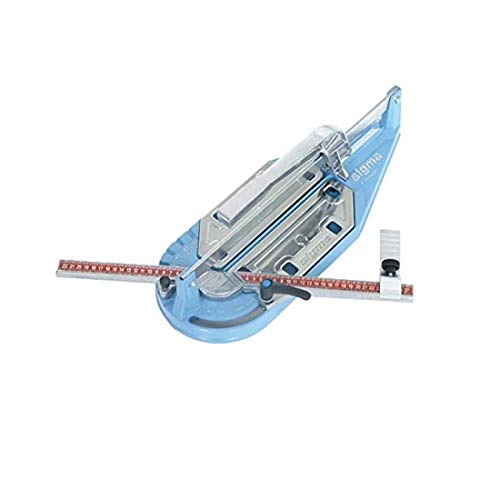
The Sigma 2G is the premium compact pick, built in Italy around a pull-style scoring action: instead of pushing the handle away, you draw the wheel toward you, which many setters find easier to keep at a steady pressure. Capacity is modest at 37 cm of straight cut, so this is a cutter for backsplashes, bathrooms and smaller floor tile rather than large panels. The swiveling measurement bar turns to 45 degrees with a rapid positioning button for diagonal work, the scale is metric only, and the published breaking strength of 600 kg is high for a tool this light. At roughly six and a half pounds it is the pick that travels between jobs without a second thought.
Specs
- Straight cut capacity: 37 cm (14.5 in)
- Diagonal cut capacity: 25 cm (about 10 in)
- Maximum tile thickness: 15 mm
- Breaking strength: 600 kg
- Scoring action: Pull
- Scoring wheel: Tungsten carbide
- Fence: Swiveling measurement bar, 0 to 45 degrees, metric scale
- Weight: 6.5 lb
VEVOR Manual Tile Cutter, 32 Inch

The VEVOR is the budget route into large-format work. Its single rail carries the scoring head over 800 mm of cutting length, enough for 24 x 24 inch floor tile and the long edge of most plank formats, and the infrared laser guide projects the cut line onto the tile before you score. The tungsten carbide wheel is 22 mm across, a spare wheel rides in the box, and the published thickness range of 4 to 15 mm covers standard ceramic and porcelain floor tile. The trade-offs for the tier are the single-rail layout, which asks for a steady hand on the longest cuts, and a published spec sheet that leaves diagonal capacity unstated.
Specs
- Maximum cutting length: 800 mm (32 in class)
- Minimum cutting width: 25 mm (1 in)
- Cutting thickness: 4 to 15 mm
- Diagonal cut capacity: Not stated
- Scoring wheel: Tungsten carbide, 22 mm, spare wheel included
- Guide: Infrared laser positioning
- Rail layout: Single rail
- Weight: 14.1 lb
- Dimensions: 40.9 x 15.7 x 8.1 in
RUBI TS-43 MAX Tile Cutter

The TS-43 MAX is the compact pro pick: only 43 cm of cutting length, but a single-point breaker rated at 800 kg of pressure, the highest breaking figure in this roundup relative to size. The maker’s adaptive breaking system applies progressive pressure matched to the tile, which helps on hard porcelain that defeats lighter cutters. Two scoring wheels ride in the case, a 6 mm and a 10 mm, so the same tool covers thin wall tile and thicker floor tile by swapping the wheel. Chromed steel guides, a reinforced base and a swiveling square for angle cuts round out a tool aimed at setters who cut tile every week and want a small frame that does not give up breaking power.
Specs
- Cutting length: 43 cm (17 in)
- Diagonal cut capacity: 30 x 30 cm (12 in)
- Cutting thickness: 6 to 15 mm
- Breaking power: 800 kg (1,764 lb)
- Breaker: Single point, adaptive pressure
- Scoring wheels: 6 mm and 10 mm included
- Guides: Chromed steel
- Carrying case: Included
- Weight: 19.4 lb with case
RUBI TX-1020 MAX Tile Cutter

The TX-1020 MAX is the premium large-format pick, with 102 cm of cutting length for the long porcelain panels that have taken over floor work. Its multipoint breaker delivers up to 1,200 kg of breaking power and can apply that force anywhere along the tile, and a trigger system locks and releases the breaker pad so thick and thin material can be handled on the same setup. Two scoring wheels are included, an 8 mm and a 22 mm, and the galvanized steel floating tables plus two supplementary arms keep wide tile supported and level while you score. It ships in a hard case, and at 52 pounds it is a shop or two-person carry rather than a one-hand tool.
Specs
- Cutting length: 102 cm (40 in)
- Diagonal cut capacity: 70 x 70 cm
- Maximum tile thickness: 21 mm
- Breaking power: 1,200 kg (2,645 lb)
- Breaker: Multipoint, trigger lock and release
- Scoring wheels: 8 mm and 22 mm included
- Base: Aluminum with galvanized steel floating tables
- Support: Two supplementary arms
- Carrying case: Included
- Weight: 52 lb
How to choose
Begin with cutting length, because it is the one figure you cannot work around. Measure the longest tile you plan to lay and add margin: a 24 inch cutter handles 12 x 24 inch planks lengthwise, while 24 x 48 inch panels need a 40 inch class tool or a wet saw. Check diagonal capacity separately if you lay tile on point, since a square tile turned 45 degrees needs more rail than its side length suggests.
Next, match thickness and breaking power to the material. Standard ceramic wall tile snaps easily on almost any cutter. Dense porcelain floor tile, especially in thicker formats, needs a higher breaking figure and a rigid frame; the published breaking power in kilograms or pounds is the number to compare. Wheel size matters too: small wheels suit thin, smooth tile, while larger wheels track better on thick or textured surfaces, and a replaceable wheel keeps the tool useful after the first edge dulls.
Finally, look at the support and guidance around the cut. Ball-bearing slides and twin rails score more evenly than a basic single rail, side arms or floating tables keep large tile from tipping mid-score, and a swiveling fence speeds up diagonal and repeat work. A laser guide helps line up a cut but does not improve the score itself, so treat it as a convenience rather than a substitute for rail quality.
Who should skip
Skip a manual cutter entirely if your project is built on cuts it cannot make. Score-and-snap tools cut straight lines only, so L-shaped notches, curves around pipes and cutouts for outlets still need a wet saw, an angle grinder with a diamond blade, or nippers for small bites. Very thick natural stone, heavily textured porcelain and narrow rip cuts under an inch wide also break unreliably on a snap cutter. And if you are tiling one small bathroom with soft ceramic, a mid-range or premium frame is more tool than the job calls for; the budget tier will do the same work.
FAQ
Can a manual tile cutter cut porcelain tile?
Yes, within its published limits. Porcelain is denser than ceramic, so match the cutter’s thickness range and breaking power to the tile: the pro picks in this roundup publish breaking figures of 800 kg and 1,200 kg for that reason. Score once with firm, even pressure and snap promptly; repeated scoring passes weaken the line instead of deepening it.
What is the difference between rip capacity and diagonal capacity?
Rip capacity is the longest straight cut along the rail. Diagonal capacity is the largest square tile the cutter can handle turned at 45 degrees, and it is always the smaller figure, because the corner-to-corner span of a square tile is longer than its side. If your layout runs on point, shop by the diagonal number.
How long does a scoring wheel last?
A tungsten carbide wheel typically scores hundreds of tiles before it dulls, and titanium-coated wheels are published as lasting longer still. There is no fixed count, since hard porcelain wears a wheel faster than soft ceramic. When scores begin to wander or the snap edge turns ragged, fit a fresh wheel; every pick here uses a replaceable wheel.
Can a manual tile cutter cut glass tile and mosaic sheets?
Most of these cutters are published for ceramic and porcelain, and some makers also rate their wheels for glass. Mosaic sheets on mesh backing score unevenly because the individual pieces shift, so single glass tiles and small formats are the safer use. Check the maker’s material list for the model you choose before relying on it for glass.
Final verdict
For most home floors and bathrooms, the QEP 10630 is the buy: honest 24 inch capacity, a smooth ball-bearing slide and a wheel that swaps out when it dulls. Choose the VEVOR when budget leads and the tile is large, the Sigma 2G when a light premium tool for smaller tile appeals, and step up to the RUBI pair when breaking power is the priority, in the compact TS-43 MAX or the 40 inch TX-1020 MAX for full large-format work.
Product and ASIN Reference
| Product | ASIN |
|---|---|
| QEP 10630 24-Inch Manual Tile Cutter | B08ZK2PKS9 |
| Sigma 2G 37 cm Tile Cutter | B00BBBBCM2 |
| VEVOR Manual Tile Cutter, 32 Inch | B0C9MD5C77 |
| RUBI TS-43 MAX Tile Cutter | B06W9LS13K |
| RUBI TX-1020 MAX Tile Cutter | B000NBCE78 |
Related guides
More from Amazon
Programs that pair well with the guide above. Offers and eligibility are set by Amazon and may change.
A free business account with business pricing and bulk-buying tools for work, shop or home office.
Create a business accountFree shipping on eligible items, Prime Video and more. Eligible new members can start with a free trial.
Start a Prime free trialAudiobooks and podcasts to listen to on the go. Eligible new members can start with a free trial.
Try Audible freeAd-free music streaming. Eligible new subscribers can start with a free trial.
Try Music Unlimited freeAs an Amazon Associate we earn from qualifying purchases.
Write Your Review
No reviews yet. Be the first to share your experience!