
What's inside
As an Amazon Associate I earn from qualifying purchases. This post may contain affiliate links at no extra cost to you.
On Milwaukee’s M12 platform, battery choice changes more than runtime. It changes how the tool sits in your hand, how easily it fits into a cabinet or ceiling space, and how much work your wrist does over a long job. The compact M12 REDLITHIUM CP batteries are usually the better match for drills, drivers, ratchets, and inspection tools. M12 XC batteries deliver longer runtime and better sustained output, but their extra size can make a small tool feel top-heavy.
The right choice depends less on maximum amp-hours than on the tool and the job. A compact battery is often the faster option when you are repeatedly repositioning the tool. An XC pack is worthwhile when stopping to recharge would cost more time than the added weight.
As an Amazon Associate we earn from qualifying purchases at no extra cost to you.
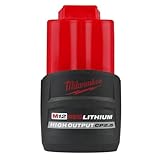


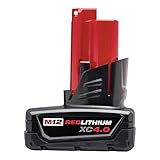
What CP and XC Mean
CP means “compact” and generally refers to the smaller M12 battery housings. Common CP capacities include 1.5Ah, 2.0Ah, and 3.0Ah. XC means “extended capacity,” with larger packs commonly available in 4.0Ah and 6.0Ah versions. Capacity is measured in amp-hours, so a 4.0Ah battery can theoretically supply twice the charge of a 2.0Ah battery under comparable conditions.
Actual runtime is not perfectly proportional. Tool load, temperature, battery age, and the tool’s electronics all matter. A high-draw impact driver may drain a small pack quickly, while an LED light can run for many hours on the same battery. The larger pack may also maintain performance better near the end of its charge, especially in cold weather or during repeated heavy cuts.
Balance and Handling in Compact Tools
Balance is the main reason to choose CP. The small pack keeps the center of gravity close to the handle, particularly on M12 drills and installation drivers. That reduces the tendency of the tool to rotate in your hand when driving screws overhead or working at an awkward angle.
An XC battery adds a noticeable lump below the grip. On a compact ratchet, that can make the tool harder to position between fasteners. On an inspection camera or powered screwdriver, it can make the tool feel unnecessarily bulky. The extra length can also interfere with a work surface or prevent the tool from standing upright.
That same extra mass can be useful. A larger battery gives some tools a steadier base and can reduce the sharp kick felt during high-torque impacts. The effect is not the same as adding power, but the tool may feel less twitchy in a two-handed operation. For overhead use, however, the weight penalty usually becomes more obvious after several minutes.
| Battery type | Typical capacity | Balance and size | Best use |
|---|---|---|---|
| M12 CP | 1.5Ah–3.0Ah | Shortest and lightest; keeps tools compact | Installation work, light drilling, ratchets, drivers, overhead tasks |
| M12 XC | 4.0Ah–6.0Ah | Larger and heavier; may feel bottom-heavy | Repeated drilling, cutting, high-use tools, longer work between charges |
Runtime, Output, and Charging
A 2.0Ah CP battery is a practical general-purpose pack for light fastening and service work. A 3.0Ah CP pack adds runtime without becoming as cumbersome as most XC options. If you are drilling dozens of holes, using a rotary tool continuously, or running a compact vacuum, the larger pack can prevent frequent battery changes.
Capacity does not turn an M12 tool into an M18 tool. The tool’s motor and electronics set the basic performance ceiling. An XC pack may help a tool hold its output longer, but it will not make a low-torque drill suitable for jobs outside its design. Check the tool’s manual before assuming that a larger battery is required or that it will increase speed.
Charging time also affects the decision. With two batteries and a standard M12 charger, a CP pack is easier to cycle through a workday. A 6.0Ah XC battery takes substantially longer to recharge than a small pack, so buying one large battery instead of two smaller ones can create downtime. For frequent use, compare the price of a M12 battery and charger kit with the cost of adding a second battery.
Which Battery Fits Which Tool?
For an M12 drill or installation driver, CP is usually the better-balanced choice. A 2.0Ah or 3.0Ah pack is enough for many cabinet, electrical, and maintenance tasks. Choose XC when you are drilling through thick material repeatedly and can tolerate the added weight.
M12 ratchets strongly favor CP batteries. The smaller pack leaves more clearance around fasteners and makes it easier to hold the tool one-handed. An XC battery can be useful for a long service shift, but its extra length may hit nearby parts before the ratchet head reaches the fastener.
For M12 impact drivers, either format can work. CP is more comfortable for screws, small lag bolts, and overhead fastening. XC makes more sense for repeated structural fastening, where stopping to swap batteries is disruptive. If the tool is used in short bursts, the cheaper CP option is often entirely adequate.
Compact saws, grinders, and heated gear tend to benefit more from XC capacity. These applications draw current for longer periods, and a 4.0Ah or 6.0Ah pack can reduce interruptions. Still, the additional weight may be tiring on a small saw. If you already own several CP batteries, using two or three charged packs may be more comfortable than carrying one heavy XC battery.
Common Buying Mistakes
The most common mistake is choosing the largest battery for every tool. That wastes money and makes compact tools less compact. Another is buying one high-capacity pack for a full workday and discovering that it takes too long to recharge. A second smaller battery often provides better workflow.
Cold weather is another failure point. Lithium-ion batteries deliver less apparent power when cold, and a nearly empty small pack may shut down under load sooner than expected. Keep spare batteries warm, avoid leaving them in a freezing vehicle, and do not charge a battery that is still very cold. Heat from heavy use also reduces battery life, so let packs cool before charging.
For occasional household repairs, a compact M12 CP battery is usually the sensible buy. It is lighter, often cheaper, and sufficient for short jobs. Professional users who run a saw, grinder, or vacuum repeatedly should look at M12 XC batteries, but should budget for a second pack or a faster charging setup.
A Practical Buying Decision
Choose CP when balance, clearance, and low hand fatigue matter most. Start with 2.0Ah or 3.0Ah packs for drills, drivers, ratchets, and inspection tools. Choose XC when the tool runs continuously, battery swaps interrupt the job, or the tool’s larger base is not a problem.
For a mixed M12 collection, two CP batteries plus one XC battery is a useful compromise. Use CP packs on hand tools and keep the XC pack for high-drain tools or long sessions. That arrangement costs less than replacing every battery with the biggest option and preserves the compact handling that makes the M12 platform useful.
FAQ
Which Battery Fits Which Tool?
Related guides
- Longest Lasting Lawn Mower Battery: AGM vs Lithium vs Flooded Lifespan and Cost per Season
- Duralast Gold Lawn Mower Battery Review: U1 Fit, CCA and When to Pay for AGM
- Greenworks Pro 80V 21-Inch Mower Review: Runtime Math, Push vs Self-Propelled and Yard Fit
- Bosch High Pressure Washer Gun Replacement: Fittings, Adapters and What Fits Your Model