What's inside
As an Amazon Associate I earn from qualifying purchases. This post may contain affiliate links at no extra cost to you.
Hands-free repair work is easier when the light stays aimed at the fastener, connector, or work surface instead of moving with your head. A cordless work light also avoids extension cords in engine bays, crawlspaces, and unfinished rooms. The right choice depends less on maximum brightness than on beam shape, mounting, battery compatibility, and how long you need it to run.
Start With the Job, Not the Light
For automotive repairs, a focused beam is useful for seeing into a bracket, behind an engine, or under a dashboard. For electrical work and general assembly, a wider beam usually works better because it reduces harsh shadows. A folding light with several light heads can illuminate both sides of a work area, but it is less compact than a single-head inspection light.
Consider where the light will sit. A magnetic base works well on steel toolboxes, vehicle body panels, and equipment frames. It is nearly useless on aluminum, plastic, wood, or drywall. A hook is better for hanging from a hood or ceiling joist, while a tripod or clamp is more stable when vibration could knock the light down.
For a small, close-up work area, a compact cordless magnetic LED work light is often enough. If you regularly work under vehicles or in larger rooms, look for a folding floodlight or area light instead.
Understand Brightness and Beam Pattern
Manufacturers rate lights in lumens, but the number alone does not tell you how useful the light will be. A 300-lumen focused beam may show a recessed screw more clearly than a 1,000-lumen floodlight aimed at the same area. High output also creates more heat and drains the battery faster.
For close repair work, 200 to 500 lumens is generally sufficient. A 500- to 1,000-lumen light gives more flexibility for engine bays, framing, and electrical rooms. Area lights rated above 1,000 lumens are useful when illuminating a whole room, but they are often excessive for a single fastener and can produce glare.
Multiple brightness settings matter more than a single peak rating. A low setting can extend runtime and prevent reflected glare from painted metal. Check whether the light has a broad flood mode, a narrow spot mode, or separate light heads. A light with a bright center and a very dark edge can make it harder to see surrounding components.
Use the Battery Platform You Already Own
For most buyers, the best cordless work light uses the same battery platform as their drill, impact driver, or saw. You already have batteries and a charger, and you avoid maintaining another battery type. Platform lights are also easy to swap between a compact 2.0Ah pack and a larger 5.0Ah pack depending on the job.
A battery’s watt-hours provide a useful runtime estimate. Multiply volts by amp-hours: an 18-volt, 5.0Ah battery stores about 90 watt-hours. A light drawing roughly 10 watts could theoretically run for nine hours, but electronics losses, brightness control, battery protection, and temperature reduce the real figure. Expect perhaps six to eight hours at a moderate setting, not nine hours at full output.
Compact batteries keep the light balanced and are less tiring when the tool is mounted overhead. Larger packs can run for much longer but may make a magnetic light more likely to slide or tip. If you do not already own compatible packs, compare the cost of the light, battery, and charger rather than comparing light prices alone. A cordless work light kit with a battery and charger can be sensible for a first purchase, but it is rarely the cheapest route if you already have a platform.
| Light type | Best use | Main advantage | Common drawback |
|---|---|---|---|
| Compact inspection light | Engine bays, cabinets, close repairs | Small and easy to position | Limited area coverage |
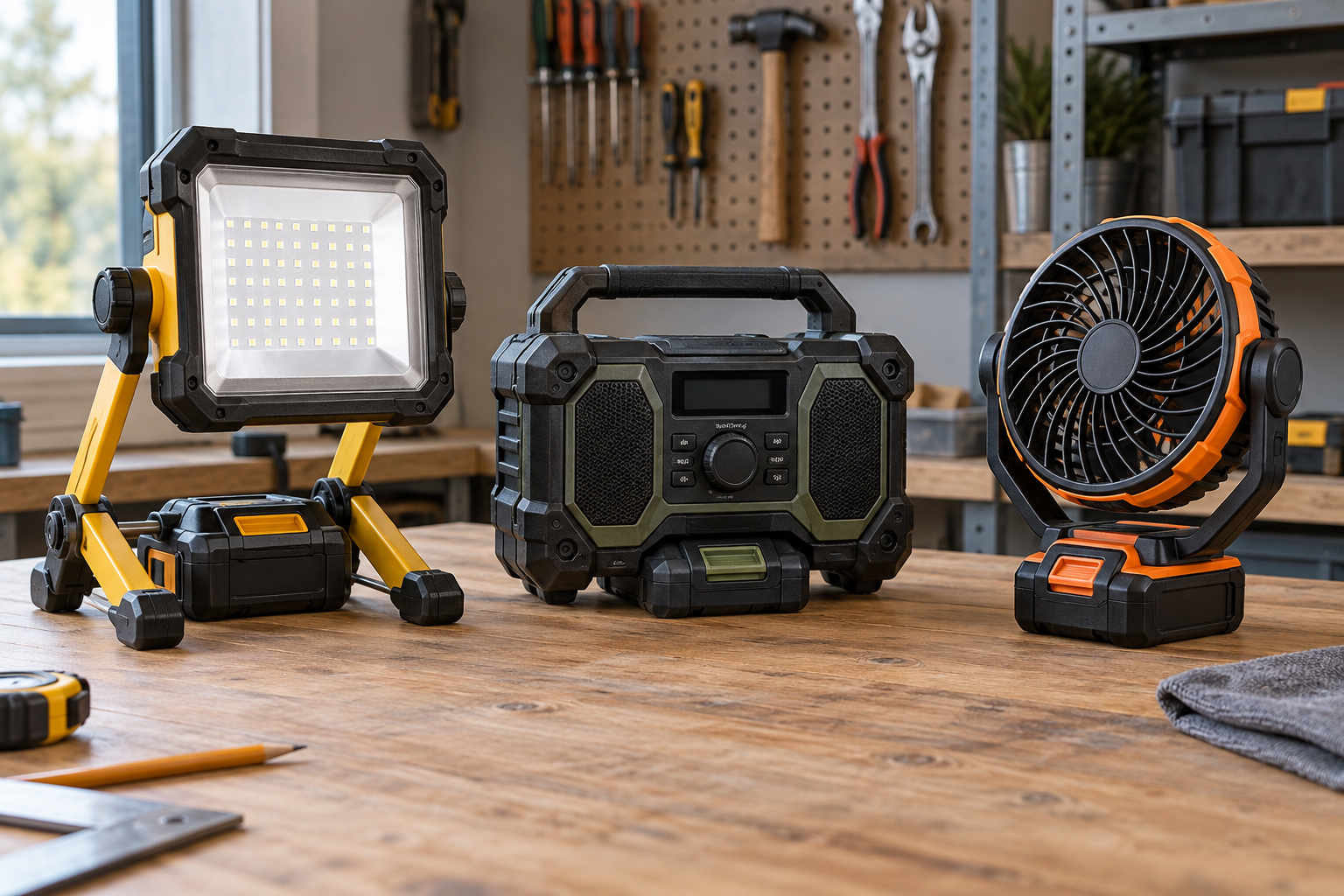
| Folding panel light | Garages, rooms, larger assemblies | Wide, adjustable illumination | Bulkier and easier to knock over |
| Spotlight | Long-distance viewing and outdoor work | Throws light far down a space | Too narrow for close-up work |
| Neck or head-mounted light | Walking inspections and very tight spaces | Truly hands-free | Beam moves whenever you move your head |
Check Mounting and Adjustment Features
A strong magnet is valuable, but its holding force depends on the surface, paint thickness, angle, and battery weight. Test the light before trusting it above a finished vehicle. Magnets can also pick up metal chips, which may scratch paint or interfere with small electrical components.
Look for a head that rotates or folds through at least 90 degrees. A rotating head lets you place the battery on a stable surface while aiming the beam into the work area. A swiveling base, belt hook, hanging hook, and tripod thread add flexibility. These features are more useful than a small increase in maximum lumens.
For overhead work, the light should have a positive hinge that does not slowly droop under its own weight. Cheap hinges often loosen after repeated adjustment. If the light will be attached to a vehicle, use a secondary hook or strap when dropping it could damage parts or injure someone.
Pay Attention to Durability and Safety
For garage and outdoor work, an IP rating helps describe water and dust resistance. IP54 indicates protection from limited dust ingress and water splashes; it is suitable for normal garage exposure but not for rain soaking or washing. Do not assume an IP-rated light can be submerged unless the manufacturer specifically says so.
A sealed lens and rubber overmold help with drops, but they do not make the light indestructible. Check the operating temperature if you work in freezing conditions. Lithium-ion batteries lose runtime in the cold and should be warmed before charging. Never charge a visibly damaged, swollen, or overheated battery.
LED work lights produce less heat than halogen lights, but the housing can still become hot at full output. Keep vents clear and do not cover the light with rags or place it against insulation. A model with a battery fuel gauge is useful because sudden shutdown is a common failure mode when a pack reaches its protection limit.
When the Cheaper Option Is Fine
A basic 300- to 500-lumen light is a reasonable buy for occasional furniture assembly, roadside emergencies, or short repairs. If you already have a compatible battery, spending extra on premium impact resistance may not be necessary. The inexpensive option becomes a poor choice when it has no low mode, a weak magnet, a non-replaceable battery, or a hinge that cannot hold position.
For frequent professional use, prioritize the battery platform, mechanical adjustment, stable mounting, and useful runtime over headline brightness. A dependable 500-lumen light that stays aimed for six hours is more valuable than a 1,500-lumen light that blinds you, overheats, and needs charging halfway through the job. If you need a wider, more stable source for a garage or renovation area, compare cordless folding LED area lights within your existing tool battery system.
Related guides
- Longest Lasting Lawn Mower Battery: AGM vs Lithium vs Flooded Lifespan and Cost per Season
- Duralast Gold Lawn Mower Battery Review: U1 Fit, CCA and When to Pay for AGM
- Greenworks Pro 80V 21-Inch Mower Review: Runtime Math, Push vs Self-Propelled and Yard Fit
- Bosch High Pressure Washer Gun Replacement: Fittings, Adapters and What Fits Your Model