What's inside
As an Amazon Associate I earn from qualifying purchases. This post may contain affiliate links at no extra cost to you.
Why panels and cabinets need a different light
Working inside an electrical panel, HVAC air handler, or kitchen cabinet is not about raw lumens. You are 12 to 18 inches from the work, surrounded by reflective metal, white melamine, or dark stained wood. A big 1,000-lumen flood on a tripod will wash out wire markings, create hard shadows from your own hands, and blind you when it reflects off a breaker cover. What you need is controlled, close-range light with accurate color and hands-free mounting.
Inspection lights are built for that. Compared to a flashlight, they put out a wide, even flood beam (typically 90 to 120 degrees), have a high color rendering index so you can tell a blue wire from a black one covered in dust, and they mount where you need them: magnet to a panel box, hook over a cabinet face frame, or clip to your shirt pocket. If you already live on a cordless tool platform, sticking with that battery system is the most practical way to power it.
As an Amazon Associate we earn from qualifying purchases at no extra cost to you.


What matters most inside a tight space
Beam and color quality beat peak lumens. For close work inside a panel or cabinet, 150 to 350 lumens on a flood beam is plenty. Anything over 500 lumens at arm’s length will cause glare and actually make it harder to read labels. Look for a stated CRI of 90+ and a color temperature around 4000K to 5000K. 4000K is easier on the eyes for long work and shows wood tones correctly; 5000K matches daylight and makes wire colors pop. Avoid cool 6500K+ lights that skew blues and make red/brown hard to distinguish.
Mounting is the feature you will use every day. A flat base with two strong magnets and a fold-out hook covers 90% of panel and cabinet work. Test the magnets: cheap lights claim a magnet but will slide down painted 26-gauge panel steel. Good ones use rare-earth magnets that hold the light horizontal off the side of a load center, even with a 12V or 18V battery attached. A 360-degree rotating head or a light bar that pivots 180 degrees lets you angle the flood away from your eyes while keeping the wire landing lit.
Runtime and heat. Inspection lights are often run for an hour straight while you terminate or troubleshoot. A light that draws 3-5W will run 8 to 12 hours on a compact 2.0Ah 12V or 18V pack. Lights that push 700+ lumens for marketing reasons get hot after 15 minutes, dim themselves thermally, and drain a battery in under 3 hours. If the head is too hot to hold after 10 minutes, it is too hot for an enclosed cabinet.
Durability failures to expect. The hinge is the first thing to fail on stick lights, followed by the rubber flap over the USB charging port on pocket lights. Lenses also scratch when tossed in a tool bag with strippers and drivers. Look for an IP54 rating minimum and a recessed lens. On lights with a hook, make sure the hook locks positively; a loose hook that folds under the light’s own weight is useless on a cabinet rail.
The three form factors that actually work
Most good options fall into three shapes. Each has a clear trade-off inside panels and cabinets.
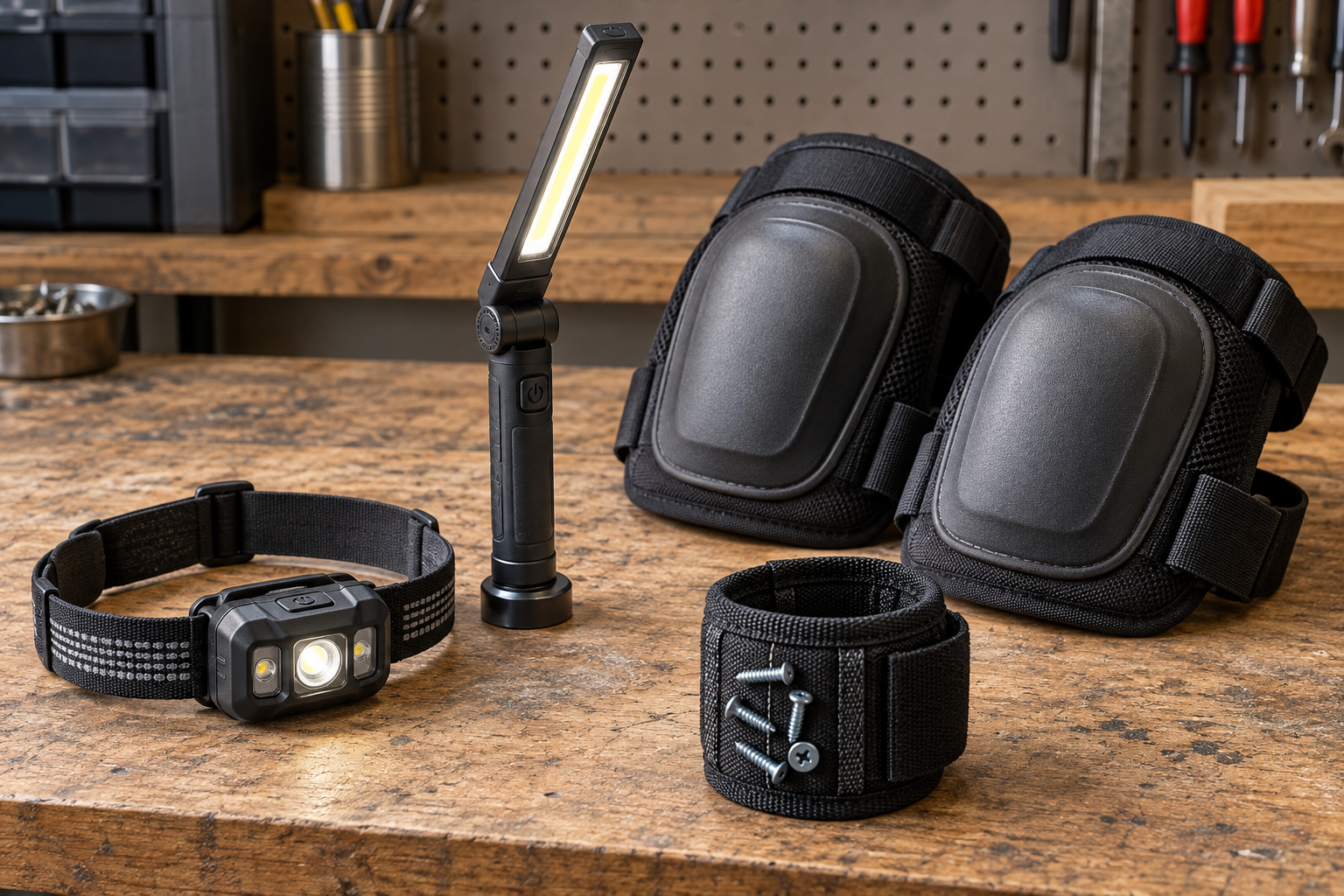
1. Stick / bar lights (10 to 14 inches long): The standard for panels. The long COB LED bar throws an even wall of light with minimal shadow. You can magnet it vertically inside a 20-inch load center and light the entire bus. Downside is size; it does not fit well in a 12-inch wall cabinet or a furnace compartment.
2. Pocket flood lights / mini panels: About the size of a phone or smaller. Typically 300 to 550 lumens with a strong clip and magnet. The best all-around compromise for service work. You can clip it to a panel door, stick it to a junction box, or hold it like a phone to look down a stud bay. Limited throw, but you rarely need throw at 12 inches.
3. Neck / head lights and right-angle lights: Useful when both hands are inside a cabinet and there is nowhere to mount. A right-angle light clipped to your chest keeps the beam where your hands are. Headlamps work but reflect badly off white cabinet interiors and get snagged on door hinges.
| Form Factor | Typical Output | Best For | Weakness Inside Cabinets/Panels | Battery Approach |
|---|---|---|---|---|
| Stick / Bar Light | 300–700 lumens, 90+ CRI options | Full panel illumination, drywall/framing bays | Too long for small cabinets, top-heavy on small batteries | Uses 12V / 18V / 20V platform pack |
| Pocket Flood / Mini Panel | 150–550 lumens, 90+ CRI common | Service calls, under-sink, HVAC compartments | Small magnet can slip on dusty metal | Platform battery or built-in USB-C Li-ion |
| Right-Angle / Chest Light | 100–350 lumens | Hands-free close work with no mounting surface | Narrower beam leaves shadows | Often AA or built-in cell, some 12V versions |
Staying on your battery platform vs. going USB-C
If you already own Milwaukee M12, DeWalt 12V/20V, Makita 12V/18V, or Ryobi ONE+, buying the inspection light on that platform is the logical move. You get shared chargers, you can swap a 2.0Ah pack from your drill in a pinch, and runtime is excellent. The trade-off is weight and bulk. An 12V stick inspection light on your battery platform with a 2.0Ah pack weighs 12 to 16 ounces. That is fine on a panel but heavy on your shirt pocket all day.
That is why many electricians and cabinet installers also carry a small USB-C rechargeable pocket flood as a second light. A 3.7V 1000–2000mAh internal cell weighs under 4 ounces, charges from the same USB-C charger as your phone, and gives you 4 to 6 hours at 200 lumens. The failure mode is different: you cannot swap the cell mid-job, and after 2–3 years the internal battery loses capacity. If you go this route, pick one with a proper USB-C port, not micro-USB, and a battery indicator with at least 3 steps. Single-LED indicators that go from green to red with no warning leave you in the dark.
A practical compromise is to own one platform-powered light for the shop and panels, and one USB-C rechargeable pocket COB work light for everyday carry. You will use the small one 80% of the time without thinking about batteries.
Do not buy a light that requires its own proprietary charger cradle if you can avoid it. It is one more thing to lose and it ties you to an outlet. USB-C or your existing tool charger are the only two systems worth adding.
What to buy based on how you work
If you live in panels 3+ days a week: Get a 12V stick light from your existing platform. 12V is lighter and shorter than 18V/20V versions but still gives you 6 to 10 hours of useful light. Look for at least two output levels (low around 150 lumens, high around 350–500) and a CRI spec printed on the box. A model that can stand on its base and pivot the bar 90 degrees is more useful than one with three extra strobe modes you will never use.
If you do trim, kitchens, and service: A pocket flood with a strong clip and magnet is more versatile than a stick. You can clip it to a cabinet face frame to light a hinge install, magnet it under a sink to see a trap, and still stick it in a panel for a quick look. Many good ones now offer 90+ CRI and a stepless dimmer instead of just high/low, which is ideal for controlling glare in white cabinets.
If you want the cheapest thing that works: A $25 to $40 USB-C COB pocket light with a 90+ CRI rating will handle panel and cabinet work just fine. You do not need to spend $80+ unless you want the convenience of your tool batteries or a noticeably stronger magnet and hinge. Cheap lights fail at the hinge and the magnet; if you buy cheap, buy two and keep one in the truck as a backup.
For brand choice, match what is already in your bag. The performance difference between platform lights is small once you stay above the budget tier. Magnet strength and hinge stiffness matter more than an extra 100 lumens. If you have no platform loyalty yet, cordless COB inspection lights with magnet and hook in both 12V and 18V sizes are worth comparing side by side to see which weight you prefer to carry.
Using it without making the job harder
Inside a panel, mount the light to the door or the side wall, not directly behind the wires you are working on, or your hands will cast a shadow exactly where you need to see. Angle it so the beam grazes the panel at 30 to 45 degrees; that highlights wire labels and screw heads through texture. In a white cabinet, bounce the light off the cabinet ceiling or side wall on low mode instead of aiming it straight at your work. You get softer, more even light with less glare.
Keep a lens wipe in your pouch. Dust from Romex sheathing and drywall settles on COB lenses and cuts output by 20% without you noticing until you step into daylight. And if you use an 18V/20V light, pull the battery when you are done. A single LED left on low will drain a 2.0Ah pack overnight, and that is the pack you need for your drill in the morning.
Related guides
- Longest Lasting Lawn Mower Battery: AGM vs Lithium vs Flooded Lifespan and Cost per Season
- Duralast Gold Lawn Mower Battery Review: U1 Fit, CCA and When to Pay for AGM
- Greenworks Pro 80V 21-Inch Mower Review: Runtime Math, Push vs Self-Propelled and Yard Fit
- Bosch High Pressure Washer Gun Replacement: Fittings, Adapters and What Fits Your Model