What's inside
As an Amazon Associate I earn from qualifying purchases. This post may contain affiliate links at no extra cost to you.
Match the platform first
A charger must match the battery’s brand and voltage platform. A 20V-class battery is not interchangeable with an 18V-class pack just because the numbers are close, and batteries from different brands generally will not fit each other’s tools or chargers. Some brands also have separate battery families within the same voltage range. Check the pack’s exact platform name and the charger’s compatibility list before buying.
Do not rely on a plug adapter to make an incompatible battery work. It may bypass temperature sensing or other protection, and it does not turn the charger into a compatible one. Use an adapter only when the tool and battery maker explicitly supports that combination; never use one to charge a pack on a charger not approved for it.
Read the charger ratings
The useful figure is charging current, usually stated in amps. A higher-current charger can reduce waiting, but only if the battery supports that rate. The charger and battery manage charging together, and the actual time varies with pack capacity, temperature, and how much charge is left. As a rough estimate, divide battery capacity in amp-hours by charger current in amps, then add time for the final part of the charge. A 5 Ah pack on a 2 A charger might take around 2.5 hours or longer; on a 6 A charger, the simple estimate is about 50 minutes, but the real result depends on the system.
Check the manufacturer’s stated charge time for your pack rather than treating that calculation as a guarantee. A charger’s maximum current may apply only to certain batteries, while a smaller pack may charge more slowly to manage heat. A rapid charger can save a crew from waiting through lunch, but it may cost more, take up more space, or be louder because of its cooling fan.
Choose for your work rhythm
For occasional home repairs, a standard charger is often the sensible buy. If a drill or impact driver gets used for a few short jobs each month, an extra battery may matter more than shaving an hour off charging time. For daily work, prioritize enough batteries to keep one in use while another charges, then consider a faster charger if charging is still the bottleneck.
These are planning ranges, not universal product specifications. Actual runtimes and charge times vary by tool, material, battery age, and temperature.
| Setup | Good fit | Main trade-off |
|---|---|---|
| One battery, standard charger | Occasional drilling, assembly, and household fixes | Work stops when the pack runs low |
| Two batteries, standard charger | Regular DIY work with breaks between tasks | Less downtime, but charging can still lag during heavy use |
| Two or more batteries, faster charger | Long work sessions or several cordless tools | Higher cost; fast charging cannot compensate for too few packs |
| Multiple-bay charger | Several packs to manage at a workshop or jobsite | Convenient, but check whether bays charge simultaneously or in sequence |
Balance battery size and tool
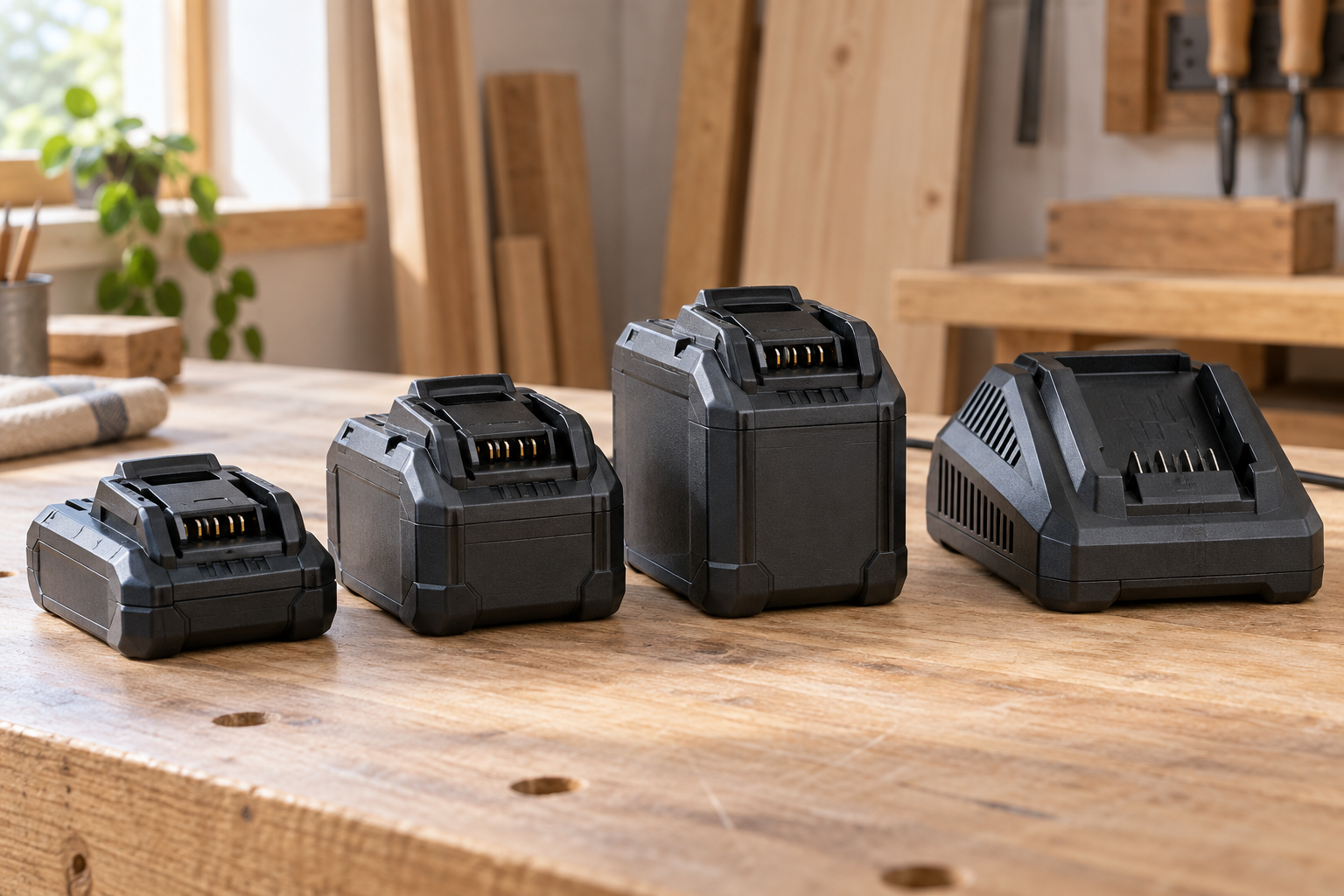
Large-capacity batteries can extend runtime, especially on saws, grinders, and other demanding tools. They also add weight and can make a compact drill tiring to use overhead. A small battery often makes more sense for light fastening or quick punch-list work. Rather than buying the largest pack for every tool, consider a mix of sizes that suits the job.
Battery capacity is not a direct promise of runtime. A 5 Ah pack does not necessarily last exactly twice as long as a 2.5 Ah pack under every condition: high current draw, cold weather, and an aging pack affect results. Some brands offer higher-output batteries for demanding tools. If you use a saw or rotary hammer heavily, check whether the tool maker recommends a particular battery type or capacity.
For a first battery or a practical second pack, compare compatible mid-capacity tool batteries with the price of a bare battery sold through the brand’s normal channels. A kit can be cheaper than buying components separately, but only if you need what is included.
Avoid charging problems
Heat is a common reason a pack will not charge immediately after hard use. Let a hot battery cool in a dry, shaded place, and check the charger’s status lights or manual before trying again. Charging in a very cold garage can also trigger a temperature lockout. Move the pack to a moderate indoor temperature and follow the maker’s instructions; do not warm it on a radiator or with a heat gun.
Inspect the battery and charger contacts for dust, damage, or corrosion. Keep the charger’s vents clear, and do not charge a pack that is cracked, swollen, wet, or unusually hot. If it repeatedly refuses to charge or the charger reports a fault, stop using it and contact the manufacturer. Do not open the pack or try to repair its cells.
For a second charger, look at rapid chargers for your exact battery platform, then verify the supported pack types and charge times on the manufacturer’s site. A marketplace listing that says “fits” is not enough if it omits the platform or compatibility details.
Set up a faster rotation
Put the charger where you can see its status lights and where its cooling vents have room. Label batteries with purchase dates or simple numbers; this helps identify a pack that is losing runtime while the others remain healthy. Rotate packs rather than repeatedly draining one to empty. Lithium-ion tool batteries do not need routine full discharge, and waiting until a tool stops can interrupt work without improving the pack.
Before a long job, charge the batteries you expect to need and keep a charged spare nearby. If a tool uses a lot of power, test your setup on the actual task: note how long a pack lasts, how long it takes to recharge, and whether the charger can keep pace. If charging falls behind, another compatible battery may be a better purchase than a more expensive charger. If packs sit unused most of the year, the cheaper standard charger is usually adequate.
Related guides
- Longest Lasting Lawn Mower Battery: AGM vs Lithium vs Flooded Lifespan and Cost per Season
- Duralast Gold Lawn Mower Battery Review: U1 Fit, CCA and When to Pay for AGM
- Greenworks Pro 80V 21-Inch Mower Review: Runtime Math, Push vs Self-Propelled and Yard Fit
- Bosch High Pressure Washer Gun Replacement: Fittings, Adapters and What Fits Your Model