What's inside
As an Amazon Associate I earn from qualifying purchases. This post may contain affiliate links at no extra cost to you.
Buying cordless tools one at a time often creates an expensive tangle of batteries, chargers, and incompatible tool bodies. A better approach is to choose a battery platform first, then build around the jobs you actually do. The battery system becomes the foundation; drills, saws, lights, sanders, and outdoor tools are additions to that foundation.
Start With Your Real Tool List
Write down the tools you expect to use in the next two years, not every tool a brand sells. Separate them into three groups: frequent-use tools, occasional tools, and high-demand tools. A drill/driver, impact driver, work light, and compact reciprocating saw might cover most household work. A circular saw, angle grinder, rotary hammer, or chainsaw can require substantially more battery capacity.
Also note whether you already own corded tools. A cordless circular saw is convenient for quick cuts, but a corded saw may still be the cheaper choice for repeated sheet-goods work in a workshop. Cordless platforms are most valuable where mobility, setup time, or lack of power outlets matters.
Choose a Platform and Voltage
Battery voltage is not a simple measure of tool quality. Most major systems use nominal 18V or 20V Max batteries that are electrically similar; the advertised number reflects different ways of measuring voltage. Higher-voltage systems, such as 36V or 40V lines, are more common in outdoor equipment and heavy-duty tools.
For general home repair, an 18V or 20V platform is usually the best starting point. It normally offers the widest selection of drills, drivers, saws, lights, sanders, vacuums, and specialty tools. Compact 12V systems are easier to carry and excellent for cabinets, fixtures, and light fastening, but they may not run full-size saws or demanding outdoor tools.
Do not assume that batteries from the same brand are interchangeable across every product. Some brands have separate 12V and 18V families, and outdoor equipment may use a different battery design. Check the exact platform name and battery interface before buying.
| Platform type | Best use | Main limitation |
|---|---|---|
| 12V compact | Cabinet work, small repairs, light drilling and driving | Less power and shorter runtime under heavy loads |
| 18V/20V general-purpose | Most home maintenance, remodeling, and workshop tools | Heavier than compact systems |
| 36V/40V outdoor or heavy-duty | Mowers, chainsaws, blowers, large grinders, demanding saws | Higher battery cost and less cross-tool flexibility |
Budget for Batteries and Chargers
The advertised price of a bare tool is misleading if you do not already own batteries. A kit containing two batteries and a charger can cost less than buying those items separately, especially during seasonal sales. For a general-purpose setup, a practical starting point is one compact battery for drills and lights, plus one 4Ah or 5Ah battery for saws and other high-drain tools.
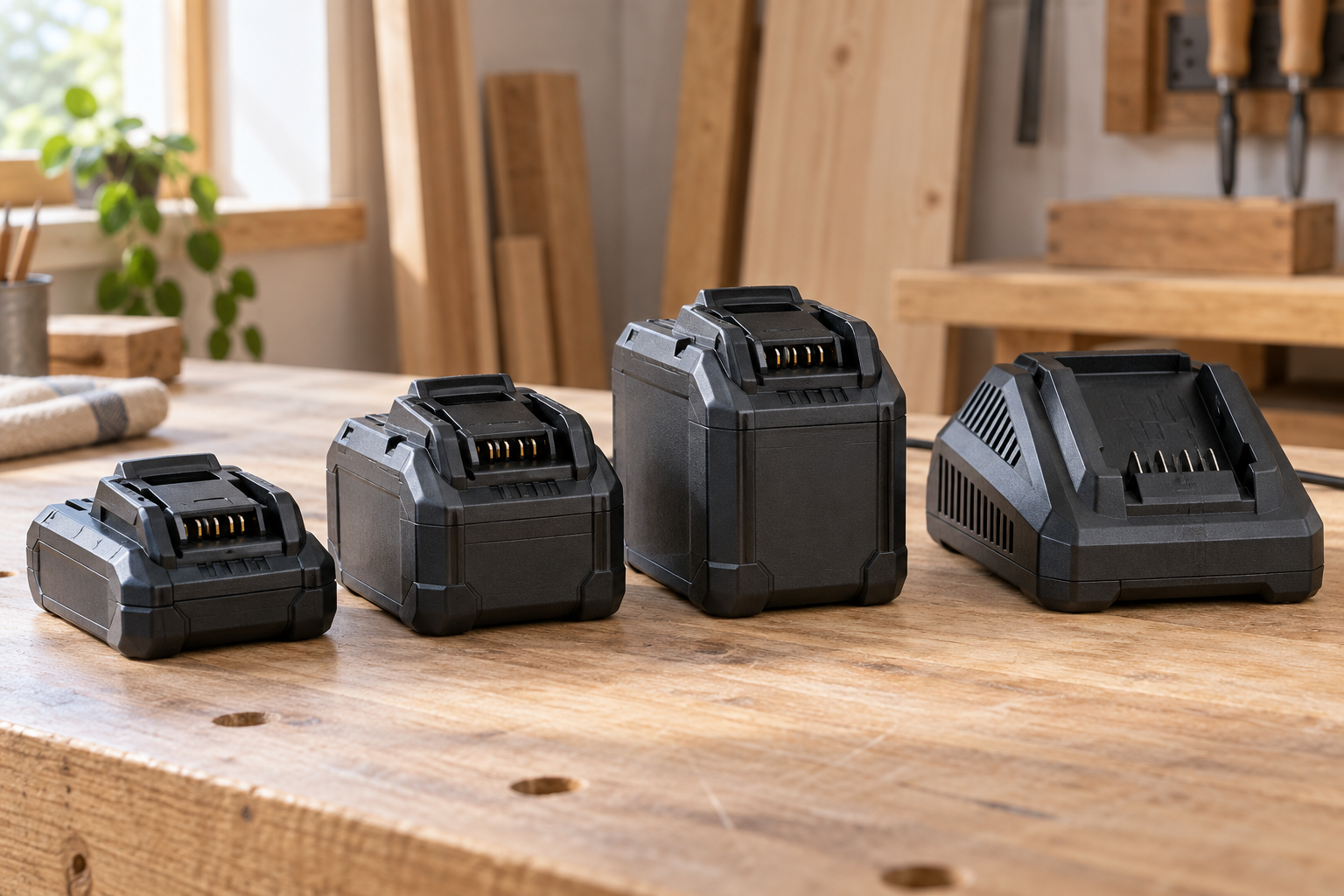
Battery capacity is usually stated in amp-hours (Ah). A 5Ah battery can provide roughly twice the energy of a 2.5Ah battery at the same voltage, though actual runtime depends on the tool and workload. The larger pack is useful on a saw or grinder but can make a drill noticeably heavier. Keep at least one small pack for overhead work and one larger pack for cutting.
Chargers also have meaningful differences. A basic charger may take several hours to refill a large battery. A rapid charger can reduce that time substantially, but it may cost more, create more heat, and offer little benefit if you own enough batteries to rotate. For occasional DIY work, a standard charger is usually fine. A second charger is worthwhile when tools are used by two people or when several batteries must be ready every morning.
If you need a sensible first purchase, compare 18V or 20V cordless combo kits rather than assembling every item separately.
Match Battery Size to the Tool
Use the smallest battery that completes the job comfortably. A 2Ah or 2.5Ah pack is often ideal for an impact driver, drill, inspection light, or compact multitool. A 4Ah or 5Ah pack is a better fit for a circular saw, reciprocating saw, grinder, or shop vacuum. High-output batteries can improve performance in tools with brushless motors, but they are not automatically worth the premium for low-demand tools.
There are two common failure modes. First, a small battery may shut down from thermal protection during long cuts, even though it still shows charge. Second, a large battery may technically run a tool but make it tiring and awkward. Runtime is not the only measure; balance and weight affect how accurately and safely you work.
For lawn equipment, consider 40V cordless outdoor tool systems separately unless the brand’s lower-voltage platform genuinely includes the equipment you need. A mower can consume several times the energy of a drill during a session, and sharing a battery with hand tools may leave nothing available for repair work.
Avoid Platform Lock-In
Once you own three or four batteries, switching brands becomes expensive. Before committing, inspect the ecosystem for the next tools you may need: a brushless drill, impact driver, compact saw, oscillating tool, light, vacuum, and outdoor equipment if relevant. Look at battery prices as carefully as tool prices. A cheap bare tool is not a bargain if replacement batteries cost more than expected.
Buying adapters between battery systems is generally a poor long-term plan. They can defeat electronic communication, void warranties, create clearance problems, and expose contacts to damage. Use only batteries and chargers designed for the platform. Never charge a pack with a charger from another system merely because the voltage appears similar.
Buy Bare Tools Selectively
After the initial kit, buy bare tools when the price makes sense. This avoids accumulating chargers and duplicate batteries. However, a kit with a useful battery may be cheaper than the bare tool during promotions, so compare the complete package rather than assuming bare-tool pricing is best.
Good additions are tools that use batteries efficiently, such as cordless oscillating multitools and work lights. For infrequent sanding or grinding, the cheaper corded option may be the better purchase. Spend on cordless convenience where it saves setup time, reaches awkward locations, or eliminates a hazardous extension cord.
Store and Maintain the System
Store batteries indoors, away from damp locations and extreme heat. Do not leave packs in a hot vehicle or on a charger indefinitely. Keep contacts clean, and remove a battery from a tool when transporting it. If a pack becomes swollen, cracked, unusually hot, or develops a strong chemical odor, stop using it and follow the manufacturer’s recycling instructions.
Label batteries by capacity if several look alike. Rotate them instead of repeatedly using one pack until the tool stops. A simple two-battery rotation—one working, one charging—prevents many interruptions. With the platform chosen around your actual workload, shared batteries and chargers reduce both clutter and the long-term cost of cordless tools.
Related guides
- Longest Lasting Lawn Mower Battery: AGM vs Lithium vs Flooded Lifespan and Cost per Season
- Duralast Gold Lawn Mower Battery Review: U1 Fit, CCA and When to Pay for AGM
- Greenworks Pro 80V 21-Inch Mower Review: Runtime Math, Push vs Self-Propelled and Yard Fit
- Bosch High Pressure Washer Gun Replacement: Fittings, Adapters and What Fits Your Model