
Our Top Picks
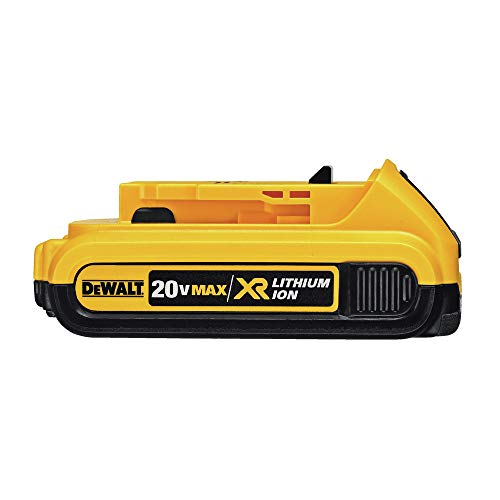
 DEWALT 20V MAX* XR Battery9.20in. x 7.00in. x 3.55in.4.5 x 3.13 x 2.63 Inches2.9 poundsCheck on Amazon

What's inside
As an Amazon Associate I earn from qualifying purchases. This post may contain affiliate links at no extra cost to you.
What matters for short jobs
For hanging a few shelves, trimming an edge, or driving a handful of screws, the best battery is not automatically the one with the most amp-hours. A large pack can run longer, but it also adds weight and may be awkward on a drill or impact driver you pick up for two minutes at a time.
For frequent brief tasks, prioritize a battery that fits the tool well, charges conveniently, and is ready when you need it. Most users are better served by one compact pack in the tool and a second pack on the charger than by buying the largest battery available. Keep in mind that a battery’s printed amp-hour (Ah) rating is capacity, not a direct measure of power. Voltage and the tool’s design also affect performance.
As an Amazon Associate we earn from qualifying purchases at no extra cost to you.


Compact or high-capacity?
A 2.0Ah pack is a sensible default for light, intermittent work with a drill, driver, inspection light, or small trim tool. It usually weighs less and makes a tool easier to handle overhead. A 4.0Ah pack can reduce interruptions on a busy day, but it adds bulk and is less pleasant on a compact tool. For demanding cutting or grinding, a larger pack may also hold performance better under sustained load, depending on the platform.
Runtime varies too much by tool, material, and technique to promise a reliable number of screws or cuts per charge. Dense wood, large holes, dull blades, and repeated hard acceleration drain a pack faster than light fastening. Cold conditions can also reduce available runtime. If a tool suddenly feels weak, check the battery charge and temperature before assuming the tool is broken.
Choosing a pack size
| Battery type | Best fit | Main trade-off |
|---|---|---|
| Compact, around 1.5–2.0Ah | Drills, impact drivers, lights, occasional small cuts | Light and easy to handle, but needs more frequent charging for extended work |
| Mid-size, around 3.0–5.0Ah | General home maintenance and mixed tool use | More runtime, with extra weight and cost |
| High-capacity, around 6.0Ah or higher | Longer sessions and tools that draw heavily on the battery | Can be cumbersome on compact tools; often unnecessary for brief jobs |
These are broad capacity ranges, not guarantees of equal size, runtime, or compatibility. Check the battery system and tool manual before buying: packs from different voltage platforms generally do not interchange, even within one brand. Some manufacturers also have multiple connectors or generations.
A practical setup to buy
If you own only one cordless tool, start with a compatible compact battery and charger, or a kit that includes both. Buying a bare tool without checking what is already in your kit can leave you with an unusable purchase. A compact battery-and-charger kit is a reasonable fit for light household work, provided it matches your exact platform.
If you already have a battery and charger, a second compact pack is usually more useful than a much larger single pack. One can stay in the tool while the other is ready for a swap. For a multi-tool setup, compare the cost of genuine bare tools and batteries against a kit; kits can be better value, but only if you will use the included tools and packs.
For heavier or longer sessions, consider a mid-capacity replacement battery from the tool maker. It is a useful middle ground for saws and other hungry tools without committing to the weight of a high-capacity pack. The cheaper compact pack is still fine if the tool is used for short bursts and you can recharge between jobs.
Charging and storage habits
A second battery only helps if it is charged when needed. Put the spare on the charger after a job rather than waiting until both packs are empty. Charging time depends on the charger and battery; a rapid charger may save time, but it can cost more and is not essential when jobs are separated by hours or days.
Do not leave a lithium-ion battery in a hot vehicle or on a damp floor. Store it somewhere dry and moderate in temperature, and avoid charging a pack that is very cold until it has warmed to room temperature. If a battery is cracked, swollen, unusually hot, or has damaged contacts, stop using it. Do not try to repair a damaged pack or force it onto a charger.
For occasional work, it is generally more useful to keep a pack partly charged and accessible than to repeatedly run it completely flat. Follow the manufacturer’s storage guidance if the tool will sit unused for months. A battery that is left discharged for a long period may become difficult or impossible to recharge.
Compatibility and common mistakes
Battery labels can be misleading: similar voltage names do not guarantee that packs fit or communicate correctly with a tool. Verify the platform, connector, and any restrictions in the manual. Avoid unbranded packs that make unusually large capacity claims at a bargain price; poor protection circuitry or inconsistent fit can turn a cheap purchase into downtime or a safety risk. A replacement battery from the tool’s brand is usually the safer choice, though a reputable, compatible third-party option may make sense for an older tool if warranty and support are not priorities.
Do not buy a high-capacity battery simply because its number is larger. If your main job is driving a few screws or drilling small pilot holes, the added weight can make the tool tiring without saving a meaningful amount of time. Conversely, repeatedly stopping a saw or vacuum for battery changes is a sign that a larger pack or a second charged pack could improve the workflow.
Match the battery to the task and the way you work: compact for frequent pickup-and-put-down jobs, mid-size for mixed use, and high-capacity for sustained demand. Before ordering, check your existing charger and tool labels. That simple check prevents the most common buying mistake: getting a battery that cannot run the tool you already own.
FAQ
Compact or high-capacity?
Related guides
More from Amazon
Programs that pair well with the guide above. Offers and eligibility are set by Amazon and may change.
A free business account with business pricing and bulk-buying tools for work, shop or home office.
Create a business accountFree shipping on eligible items, Prime Video and more. Eligible new members can start with a free trial.
Start a Prime free trialAudiobooks and podcasts to listen to on the go. Eligible new members can start with a free trial.
Try Audible freeAd-free music streaming. Eligible new subscribers can start with a free trial.
Try Music Unlimited freeAs an Amazon Associate we earn from qualifying purchases.

Write Your Review
No reviews yet. Be the first to share your experience!