
What's inside
As an Amazon Associate I earn from qualifying purchases. This post may contain affiliate links at no extra cost to you.
Working overhead changes what a battery feels like. A pack that seems manageable at waist height can pull on your wrist during a long run of screws or make a drill awkward on a ladder. For overhead work, the best choice is usually the smallest compatible battery that can finish the task without frequent swaps—not the pack with the biggest capacity number.
As an Amazon Associate we earn from qualifying purchases at no extra cost to you.

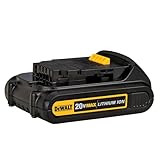

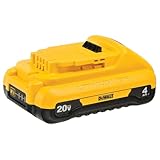
What “slim” means in practice
Battery makers don’t use one shared definition of “slim.” Look for a compact pack with a short body and low weight, often in the roughly 1.5–2.0Ah range on 18V-class platforms. Check the listed weight and dimensions rather than relying on the product name: a compact 2.0Ah pack may weigh less than half as much as a high-capacity pack, though the difference varies by platform.
Voltage alone doesn’t tell you how long the battery will last. Amp-hours (Ah) are a rough guide to stored capacity within the same battery platform, not a direct promise of runtime. A 2.0Ah pack will generally need recharging sooner than a 5.0Ah pack, but tool load, material, bit size, and battery condition all matter.
Choose by task, not by habit
For driving small screws, fitting hardware, or making occasional pilot holes, a compact battery is often the better tool-balance choice. In an impact driver, it can make repeated overhead fastening less tiring, and the lower mass at the handle can help you keep the bit aligned.
Drilling large holes, using a hole saw, or mixing material draws more current and keeps the motor working harder. A small pack may sag under that load, run hot, or shut the tool down before the job is done. Use a larger pack for sustained high-load work, or bring a second compact battery and rotate packs if that is easier than holding the heavier one overhead.
For overhead cutting, sanding, or drilling, consider both battery weight and tool shape. A slim battery cannot make a front-heavy tool feel balanced. Try the tool with the battery attached, if possible, and check whether you can reach the trigger and maintain control with one hand while safely supporting the work.
Compact versus larger packs
| Pack type | Typical fit | Trade-off overhead |
|---|---|---|
| Compact, about 1.5–2.0Ah | Light fastening, small holes, short tasks | Less arm fatigue; more swaps and less reserve for heavy loads |
| Mid-size, about 3.0–4.0Ah | Mixed drilling and fastening | Longer runtime, but noticeably more weight on the tool |
| High-capacity, about 5.0Ah and up | Long runs or demanding work | Fewer interruptions; often tiring and less nimble overhead |
These ranges are broad, not a guarantee of physical size or performance. Battery designs differ, and some platforms use different cell layouts to make a higher-capacity pack relatively compact. Compare the exact pack’s weight, dimensions, and compatibility with your tool.
What to buy
If your platform offers a genuine compact battery around 2.0Ah, start there for light overhead work. Check that it is compatible with the exact tool and charger generation you own; batteries that look similar may not fit every product in a brand’s lineup. Compare compact 18V 2.0Ah tool batteries.
For a full day of intermittent work, two compact packs can be more comfortable than one large pack. Keep one charging when the platform’s instructions allow it, and swap before a battery is fully depleted if the tool begins slowing or the pack gets hot. Look at compact battery-and-charger kits.
If you already own a larger battery, there’s no need to replace it just because a compact pack exists. It is fine for a few overhead cuts or a short fastening run, especially if the job would otherwise mean buying a battery you rarely use. The upgrade makes more sense when weight is repeatedly limiting control or causing fatigue.
Runtime, heat, and common failure modes
A compact battery’s main failure mode is running out sooner than expected. Keep a charged spare nearby rather than reaching for an oversized pack by default. A second problem is heat: repeated high-load drilling can heat both the pack and tool. Stop if the battery feels unusually hot, the tool cuts out, or the charger indicates a temperature delay. Let the pack cool naturally; don’t cool it with water or put it in a freezer.
Cold weather can reduce available output and make runtime seem worse. A battery stored in an unheated vehicle may perform poorly at the start of the day. Bring it indoors before work and follow the manufacturer’s temperature guidance for charging. Also keep contacts clean and dry; a loose or dirty connection can interrupt power, especially when the tool is moving overhead.
Make the job safer
Less battery weight helps, but it does not make an overhead tool safe to use one-handed in every situation. Secure the workpiece, use a stable ladder or platform, and keep your body out of the path of a falling tool or cut material. A wrist strap is not a substitute for a proper tool tether where a dropped tool could injure someone. Don’t work directly above other people.
For most fastening and light drilling overhead, a compatible compact battery is the sensible first choice. For large bits, long cuts, or repeated high-load use, accept the extra weight of a larger pack—or plan for a battery swap. The right trade-off is the one that keeps the tool controllable while providing enough runtime for the task.
Related guides
- Longest Lasting Lawn Mower Battery: AGM vs Lithium vs Flooded Lifespan and Cost per Season
- Duralast Gold Lawn Mower Battery Review: U1 Fit, CCA and When to Pay for AGM
- Greenworks Pro 80V 21-Inch Mower Review: Runtime Math, Push vs Self-Propelled and Yard Fit
- Bosch High Pressure Washer Gun Replacement: Fittings, Adapters and What Fits Your Model