What's inside
As an Amazon Associate I earn from qualifying purchases. This post may contain affiliate links at no extra cost to you.
Cordless tools do not protect their batteries with a single fuse. Modern platforms use several layers of electronic tool protection to control current, temperature, voltage, and communication between the battery, tool, and charger. The goal is not just to prevent a dramatic failure. It is also to stop repeated overloads from shortening the battery’s useful life.
That protection affects how a drill, saw, grinder, or impact driver behaves under load. A tool may slow down, stop suddenly, or refuse to restart until the battery cools. Those behaviors are usually intentional. They indicate that the platform has reached a limit set by the battery management system, tool electronics, or both.
What overload means in a cordless tool
Overload occurs when the tool demands more electrical current than the battery and electronics can safely provide. A motor draws the most current when starting, when the accessory binds, or when you force the tool to maintain speed in a difficult cut. A 18V or 20V-max battery can briefly deliver very high current, but its safe output depends on cell type, temperature, state of charge, and battery size.
For example, a drill bit that catches in framing lumber can cause a momentary current spike. A circular saw cutting wet pressure-treated stock may draw heavy current for several seconds. A grinder with a jammed disc can create an even more severe event. Without current limiting, heat would build quickly in the motor windings, switching components, battery tabs, and cells.
Electrical power is approximately voltage multiplied by current. At 18V, a 50-amp demand is about 900 watts before accounting for losses. That power creates heat throughout the system. The battery cannot simply “push” unlimited current because the tool is connected; its internal resistance and control electronics determine how much current is allowed.
How electronic protection works
A cordless battery pack normally contains multiple lithium-ion cells, temperature sensors, a battery management circuit, and switching components. The circuit monitors cell voltage and pack temperature, and it can disconnect the output when conditions become unsafe. Tool and battery contacts may also carry communication signals, allowing the tool to identify battery condition and available output.
The tool’s controller monitors motor current and switching temperature. If current rises beyond a programmed threshold, it may reduce power or shut the motor off. Some tools use a gradual electronic limit that feels like the motor bogging down. Others stop abruptly, especially when the controller detects a stalled motor.
Over-temperature protection works in a similar way. A sensor may detect heat in the battery cells, motor, circuit board, or power transistors. The tool can stop before those parts reach a damaging temperature. The pack may still show charge on its indicator, but it can remain unavailable until the sensor reading falls.
Low-voltage protection is equally important. Lithium-ion cells should not be discharged below their safe limit. The battery management system disconnects the pack when the weakest cell reaches that limit. This can happen under a heavy load even when the pack indicator still shows one or two bars. The voltage may recover after the load is removed, but the protection circuit has already made its decision.
Protection trigger and what it feels like
| Protection event | Typical cause | What you may notice | Best response |
|---|---|---|---|
| Overcurrent | Bound blade, stalled bit, aggressive feed rate | Instant stop or sharp power reduction | Release the trigger, clear the bind, and inspect the accessory |
| Overtemperature | Long cuts, heavy grinding, hot battery, blocked cooling | Tool stops and will not restart immediately | Let the tool and battery cool separately in a dry, shaded place |
| Low voltage | Nearly empty pack or high load on a small pack | Power fades, then the pack shuts off | Install a charged battery; avoid repeatedly forcing the cutoff |
| Cell imbalance or fault | Aging cell group, damage, moisture, or electronics fault | Pack refuses to run or charge normally | Stop using it and follow the manufacturer’s replacement guidance |
Battery size and platform trade-offs
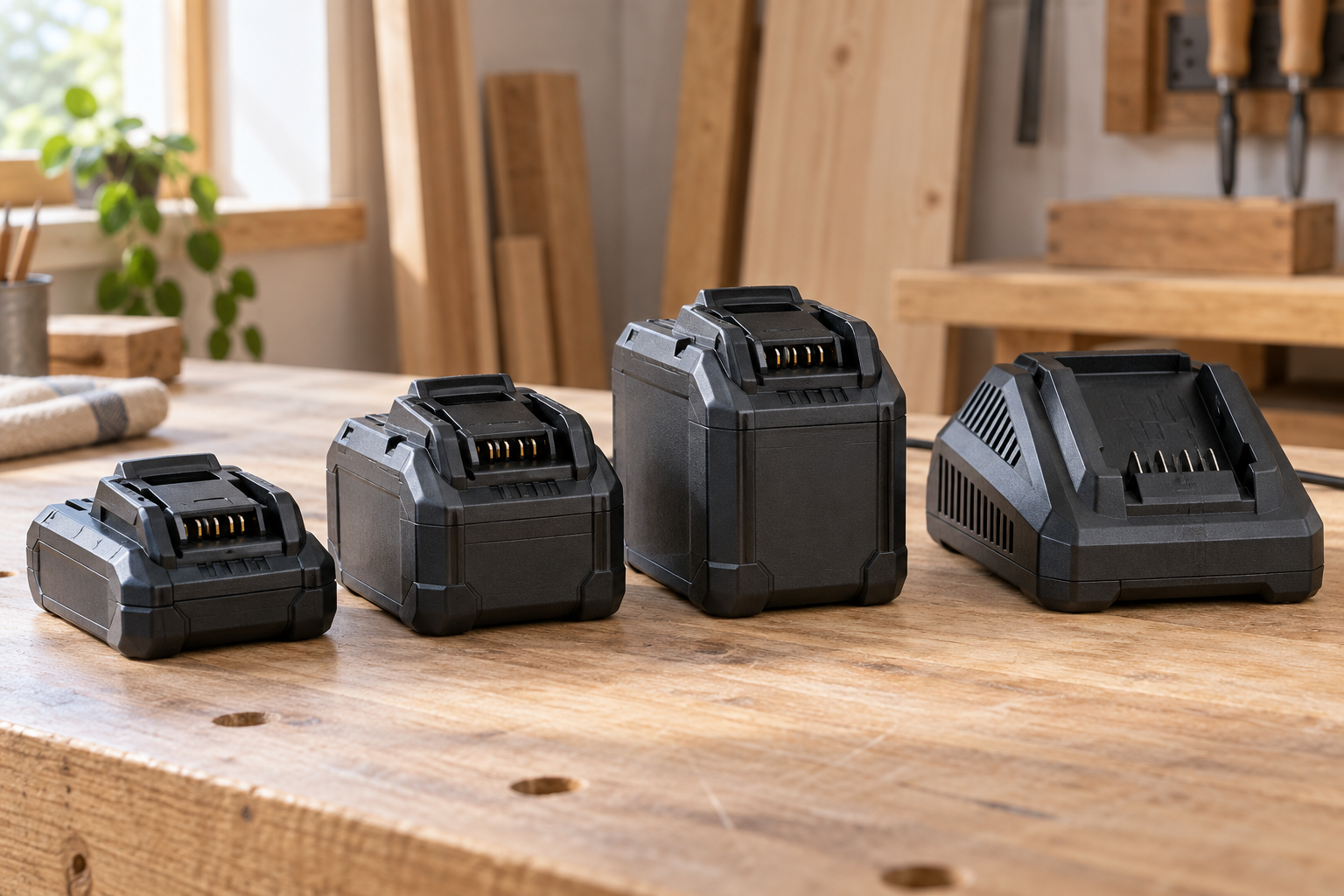
A larger battery is not automatically “more powerful,” but it usually has more parallel cells and can spread current across them. That reduces stress and voltage sag during demanding work. A compact 2.0Ah pack may run a drill or impact driver comfortably, while a high-output 5.0Ah or 8.0Ah pack is better suited to a circular saw, reciprocating saw, or grinder.
The trade-off is weight, price, and charging time. A large pack can make a drill tiring overhead and can be unnecessary for assembling cabinets or driving occasional screws. For light-duty work, a compact cordless tool battery is often the cheaper and more comfortable choice.
For tools that regularly cut thick lumber or remove material with an abrasive wheel, choose the manufacturer’s high-output battery category rather than simply buying the highest amp-hour rating. High-output packs commonly use cells and internal connections designed for greater current. They can still overheat or shut down, but they generally maintain voltage better under load.
How to avoid unwanted shutdowns
Use a sharp blade or bit and match it to the material. Feed a saw steadily instead of forcing it. With a reciprocating saw, let the blade do the cutting and use the correct tooth pattern. On a grinder, avoid twisting the disc and do not cover the tool’s cooling vents.
Keep batteries within their working temperature range. Do not charge a pack immediately after a hard run if it is hot to the touch. Many chargers will refuse a battery that is too hot or too cold, which is normal. Let it reach room temperature rather than placing it on a heater or in a freezer.
Do not repeatedly pull the trigger after an overload shutdown. If the cause was a jam, remove the load first. Repeated restarts create additional current spikes and heat. Also inspect contacts for dirt, corrosion, or damage. Poor contact can create resistance and localized heating, although it will not usually explain a clean, immediate electronic cutoff.
When a cheaper battery is enough
For occasional drilling, fastening, trim work, and light repairs, standard batteries from the tool maker are usually adequate. There is little benefit in paying for a large high-output pack if the tool rarely approaches its limits. A second small pack may be more useful than one expensive large pack because you can keep working while the first charges.
For production work, heavy cutting, or tools that regularly trigger protection, upgrade the battery and charger as a matched platform. A high-output cordless battery and charger can reduce voltage sag and downtime, but it cannot compensate for a dull blade, blocked vents, or an undersized tool.
If a pack repeatedly shuts down during ordinary light work, swells, smells unusual, becomes hot while idle, or will not charge, remove it from service. Do not open a lithium-ion pack or bypass its protection circuit. Electronic protection is a safety system, not an inconvenience to defeat.
Related guides
- Longest Lasting Lawn Mower Battery: AGM vs Lithium vs Flooded Lifespan and Cost per Season
- Duralast Gold Lawn Mower Battery Review: U1 Fit, CCA and When to Pay for AGM
- Greenworks Pro 80V 21-Inch Mower Review: Runtime Math, Push vs Self-Propelled and Yard Fit
- Bosch High Pressure Washer Gun Replacement: Fittings, Adapters and What Fits Your Model