What's inside
As an Amazon Associate I earn from qualifying purchases. This post may contain affiliate links at no extra cost to you.
What battery communication means
A cordless tool battery is more than a row of cells and two power contacts. The pack and tool also need to manage current, temperature and low-voltage limits. In simple platforms, that coordination happens through basic electrical connections and protective circuits inside the battery. More advanced systems add contacts or electronics that let the tool and pack exchange additional information.
The details vary by brand and battery generation. A third-party adapter may connect the main power terminals without carrying every signal used by the original system. That can make an incompatible combination appear to work, but it may also leave some protections or features unavailable. Compatibility is about more than whether the pack physically clicks into place.
The main contacts and signals
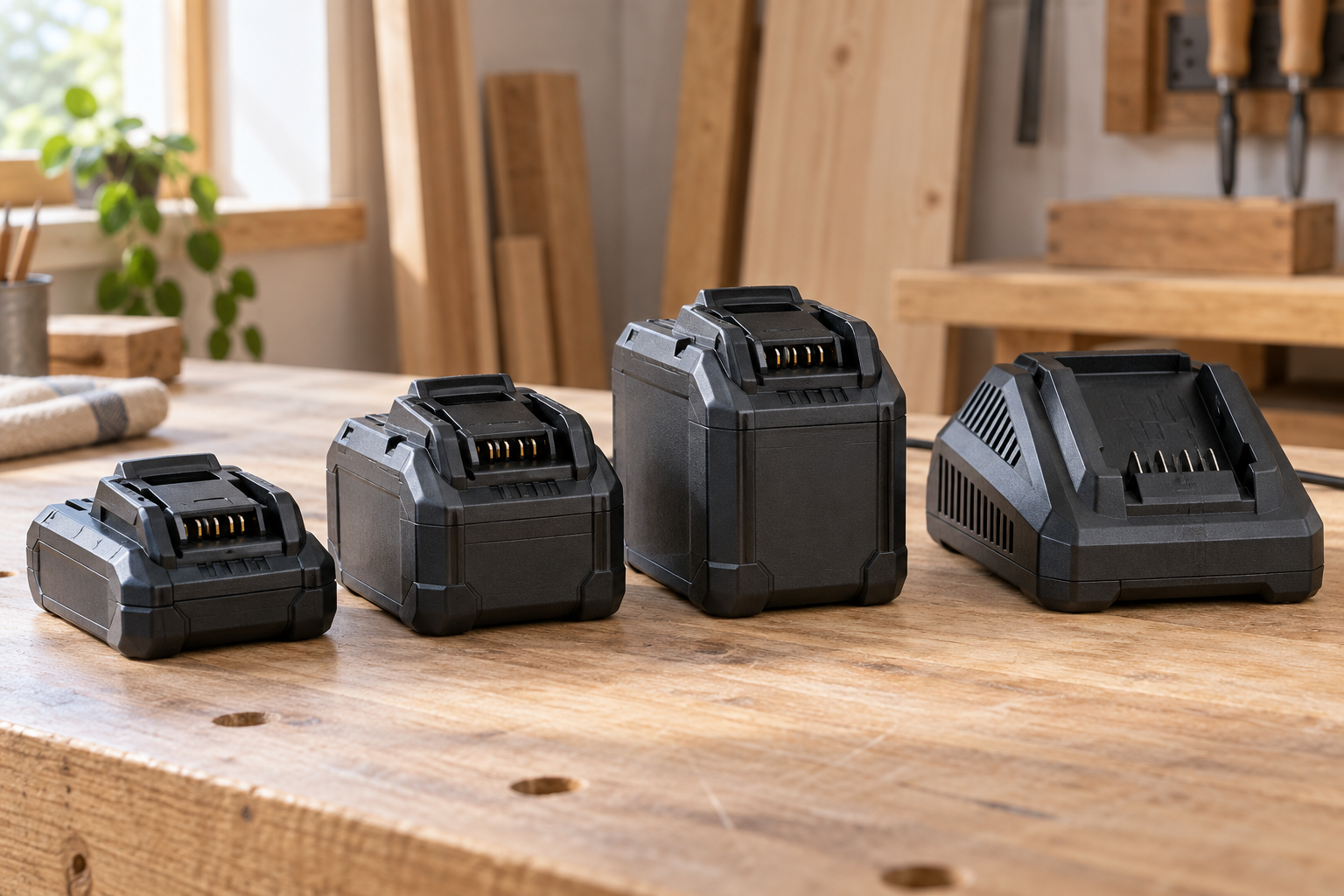
The large positive and negative terminals carry power to the motor. Other contacts, when present, may serve temperature sensing, identification or data communication. A thermistor, for example, changes electrical resistance as it heats up; the charger can use that reading to delay or stop charging when the pack is too hot or too cold.
Some platforms use a separate signal contact for information about battery condition or capability. Others rely more heavily on circuitry inside the pack and tool. A contact’s function is not always obvious from its position, and a similar-looking terminal on a different brand is not proof that the same signal or voltage is used. Don’t bridge contacts or probe them with metal tools: a short across power terminals can cause burns, sparks or fire.
What the tool needs to know
During use, the pack’s control electronics watch for problems such as excessive cell temperature, high current or an unsafe cell voltage. The tool may also control how much current it requests. In a high-demand job, such as cutting thick lumber, current draw can rise sharply; a pack with small cells may hit its limit sooner than a larger pack, even if both carry the same nominal voltage.
That difference is one reason a high-capacity battery can improve runtime and sometimes sustain demanding work longer. It does not guarantee more power in every tool. Cell design, pack electronics, tool controls and heat all matter. A pack that is hot from repeated heavy cuts may reduce output or shut down, then work again after cooling. Repeated shutdowns are a sign to pause and inspect the setup, not to defeat a protection circuit.
Charging and protection
A charger needs to know when and how quickly it can safely charge a pack. It monitors pack voltage and, on systems that provide it, temperature or other status signals. Lithium-ion batteries are commonly charged within a temperature range around 0–45°C (32–113°F), but the allowed range depends on the manufacturer and pack. Follow the label and manual rather than assuming one brand’s limits apply to another.
If a pack is too hot after use, let it cool at room temperature before charging. If it is very cold, let it warm naturally. Don’t use a heater, place it in a freezer or leave it in direct sun to force a temperature change. A charger’s flashing lights can indicate temperature delay, a fault or another condition; check that charger’s manual because blink codes are not universal.
Simple versus smarter systems
| Approach | What it can do | Trade-off |
|---|---|---|
| Basic power connections and pack protection | Run compatible tools while the pack protects against conditions such as overcurrent or low voltage | Fewer tool-to-pack features; exact behavior depends on the platform |
| Additional sensing or data communication | Support more detailed status checks, coordinated power limits or platform-specific features | More electronics and contacts; compatibility can be stricter |
| Adapter between platforms | May let a battery physically power a tool from another system | Can omit communication, temperature reporting or other protections; often not manufacturer-approved |
A cheaper, basic battery is often fine for light work: driving screws, occasional drilling or trimming small amounts of material. Spending more on a higher-capacity pack makes sense if you regularly use a saw, grinder or other tool that draws sustained current, or if you want fewer battery swaps. Compare the platform’s approved battery options rather than choosing by amp-hour number alone. A replacement battery for your tool platform should be listed as compatible with the exact tool family and generation.
Adapters and compatibility
Adapters are tempting when you already own several batteries, but they introduce another electrical connection and may not pass every signal. A tool might run while losing a fuel gauge, coordinated power management or other functions. The tool’s low-voltage protection may also behave differently if the adapter does not communicate as intended. That can shorten battery life or cause an abrupt shutdown.
For occasional, low-load use, a reputable adapter may be a practical compromise if its maker clearly identifies compatible tools and batteries. For a high-current saw, grinder or outdoor power tool, use the battery and adapter combination approved by the tool maker. Avoid adapters with loose terminals, exposed wiring or no clear safety information. Never modify a pack to make contacts line up.
Buying and troubleshooting
Before buying, check the tool’s manual or battery compatibility chart for the exact pack series. Confirm the voltage family, connector and any stated restrictions. If you are building a platform from scratch, compare the tools you need and the cost of a starter kit with charger against buying batteries separately. A cordless tool starter kit with battery and charger can be cheaper than assembling those parts one at a time.
If a tool stops unexpectedly, check the pack’s charge, temperature and terminals first. Let a hot battery cool, and make sure contacts are clean and dry. If one battery fails in several compatible tools while other packs work, the fault is more likely in that pack. If several batteries fail in one tool, inspect the tool or seek service. Don’t open a lithium-ion pack or bypass its electronics: damaged cells can ignite, and a short circuit can deliver dangerous current.
Related guides
- Longest Lasting Lawn Mower Battery: AGM vs Lithium vs Flooded Lifespan and Cost per Season
- Duralast Gold Lawn Mower Battery Review: U1 Fit, CCA and When to Pay for AGM
- Greenworks Pro 80V 21-Inch Mower Review: Runtime Math, Push vs Self-Propelled and Yard Fit
- Bosch High Pressure Washer Gun Replacement: Fittings, Adapters and What Fits Your Model