Our Top Picks


What's inside
- 1. Random orbit — the all-rounder
- 2. Detail sander — corners and tight spots
- 3. Belt sander — heavy stock removal
- 4. Quarter-sheet finishing sander — cheapest to feed
- 5. Oscillating spindle sander — inside curves
- 6. Benchtop belt/disc sander — small parts and repeatable angles
- 7. Drywall and long-reach sander — walls and ceilings
- How to weigh the specs against each other
- What changes at each price band
- Common mistakes, and how to avoid them
- FAQ
- The takeaway
- 1. Random orbit — the all-rounder
- 2. Detail sander — corners and tight spots
- 3. Belt sander — heavy stock removal
- 4. Quarter-sheet finishing sander — cheapest to feed
- 5. Oscillating spindle sander — inside curves
- 6. Benchtop belt/disc sander — small parts and repeatable angles
- 7. Drywall and long-reach sander — walls and ceilings
- How to weigh the specs against each other
- What changes at each price band
- Common mistakes, and how to avoid them
- FAQ
- The takeaway
As an Amazon Associate I earn from qualifying purchases. This post may contain affiliate links at no extra cost to you.
Buying a “best sander” is a trap, because the best sander depends entirely on the job. So we ranked the top picks by task — get the right type and your finish improves overnight. Sanding is the one operation where the wrong machine does not just slow you down; it leaves marks you then have to remove with a different machine.
The order below is by how often a working shop actually reaches for the tool, not by price and not by how good it looks on a bench. Each entry says which job it owns, who it suits, and who should skip it. Most woodworkers genuinely need two of these seven. Almost nobody needs all seven, and the shops that own all seven usually bought them in the wrong order.
As an Amazon Associate we earn from qualifying purchases at no extra cost to you.


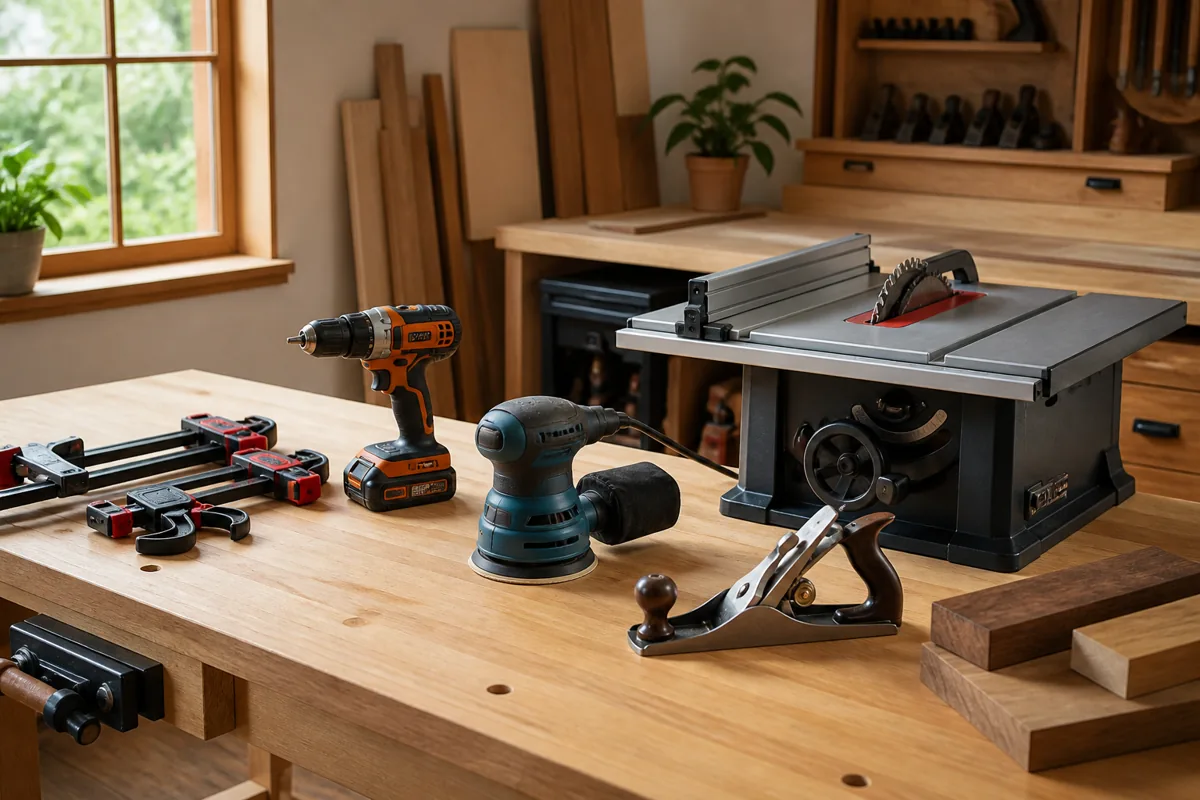
1. Random orbit — the all-rounder
If you buy one sander, make it a random orbit. It removes stock fast and leaves a swirl-free finish for most work.
The pad spins on a bearing while the whole assembly orbits, so no grit ever traces the same path twice — that is what kills the straight-line scratches that show up under stain. Choose a 5-inch pad for the cheapest and most widely stocked discs, 6-inch if you flatten panels and tabletops often. Match the pad’s hole pattern to the discs you can actually buy, because a mismatch wrecks dust extraction. Then look for variable speed, a replaceable hook-and-loop pad, and a body you can hold flat with one relaxed hand.
Random Orbit Sander
The one sander to own if you own only one. Fast stock removal, swirl-free finish, cheap discs. Handles the vast majority of sanding tasks a woodworker faces.
2. Detail sander — corners and tight spots
For corners, edges, and intricate work a random orbit can’t reach, a triangular detail sander is the answer.
The pointed tip is the whole product, so check that replacement pads and tips are sold for the model — cheap ones lose their grip surface fast and start shedding paper mid-pass. If you already own an oscillating multi-tool, its triangular pad does most of this job and you can skip the category. Buy the dedicated tool if you sand mouldings, window sashes, louvred doors or inside cabinet corners; skip it if your work is flat panels and straight edges.
3. Belt sander — heavy stock removal
When you need to hog off material fast — flattening, shaping, old finish removal — nothing beats a belt sander.
It is also the sander most likely to ruin the work, because it cuts in one direction and will dig a hollow the moment you let it sit still or tip it onto an edge. Start it in the air, land it moving, keep it moving, and let its weight do the pressing. Narrow, short belts are easier to control one-handed on doors and edges; wide, long ones flatten glue-ups faster with less fatigue. Check for a flat platen, tracking you can adjust without tools, and dust going to a hose rather than a cloth bag. Skip it if your work is finish-scale joinery — a hand plane is slower and far less risky.
4. Quarter-sheet finishing sander — cheapest to feed
The old palm sander is not obsolete. It vibrates in a tiny fixed orbit, so it is slow at removing stock and very hard to gouge, and its square pad reaches into corners a round pad rides straight over. It also takes cut sheets of ordinary paper rather than branded discs, which makes it the cheapest sander here to keep running.
It suits painters, trim carpenters, and knocking back finish between coats, where you want almost no cutting action at all. Skip it if you already own a random orbit and a detail sander; it adds a cheaper way to do the work, not a new capability.
5. Oscillating spindle sander — inside curves
Cut curves on a bandsaw or jigsaw and you need a way to sand to the line without flat-spotting it. A spindle sander’s drum turns and travels up and down at the same time, which spreads wear across the whole sleeve and stops it burning a stripe into the edge.
Buy on sleeve range and table quality: drums from pencil-thin up to a couple of inches cover most radii, and a tilting table lets you sand bevelled edges. Sanding drums chucked into a drill press are the cheap substitute — they do work, but they burn and wear out in one band because nothing oscillates. Skip it if everything you build is straight.
6. Benchtop belt/disc sander — small parts and repeatable angles
This one inverts the relationship: the work comes to the machine. That is what you want for parts too small to clamp safely, for truing end grain, and for sneaking up on a mitre against the disc with a mitre table, while the belt side handles edges and long curves.
Judge it on the castings, not the motor claims. A table that sits flat and square to the disc, a mitre gauge without slop, and a real dust port are what separate a useful bench sander from a machine that only makes dust. It suits box makers, model builders and anyone cleaning up joinery. Skip it if bench space is your scarcest resource.
7. Drywall and long-reach sander — walls and ceilings
Last, because most woodworkers need one for a week and then not again for years. A pole sander with a pivoting round head and a vacuum connection turns skim coat and tired ceiling texture from a two-day job into an afternoon, and it is the only tool here built to work above your head.
Buy it if you renovate, rent it for a single room, and skip it if you only ever sand furniture. A manual pole sander with mesh screens is the honest budget substitute, at the cost of your shoulders. Either way, respect the dust: unknown old wall coatings are the one case where testing before you sand matters more than which sander you pick.
How to weigh the specs against each other
Once you have picked the type, the decision comes down to the same questions in the same order of importance.
- Dust extraction first. A sander emptying into a cloth bag grinds its own dust back into the surface, clogs discs early and fills the room. Fitting the vacuum you already own outranks every other feature.
- Vibration and grip second. Numb hands make you press harder, and pressing harder is what causes the swirl marks you were trying to avoid.
- Variable speed third. The only reliable way to sand thin veneer, soft timber and cured finish without burning through.
- Abrasive supply fourth. You will spend more on discs and belts over the tool’s life than on the tool. Odd sizes and proprietary hole patterns are a slow tax.
- Motor ratings last. Amps and watts predict very little about how fast a sander cuts; pad flatness, orbit and fresh abrasive do the work.
Cordless earns its premium on random orbit and detail sanders if you already own the batteries and work away from outlets. For belt sanders and anything benchtop, stay corded.
What changes at each price band
Entry tier. You get the correct motion and not much else: pads that go out of flat, hook-and-loop that stops gripping, loud bearings, and vibration you still feel the next morning. Acceptable for a category you rarely touch, or for a first random orbit when the alternative is no sander at all.
Middle tier. Where most people should buy. Better balance so the tool tracks flat instead of chattering, sealed switches, pads and brushes stocked as spare parts, and dust ports that fit standard hoses.
Top tier. You are paying for endurance and dust control rather than raw speed: pad brakes that stop the disc gouging on contact, vibration low enough to sand all day, and extraction good enough that you can see the surface while you work. Worth it if you sand for money, hard to justify for a few weekends a year.
Common mistakes, and how to avoid them
- Skipping grits. Fine grit cannot remove coarse scratches. Step through the sequence and never skip more than one grade.
- Sanding too fine before stain. Polished bare wood stops accepting pigment, which is how a surface that feels perfect finishes blotchy.
- Pushing down. Pressure stalls a random orbit’s pad and turns it into a scratch machine. Guide it, don’t lean on it.
- Running dead abrasive. A worn disc burnishes instead of cutting, and it is cheaper to change than to repair the marks it leaves.
- Not cleaning between grits. One stray coarse particle under a fine disc will write a scratch across an entire panel.
- Sanding through veneer and edges. Plywood faces are thin and every edge is somewhere a sander tips. Mark edges in pencil so you can see the moment you have touched them.
- ✔ Right sander per job
- ✔ Better finish instantly
- ✔ Covers every task
- ✔ Clear rankings
- ✘ No single sander does it all
- ✘ Belt sanders can gouge if careless
FAQ
If I can only buy one, which sander is it?
The random orbit, with no close second. It removes stock quickly enough for rough work, finishes cleanly enough for stain, and uses the cheapest abrasives available. The only reader who should choose otherwise is one whose work is almost entirely walls and ceilings.
Do I need a cordless sander?
Only if you regularly sand away from power. Sanding is a sustained load, so it drains packs faster than driving screws and you will want spares. If you already own a battery platform, a bare-tool cordless sander is a useful second machine; if you are starting from nothing, corded buys more sander for the money.
Can an oscillating multi-tool replace a detail sander?
For most people, yes. The triangular pad reaches the same corners, and the tool pays for itself on cutting tasks the rest of the time. A dedicated detail sander is smoother and easier to control over long finishing sessions, which matters if you sand mouldings often.
Why does my random orbit still leave swirls?
Usually pressure, a clogged or worn disc, a skipped grit, or dust trapped between pad and paper. Lighten your grip, let the pad reach speed before it touches the work, keep extraction running, and lift the sander only while it is still moving.
The takeaway
Everything after the first three entries is a specialist, and specialists should be bought when a specific job stalls without them. If you find yourself fighting the same operation twice, that is your signal.
Start with a random orbit, add a detail sander for corners, and a belt sander only if you do heavy shaping. Buy by job, not by popularity. Pair with a top cordless drill for a starter kit.