What's inside
- How a Steering Wheel Zero-Turn Actually Steers
- Steering Wheel vs. Lap Bars: Which Controls Are Right for You
- Why Steering Wheel Models Hold Slopes Better
- Who Makes Zero Turn Mowers With Steering Wheels in 2026
- Which Model Should You Buy? A Decision Matrix
- Durability and Ownership Realities
- Frequently Asked Questions
- How a Steering Wheel Zero-Turn Actually Steers
- Steering Wheel vs. Lap Bars: Which Controls Are Right for You
- Why Steering Wheel Models Hold Slopes Better
- Who Makes Zero Turn Mowers With Steering Wheels in 2026
- Which Model Should You Buy? A Decision Matrix
- Durability and Ownership Realities
- Frequently Asked Questions
As an Amazon Associate I earn from qualifying purchases. This post may contain affiliate links at no extra cost to you.
A zero turn mower with steering wheel uses a synchronized four-wheel steering system to control both the front wheels and the independent rear transmissions from a single wheel, giving you true zero-turn maneuverability without lap bars and significantly better control on slopes up to 20 degrees.
As an Amazon Associate we earn from qualifying purchases at no extra cost to you.
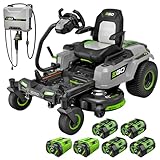
How a Steering Wheel Zero-Turn Actually Steers
Traditional zero-turns use two lap bars that each control a separate hydrostatic transmission for the left and right rear wheels. Push both forward to go straight, pull one back to pivot. It is fast and precise on flat ground but requires two hands and practice.
A steering wheel model, most notably Cub Cadet’s Synchro-Steer Technology, replaces the lap bars with a steering column, gear system, and linkages that do two jobs at once:
- Front-wheel steering: Turning the wheel physically angles the front caster-style wheels left or right, up to about 30 degrees, just like a lawn tractor. This gives directional stability.
- Rear transmission control: The same steering input electronically or mechanically adjusts the speed of the two rear hydrostatic transaxles. Turn left, and the system slows the left rear wheel while speeding up the right rear wheel. Turn the wheel fully, and one rear wheel reverses while the other moves forward for a true zero-degree turn.
- Self-correcting straight line: Because the front wheels are linked, the mower tracks straight without you having to constantly juggle two bars to compensate for a hillside pulling you downhill.
You still have a single foot pedal (or two pedals on some models) for forward and reverse speed. The wheel only handles direction. This is why you can drive one-handed and why beginners learn it in minutes instead of hours.
Steering Wheel vs. Lap Bars: Which Controls Are Right for You
The driving experience is fundamentally different, and each has trade-offs beyond just comfort.
| Feature | Steering Wheel Zero-Turn | Traditional Lap Bar Zero-Turn |
|---|---|---|
| Learning Curve | Very low – drives like a car/tractor | Moderate – requires 2-3 hours to become smooth |
| Hands Required | One hand possible | Two hands at all times |
| Hill Stability | Excellent – front wheels prevent downhill drift | Fair – rear wheels can slide on side slopes |
| Maximum Slope Rating | 15 to 20 degrees | 10 to 15 degrees (most manufacturers) |
| Precision Around Obstacles | Very good, slightly wider turn arc | Excellent, true pivot on the spot |
| Speed on Flat, Open Ground | Up to 7-8 mph | Up to 8-9+ mph (commercial models faster) |
| Operator Fatigue | Lower – automotive seating position | Higher – arms extended forward constantly |
If your property is flat, open, and you want maximum mowing speed and tightest pivots, lap bars still win. If you have hills, ditches, obstacles you need to mow around while holding a drink or needing a free hand for branches, or you have family members intimidated by lap bars, the wheel is the better choice.
Why Steering Wheel Models Hold Slopes Better
The slope advantage is not marketing. It is physics. A traditional zero-turn has two free-spinning front caster wheels that follow the path of least resistance. On a side hill, gravity pulls the casters downhill, so the mower crab-walks and you have to constantly fight the lap bars to stay straight. If the rear wheels lose traction, there is nothing at the front to stop a slide.
A steering wheel zero-turn locks the front wheels at a set angle. The Synchro-Steer linkage actively holds that angle against gravity. Combine that with four-wheel control and you get:
- Four-point traction: All wheels are engaged in directional control, not just the two rears.
- Reduced downhill drift: The front axle acts as an anchor, preventing the nose from swinging downhill.
- Controlled descent: The dual hydrostatic transaxles provide engine braking on both rear wheels while the front wheels steer, so you can traverse rather than just go up and down.
This is why Cub Cadet rates its ZTS and ZTXS steering wheel models for up to 20-degree slopes, while most residential lap-bar zero-turns are limited to 15 degrees in the manual. It does not make them a slope mower for extreme banks, but for the typical 10-15 degree suburban hill or drainage swale, the difference is confidence-inspiring. You should still mow up and down on anything steeper than 15 degrees and never mow across a wet slope.
Who Makes Zero Turn Mowers With Steering Wheels in 2026
This category is much smaller than the lap-bar market. As of 2026, one manufacturer dominates it.
Cub Cadet (Stanley Black & Decker) is the originator and primary producer of steering wheel zero-turns. Its system is licensed across its MTD family, so you will also see the same platform sold as Troy-Bilt and Remington in some retailers, with different paint and seat options but identical Synchro-Steer hardware. Major commercial brands like John Deere, Toro, Husqvarna, Exmark, and Gravely do not offer a true steering wheel zero-turn in their residential or commercial lines as of 2026; they stay with lap bars or lap-bar with steering lever hybrids.
Cub Cadet splits its steering wheel lineup into two families: ZTS for residential use and ZTXS for heavy-duty residential to prosumer use.
| Model | Deck Size | Engine | Transmission | Weight (approx.) | Slope Rating | Fuel Capacity |
|---|---|---|---|---|---|---|
| Cub Cadet Ultima ZTS1 42 | 42-inch stamped | 22 HP Kohler 7000 | Dual Hydro-Gear EZT 2200 | 542 lbs | Up to 20 degrees | 3.5 gal |
| Cub Cadet Ultima ZTS2 50 | 50-inch fabricated | 23 HP Kawasaki FR691V | Dual Hydro-Gear EZT 2800 | 618 lbs | Up to 20 degrees | 3.5 gal |
| Cub Cadet Ultima ZTXS4 48 | 48-inch fabricated | 23 HP Kawasaki FR691V | Dual Hydro-Gear ZT-3100 | 685 lbs | Up to 20 degrees | 5.0 gal |
| Cub Cadet Ultima ZTXS5 54 | 54-inch fabricated | 24 HP Kawasaki FR730V | Dual Hydro-Gear ZT-3100 | 712 lbs | Up to 20 degrees | 5.0 gal |
| Cub Cadet Ultima ZTXS6 60 | 60-inch fabricated | 25.5 HP Kawasaki FT730V EFI | Dual Hydro-Gear ZT-3400 | 785 lbs | Up to 20 degrees | 5.0 gal |
All models use a 3-blade system, electric PTO, and a high-back automotive-style seat with armrests. ZTXS models add commercial-grade fabricated decks (11-gauge steel with reinforced leading edge), stronger ZT-3100/3400 serviceable transmissions with external filters, and larger tires for better traction. General market pricing for steering wheel zero-turns in 2026 falls between $3,200 for a 42-inch ZTS1 and $5,800+ for a 60-inch ZTXS6, putting them $200 to $400 above comparable lap-bar models with the same deck size.
Which Model Should You Buy? A Decision Matrix
Match your situation to the right tier instead of just buying the biggest deck you can afford.
| Your Situation | Recommended Choice | Why |
|---|---|---|
| Under 2 acres, mostly flat, first zero-turn | ZTS1 42 or 46-inch | Smallest footprint, easiest storage, lowest cost to learn on |
| 2-4 acres with hills and trees | ZTS2 50-inch | Fabricated deck handles roots/bumps, 50-inch balances speed and gate clearance |
| 3-5+ acres, slopes, mowing weekly in season | ZTXS4 48 or ZTXS5 54-inch | Serviceable transmissions last longer, heavier frame holds hills better, larger fuel tank |
| 5+ acres, rough or uneven terrain, want longest life | ZTXS6 60-inch | ZT-3400 transaxles, EFI engine for fuel efficiency, 60-inch cuts time by ~25% vs 42-inch |
| Need to fit through a 48-inch garden gate | ZTS1 42-inch only | A 50-inch deck with discharge chute needs 62+ inches of clearance |
Coverage calculation: To estimate time savings, use (Deck Width in feet x Speed in mph x 0.85 efficiency) = acres per hour. A 42-inch (3.5 ft) deck at 6 mph covers about 2.18 acres per hour in perfect conditions. A 54-inch (4.5 ft) deck at the same speed covers about 2.8 acres per hour. On a 3-acre lawn with obstacles, the real-world difference is roughly 20-30 minutes per mow, or 10+ hours per season.
Durability and Ownership Realities
Steering wheel zero-turns share most maintenance with lap-bar models, but the front steering adds specific wear points to watch.
- What wears first: The front tie rod ends and steering sector gear. Dust and vibration loosen them over 150-300 hours. Check for play in the wheel (more than 1/2 inch of free movement at the rim) and grease all front axle fittings every 25 hours.
- Transmissions: ZTS EZT series are sealed and non-serviceable; plan to change the whole unit if it fails after 500+ hours. ZTXS ZT-3100/3400 have spin-on filters and oil reservoirs. Change oil and filters at 100 hours, then every 200 hours to double transmission life.
- Deck and belts: Fabricated decks resist rust far better than stamped decks but are heavier. Still clean the underside after every 2-3 mows. Dried grass holds moisture and rots spindles. Keep the electric PTO clutch air gap adjusted and replace the deck drive belt at the first sign of fraying or squealing.
- Tires and traction: Turf-saver tires on ZTS models will slip on damp hills. Consider upgrading to AT101 or bar-tread tires if you regularly mow slopes. Keep front tire pressure equal (typically 14 PSI front / 10-12 PSI rear) or the steering will pull.
- Common mistakes: Forcing the wheel at full lock while stationary scrubs the turf and stresses the steering linkage. Always keep the mower creeping slightly when turning hard. Never hose down the steering column or dash with high pressure; the electronic control module for Synchro-Steer is not sealed for pressure washing.
Frequently Asked Questions
Can a steering wheel zero-turn do a true zero-degree turn?
Yes. When you turn the wheel to full lock, the system drives one rear wheel forward and the other in reverse, spinning the mower in place like a lap-bar model. The turn radius is functionally zero, though the front wheels swing slightly wider than fixed casters.
Are they good for people with shoulder or arm issues?
Many owners find them more comfortable because your arms stay at your sides and you steer with light wheel effort rather than pushing heavy bars forward for an hour. However, they still require good leg strength for the foot pedal and core stability on hills. If you have mobility limitations, try sitting on both types at a dealer first.
Do steering wheel zero-turns need more maintenance?
Slightly more. You add front steering linkage greasing and toe-in checks to standard zero-turn maintenance (oil, filters, blades, deck cleaning). The extra 10 minutes every 25 hours prevents sloppy steering later.
Can I add a steering wheel to a lap-bar mower?
No. The frame, steering gear, front axle, and dual-transmission control module are completely different. Conversion is not practical or safe. You must buy the platform designed as a steering wheel model.
Related guides
- O’Reilly Lawn Mower Battery Guide: U1 vs U1R Sizes, CCA, and Getting the Right Fit
- DeWalt 18V Lithium-Ion Battery Guide: Sizes, Chargers, and 20V MAX Equivalence
- Craftsman 2800 PSI Pressure Washer Review: Engine, Specs, and Jobs It Handles
- DeWalt 20V Pressure Washer Review: How Much Cleaning Power Does Cordless Really Deliver?