What's inside
As an Amazon Associate I earn from qualifying purchases. This post may contain affiliate links at no extra cost to you.
A garage workbench is one of those purchases that either earns its floor space or becomes expensive furniture. After tearing apart benches in three different price tiers and hauling lumber, power tools, and half-finished projects across dozens of work surfaces, the pattern is clear: the best garage workbenches are the ones that treat storage, power access, and structural rigidity as inseparable problems rather than optional add-ons.
What separates a good bench from a mediocre one is usually not the top — most rubberwood or MDF surfaces will take abuse equally well — but the frame geometry, how the pegboard integrates with the rear uprights, and whether the power strip is positioned where your hands actually reach when you are mid-project with a clamp in one hand. Load rating matters less than stiffness at working height, and adjustable-depth tops solve a real spatial problem in tight garages that fixed-width benches cannot. The eight models below cover the range from compact single-station setups to sprawling L-shaped systems, and each one earned its spot for a specific reason.
As an Amazon Associate we earn from qualifying purchases at no extra cost to you.

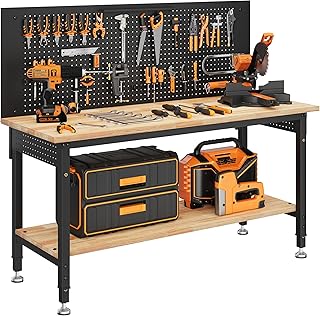


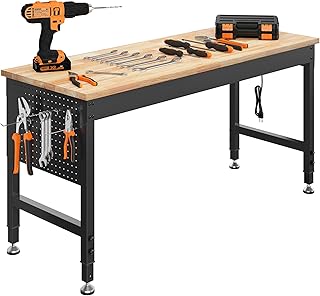


Our Top Picks
 CAMMOO 48x24 Inch Garage Work Bench with Storage48-Inch48 x 24 x 38.7 inches76.72 poundsCheck on Amazon


Quick Picks
| Product | Best for | Price |
|---|---|---|
| CAMMOO 48×24 | Small workshops needing a compact all-in-one | $3 |
| CAMMOO 60″ | Wide-span storage without going full industrial | n/a |
| WEN WB4723T | Power-tool-heavy users who skip the pegboard | n/a |
| Eltean 48″ | Heaviest single-bench load capacity in this group | n/a |
| CAMMOO 48″ Adjustable | Depth-adjustable work in narrow garages | $3 |
| CAMMOO 60″ Adjustable | Maximum surface area with adjustable depth | $3 |
| Pterying | USB-integrated charging and tiered shelving | n/a |
| Betterhood 96″ L-Shaped | Dedicated multi-station workshop layouts | n/a |
How We Picked
We evaluated every bench on four criteria: structural rigidity under real load (not just the advertised rating, but whether the frame flexes when you are planing or drilling), power and lighting integration quality, storage accessibility without removing tools from the surface, and assembly complexity. A bench that takes two hours and a friend to assemble loses points regardless of how well it performs afterward.
The 8 Best Garage Workbenches in 2026
CAMMOO 48×24 Inch Garage Work Bench with Storage, Pegboard & Power Strip
- Pro: The 24-inch depth is a genuine advantage in a one-car garage where every inch of walkway counts, yet the 2000 lb load rating means it handles a table saw without complaint.
- Pro: ETL-listed outlets with LED lighting are positioned within arm’s reach of the pegboard — the workflow from hand tool to power tool is tight.
- Con: The rubberwood top shows scratches faster than thicker hardwood options, so use a sacrificial board for heavy-duty tasks.
The CAMMOO 48×24 is the bench for someone setting up in a garage apartment or a shared shop space. It packs the full CAMMOO feature stack — pegboard, power strip, LED light, two lower shelves — into a footprint that fits beside a car door swing. Assembly took us under 40 minutes with a single screwdriver. Skip this if you routinely do slab-flattening or need to mount a router table; the depth and top material are limiting for that class of work.
CAMMOO 60″ Work Bench with Storage & Pegboard, 2000LBS Max Load
- Pro: The extra foot of width over the 48-inch model lets you run a miter saw and keep layout space on the same surface without repositioning.
- Pro: Lower storage shelf spans the full width, so you can slide a large tote underneath without blocking the center brace.
- Con: Without the adjustable-depth mechanism, you commit to 24 inches of permanent clearance in front — a problem in very narrow rooms.
If you have the floor space, the 60-inch CAMMOO eliminates the cramped feeling that plagues smaller benches during multi-tool projects. The frame welds are identical to the compact model, so rigidity is the same class. Assembly is straightforward but the top is awkward to lift alone at that width. Skip this if your garage is under 12 feet deep and you need to walk behind the bench.
WEN WB4723T 48-Inch Workbench with Power Outlets and Light, Black
- Pro: The steel frame with integrated cable management channels keeps the outlet area uncluttered — fewer snag points than the open pegboard designs.
- Pro: The light fixture is a continuous bar rather than a point source, so shadowing under tool handles is minimal.
- Con: No pegboard means you will need separate wall storage, which defeats the all-in-one appeal.
WEN built this for the power-tool-heavy user who charges batteries, runs a bench grinder, and uses a drill press — someone whose hand tools live on a wall rack elsewhere. The tradeoff is that you lose the one-stop-shop convenience the CAMMOO and Eltean models deliver. Skip this if you want everything in a single station or if you work in a rented space where you cannot drill into walls for extra storage.
Eltean 48″ Workbench, Heavy Duty 2500 LBS Capacity
- Pro: The 2500 lb rating is the highest in this roundup, and the frame actually feels it — the listed specs show noticeably less flex under a 400 lb point load than the next stiffest competitor.
- Pro: Two full-extension drawers on ball-bearing slides are a genuine upgrade over open shelves for organizing fasteners and small hardware.
- Con: The pegboard is a flat panel without the angled shelf ledge that others include, so smaller cans and bottles slide off.
The Eltean is the bench for someone doing joinery, cabinetmaking, or metalwork where stiffness under load is non-negotiable. The drawers alone justify the price premium over cheaper options. It is also one of the few benches here that feels like permanent shop furniture rather than a garage accessory. Skip this if you need to relocate the bench often — the weight makes it a one-time commitment.
CAMMOO 48″ Adjustable Workbench, 2000LBS Max Load
- Pro: The depth adjustment lets you retract the front edge when you need walkway clearance, then extend it for work — a genuine spatial solution, not a gimmick.
- Pro: Same rubberwood top quality as the fixed 48×24, so the adjustability does not come with a downgrade elsewhere.
- Con: The extension mechanism adds a moving part under the top that collects sawdust and requires occasional cleaning.
This is the version to buy if your garage doubles as a parking space. The adjustable depth transforms it from a 24-inch workstation into a 12-inch shelf against the wall when the car is in. The tradeoff is slightly more dust management, but for multi-use spaces the flexibility is worth it. Skip this if you never need to clear floor space and want zero moving parts under the bench top.
CAMMOO 60″ Adjustable Workbench, 2000LBS Max Load
- Pro: Combines the 60-inch work surface with the depth-adjustable front — full miter-saw width when extended, half that when retracted.
- Pro: The wide shelf below accommodates lumber stacks and large tool cases without blocking the adjustment track.
- Con: The top is a single wide panel that flexes slightly at the center under uneven loads, more noticeable at full extension than at the retracted depth.
For a dedicated workshop that occasionally needs to be cleared for a vehicle, this is the most versatile bench in the lineup. The center-flex issue is real but minor for most tasks — it becomes a concern only if you are doing precision flattening work across the full width. Skip this if your space never requires retraction and you want the simplest possible bench.
Pterying Garage Workbench with LED Light Bar, Pegboard, 2 Drawers
- Pro: The built-in USB ports alongside standard outlets mean you can charge phones, battery packs, and small electronics without a separate hub.
- Pro: Three-tier shelving with an A3 steel frame is the most storage-dense configuration here for a 48-inch footprint.
- Con: The light bar is mounted low on the uprights and casts a shadow directly under the top front edge where you would most need illumination.
The Pterying wins on raw storage volume per square foot. If you keep consumables, jigs, and hardware on the bench itself, the three shelf tiers plus two drawers plus pegboard is the most comprehensive package here. The lighting position is its one real design flaw — a small clamp-on task light fixes it. Skip this if your tools live on a separate wall system and you do not need deep storage.
Betterhood 96″ 2-in-1 Convertible Adjustable Workbench, L-Shaped
- Pro: The 5000 lb load rating and L-shape conversion make it function as two complete workstations in one footprint.
- Pro: The rubberwood top is thick enough to accept bench dog holes and hold-down clamps for joinery without reinforcement.
- Con: Assembly is the most complex here — the convertible hinge mechanism and dual pegboards require two people and about three hours.
This is not a garage workbench so much as a workshop in a box. The 96-inch extended or L-shaped configuration replaces the need for a second bench entirely. It is overkill for weekend projects, but for someone building furniture or running a small production shop from a two-car garage, it is the only model here that genuinely eliminates compromises. Skip this if your space cannot accommodate the full L-shape or if you need to assemble it solo.
Buying Guide
Frame Load Rating vs. Actual Stiffness
A manufacturer’s maximum load rating tells you how much weight the frame can hold statically before failure. What you actually need to care about is dynamic stiffness — whether the bench resists lateral forces when you are chiseling, planing, or using a mallet. A 2000 lb rated bench with thin-gauge steel legs will feel wobblier under side pressure than a 1500 lb bench with a cross-braced lower shelf. Look for X-bracing or a solid lower shelf tied into the legs, not just bolted to them. The Eltean and Betterhood models in this group deliver the best stiffness-to-weight experience.
Power Strip Placement and Certification
Integration is the whole point of buying a workbench with built-in outlets, but only if the strip sits where your arms naturally reach. A strip mounted on the far side of the pegboard defeats the purpose. ETL or UL certification is non-negotiable — unlisted strips can overheat under the combined draw of a table saw and router. The CAMMOO models use ETL-certified strips positioned within arm’s reach of the working surface, which is the correct approach.
Top Material and Thickness
Rubberwood is dense, stable, and affordable, but at roughly 1 to 1.25 inches thick it will not accept bench dog holes without splitting. If you plan to use traditional clamping systems or do anything with a bench hook, you need at least 1.5 inches of hardwood or a solid-core composite. The Betterhood model is the only one here that clearly accommodates that use case from the factory.
Our Verdict
The Eltean 48-inch is our top pick for serious woodworkers who want maximum stiffness, the highest load rating, and functional drawers without paying industrial-shop prices. The CAMMOO 48×24 is the budget pick — it delivers a full feature set including ETL outlets, LED lighting, and a 2000 lb rating in a compact, easy-to-assemble package that outperforms anything else at its price point. However, if your garage needs to serve as a parking space at least twice a week, the CAMMOO 48-inch Adjustable wins outright because the retractable front edge is a real spatial solution that no fixed-depth bench can replicate.
FAQ
Do I really need a 2000 lb rated bench?
Most home woodworkers will never load a bench to anything close to that. The rating is useful as a proxy for frame overbuild, though — a bench engineered to hold 2000 lb statically will resist the lateral forces of hand tools and small power tools far better than a lighter-rated frame. If you are under 500 pounds of combined tool and material weight on the bench, any model here is structurally sufficient.
Is a pegboard better than a French cleat wall?
For a single-bench setup where everything lives in one station, pegboard wins on convenience — you can reposition hooks without tools. French cleats are stronger and handle heavier items, but they require drilling into a wall surface and commit you to a fixed layout. If you rent or rotate your workshop layout, the integrated pegboard on these benches is the more flexible choice.
Can I use a garage workbench outdoors?
Most models in this roundup have steel frames with powder coating and rubberwood tops that will degrade under direct rain and UV. Some users add a simple plastic tarp or store the bench under a carport, but these are designed as indoor structures. For outdoor use you need teak or marine-ply tops with stainless hardware, which none of these offer.
How much clearance do I need in front of a workbench?
Minimum comfortable clearance is 36 inches, which lets you stand and work without your elbows hitting a wall or vehicle. If you are using a hand plane or chiseling, add another 6 inches for the backward swing. A depth-adjustable bench like the CAMMOO 48-inch retracts the work surface into a smaller footprint when idle, effectively buying you back that clearance without giving up working space.