Our Top Picks
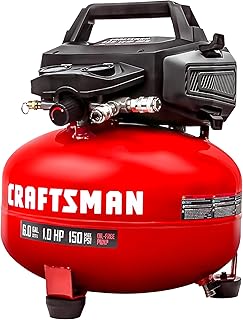
 CRAFTSMAN 6 Gallon 150 PSI Oil-Free Pancake AirMedium15.8 x 16.4 x 17 inches30.8 poundsCheck on Amazon
 CRAFTSMAN 6-Gal 150 PSI Oil-Free Pancake Air Compressor15.9 x 16.5 x 17.3 inches31.53 poundsCheck on Amazon
What's inside
- 1. Start with a 6-gallon pancake, because it covers 80% of garage air
- 2. Move to a twin-stack or wheeled portable only if you frame or roof
- 3. A 20 to 30-gallon vertical is the real air compressor for garage workshop upgrade
- 4. Stationary two-stage: buy it for one of three specific jobs
- What to skip
- Setup details that decide whether you like the thing
- FAQ
- Related Guides
- 1. Start with a 6-gallon pancake, because it covers 80% of garage air
- 2. Move to a twin-stack or wheeled portable only if you frame or roof
- 3. A 20 to 30-gallon vertical is the real air compressor for garage workshop upgrade
- 4. Stationary two-stage: buy it for one of three specific jobs
- What to skip
- Setup details that decide whether you like the thing
- FAQ
- Related Guides
As an Amazon Associate I earn from qualifying purchases. This post may contain affiliate links at no extra cost to you.
Most people buy the wrong air compressor for garage workshop use because they shop by tank size. Tank size is the least important number on the sticker. What actually decides whether a compressor can run the tool you bought it for is CFM at 90 PSI, and a 20-gallon tank with weak output will leave you standing around waiting for the motor to catch up while a 6-gallon unit with better recovery keeps going.
The other mistake is buying big first. A 60-gallon two-stage compressor bolted to the wall is a fantastic machine and completely wasted on someone who mostly needs to shoot brad nails, top off tires, and blow sawdust off a table saw. This ranking is ordered by what to buy first, not by price or prestige. Each tier lists the job it unlocks, because that is the only reason to move up.
As an Amazon Associate we earn from qualifying purchases at no extra cost to you.





| Tier | Typical size | Continuous CFM range | What it unlocks |
|---|---|---|---|
| 1. Pancake or hotdog | 4-6 gal | 2.0-2.6 @ 90 PSI | Brad/finish nailers, inflation, blowgun |
| 2. Twin-stack or wheeled portable | 8-10 gal | 3.0-4.0 @ 90 PSI | Framing nailer, roofing gun, light impact work |
| 3. Vertical single-stage | 20-30 gal | 4.5-6.5 @ 90 PSI | Impact wrench, die grinder, HVLP touch-up |
| 4. Stationary two-stage | 60-80 gal | 11-17 @ 175 PSI | Sandblasting, DA sanding all day, full paint work |
1. Start with a 6-gallon pancake, because it covers 80% of garage air
If you do not already own a compressor, this is the one to buy, and for a lot of people it is the last one they need. A 6-gallon oil-free pancake in the 2.0 to 2.6 CFM range runs any 18-gauge brad nailer or 16-gauge finish nailer without hesitation, fills car and trailer tires, feeds a blowgun for cleanup, and handles a small crown stapler for cabinet backs and upholstery.
The job it unlocks is trim and finish work. That is a real unlock: pneumatic finish nailers are still faster and lighter than cordless equivalents, and they leave smaller holes. A pancake also sets up in seconds, weighs 30-something pounds, and stores on a shelf instead of eating floor space you do not have.
What to look for: an oil-free pump you never have to service, a regulator and gauges you can read from standing height, and a decibel rating in the low-to-mid 70s if you work in an attached garage. Skip the ultra-cheap no-name units where the drain valve is a plastic petcock you cannot reach.
6-Gallon Pancake Compressor (Best First Buy)
Look for roughly 2.6 CFM at 90 PSI, oil-free, and a quiet rating if your garage shares a wall with the house. Brands like DeWalt, Bostitch, and Metabo HPT all sell essentially the same proven design, so buy on price, noise rating, and whether it comes bundled with a nailer you actually want. Do not pay extra for a bigger tank at this tier; pay for CFM and noise.
2. Move to a twin-stack or wheeled portable only if you frame or roof
The reason to step up from a pancake is not “more air in general.” It is one specific class of tool: high-consumption impact nailers. A framing nailer sinking 3-inch nails, a roofing coil gun, or a flooring cleat nailer will drain a 6-gallon tank and then run at the mercy of the pump.
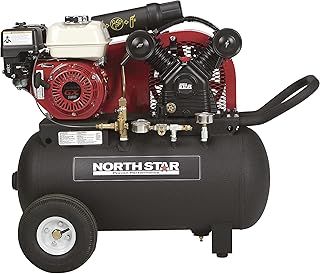
An 8 to 10-gallon twin-stack or wheeled portable in the 3.0 to 4.0 CFM range gives you enough recovery to keep a framing gun fed at a normal working pace. Wheels matter more than you expect, because these units are heavy enough that carrying them across a job site or up a driveway gets old fast.
This tier is also where cast-iron, oil-lubricated pumps start appearing. They are quieter and last longer, but they need level placement and periodic oil changes. If the compressor lives in a fixed spot, oil-lubed is worth it. If it rides in a truck bed, stay oil-free.
3. A 20 to 30-gallon vertical is the real air compressor for garage workshop upgrade
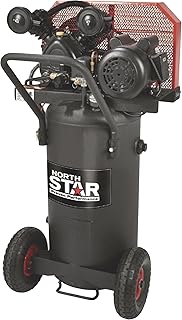
This is the tier where the compressor stops being a nail-gun accessory and becomes shop infrastructure. A 20 to 30-gallon vertical single-stage at 4.5 to 6.5 CFM at 90 PSI unlocks air tools that consume rather than sip: 1/2-inch impact wrenches for suspension and brake work, ratchets, cut-off tools in short bursts, die grinders, and small HVLP or detail spray guns for touch-up.
Vertical is the key word. Footprint is the currency of a garage, and a vertical tank takes roughly the space of a trash can while giving you tank volume that a wheeled portable cannot match. Most of these run on standard 120V, which means no electrician, though some 30-gallon models want a dedicated 20-amp circuit. Check that before you buy, and check it against your actual panel, not your optimism.
Be honest about duty cycle here. A single-stage 30-gallon can run an impact wrench all afternoon. It cannot run a dual-action sander continuously, because DA sanders want 8 to 12 CFM without pause and will simply outrun the pump. That is a tier-4 job.
20-30 Gallon Vertical Single-Stage
The sweet spot for a serious home garage. Prioritize CFM at 90 PSI over tank gallons, confirm the voltage and circuit requirement, and favor a cast-iron oil-lubricated pump for longevity. Add a decent inline filter and a quarter-turn ball valve on the drain, since the factory drain on almost every unit at this price is awkward to reach.
4. Stationary two-stage: buy it for one of three specific jobs
A 60 to 80-gallon two-stage compressor is a different category of machine. It runs on 240V, needs a dedicated circuit and often a hard-wired connection, weighs several hundred pounds, and pressurizes to around 175 PSI, which means the effective usable air in the tank is far greater than the gallon number suggests.
Buy one if you do bodywork with a DA sander, full-panel or whole-vehicle painting, or media blasting. Those three jobs demand sustained double-digit CFM and nothing smaller will do them without constant stopping. Buy one also if you plan to plumb hard lines around the shop and run multiple stations. Outside those cases, it is a lot of money and floor space for capacity you will never touch.
- ✔ Sustained CFM for sanders, blasters, and spray guns
- ✔ Higher pressure means more usable air per gallon
- ✔ Two-stage pumps run cooler and last for decades
- ✔ Quieter under load than a screaming oil-free portable
- ✘ Requires 240V and usually an electrician
- ✘ Effectively permanent once it is placed
- ✘ Costs several times a good 30-gallon unit
- ✘ Overkill for nailing, inflation, and occasional impact work
What to skip
Skip 1-gallon and 2-gallon “trim” compressors as your only compressor. They are quiet and cute, and the pump cycles nonstop the moment you do anything beyond a few brads. If you already own a 6-gallon, one of these makes sense as a second unit for finish work inside a house. As a first buy, it is a dead end.
Skip tank-size-only marketing. A 20-gallon tank fed by a 2.6 CFM pump is not an upgrade over a 6-gallon fed by 2.6 CFM. It just takes longer to fill and gives you one longer burst before the same bottleneck appears. Read the CFM at 90 PSI figure, and ignore “peak” or “displacement” CFM entirely, since those are theoretical.
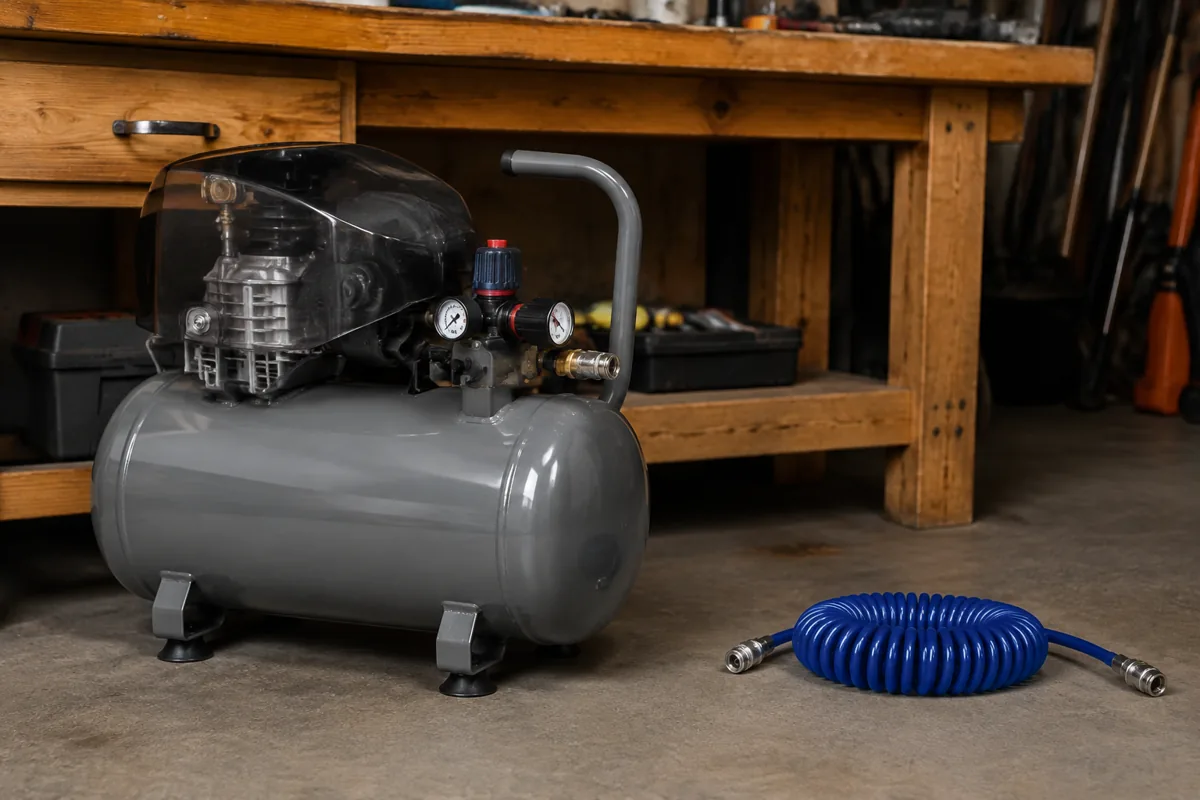
Skip the cheap recoil hose that came in the box. Coil hoses fight you, kink, and lose pressure over length. Get a 50-foot rubber or hybrid polymer hose in 3/8-inch for air tools, or 1/4-inch if you only shoot nails. This single swap improves the experience more than a tank upgrade.
Skip buying a compressor for tire inflation alone. A decent 12V portable inflator does that job for a fraction of the cost and lives in the trunk where you need it.
Skip skipping the water management. Every compressor makes condensate. Drain the tank after each session, and add an inline filter or water separator before any spray gun or air tool. Rust inside a tank is what turns a ten-year compressor into a three-year compressor.
Setup details that decide whether you like the thing
Noise is the number one reason garage compressors get resented. Oil-free direct-drive pumps in the older style commonly land in the high 70s to high 80s decibel range, which is genuinely unpleasant in an enclosed garage. The quieter modern units advertise low-to-mid 70s and the difference is dramatic in practice. If your shop shares a wall with a bedroom, treat noise as a primary spec.
Circuit capacity is the number two reason. A 120V compressor drawing near 15 amps on startup will trip a shared circuit when the shop lights, dust collector, and battery chargers are on the same run. Put the compressor on its own circuit if you can.
Finally, plan the accessory kit up front: a good regulator with a water trap, quality quick-connect fittings in one consistent style throughout the shop, thread sealant, and a ball-valve tank drain. Mixed fitting styles are a slow-motion annoyance that lasts as long as you own the shop.
FAQ
How many CFM do I actually need for a garage workshop? For nailing, inflation, and cleanup, roughly 2.5 CFM at 90 PSI is plenty. For impact wrenches and general automotive work, aim for 4.5 or more. For continuous sanding, blasting, or painting, you need double-digit CFM, which realistically means a two-stage stationary unit. Add up the requirement of the single thirstiest tool you own and add a margin; you rarely run two air tools at once in a one-person shop.
Is oil-free or oil-lubricated better? Oil-free wins on portability and zero maintenance and is the right call for pancakes and job-site units. Oil-lubricated cast-iron pumps run quieter and last significantly longer, so they are the better choice for anything that stays parked in one place. Neither is universally better; it tracks with whether the compressor moves.
Can one compressor handle both woodworking nailers and car work? Yes, and a 20 to 30-gallon vertical single-stage is exactly that compromise. It has more than enough for any nailer and enough recovery for impact wrenches and short bursts on grinders. The only thing it will not do well is continuous high-consumption work like DA sanding or spraying a whole vehicle.
Buy for the job you are actually doing this year. Most garages are best served by a quiet 6-gallon pancake now and a vertical 20 to 30-gallon later, once a specific tool forces the issue.
Check prices on Amazon →