
Key takeaways
- Hot dog air compressors compared on CFM at 90 PSI, tank size and noise, so your nailers and jobsite air tools keep firing without waiting on the tank.
What's inside
As an Amazon Associate I earn from qualifying purchases. This post may contain affiliate links at no extra cost to you.
A hot dog compressor lives or dies by one number: how much air it delivers at 90 PSI compared with what your tools consume. The long horizontal tank is easy to carry and slides into a truck bed or under a bench, but it holds only a gallon or two, so the pump must recover fast enough that a finish nailer, a stapler or a blow gun never leaves you standing around mid-task. Buyers fixate on maximum PSI, yet pressure on the gauge is not airflow in the hose.


This roundup is for trim carpenters, remodelers and punch-list crews whose air tools are nailers, staplers and small intermittent tools rather than grinders or sprayers. Every compressor below was chosen from the specifications on its Amazon product page, and every one uses the hot dog layout: a single horizontal cylindrical tank, distinct from flat pancake models and from stacked twin-tank designs.
Quick Picks
As an Amazon Associate we earn from qualifying purchases.
| Product | Best for | Key spec from title |
|---|---|---|
| California Air Tools 2010A | Quiet indoor trim work with the strongest airflow here | 1 HP, 2 gallon aluminum tank, 60 dBA |
| Makita MAC210Q | Daily jobsite carry where durability matters more than weight | 1 HP, 2 gallon, oil-free, 135 PSI |
| DEWALT D55140 | One-person trim and punch-list work in finished homes | 135 PSI max, 1 gallon tank, 2.6 amp |
| Senco PC1010 | The lightest carry for finish nailing room to room | 1/2 horsepower, 1 gallon hot dog tank |
How to Choose
Match CFM at 90 PSI to the Tool, Not the Tank
Air tools list their appetite in CFM at 90 PSI, and your compressor must replace air at least that fast over a work session. A brad or finish nailer sips air in bursts, so even 0.75 CFM at 90 PSI keeps up because the tank buffers each shot. A framing nailer driven hard, a die grinder or a spray gun drinks continuously and will outrun every hot dog model made. Read the tool’s stated consumption, compare it with the compressor’s delivery at 90 PSI, and be honest about which tools you actually run.
Tank Size Sets the Rhythm of the Motor
On a 1-gallon tank the motor cycles often, sometimes every handful of nails; on a 2-gallon tank the same work spreads into longer, less frequent runs. Neither is wrong, but the cycling pattern matters in a finished home where the compressor sits in the next room. Bigger hot dog tanks also add pounds. Decide whether you would rather hear the pump more often or carry more weight up the stairs, because in this shape of compressor you are always trading one against the other.
Noise Ratings Decide Where You Can Work
Standard jobsite compressors often run loud enough to banish themselves outside. The quiet models in this roundup publish figures from 60 to 69 decibels, which changes the work: the compressor can sit in the same room as the installer, conversations continue over it, and occupied homes stop being a problem. Ratings are measured differently between brands, so treat them as a class indicator rather than laboratory truth. If you work in finished, occupied spaces, the quiet class is worth prioritizing over a small CFM gain.
Oil-Free Pumps and Jobsite Handling
Every model here runs an oil-free pump, which removes oil checks from the morning routine and removes the spill risk when the unit tips in a truck bed. Oil-free also means the pump tolerates running on uneven ground, useful on renovation sites. What still matters is protection: roll cages and shrouded panels keep gauges and regulators alive through loading and unloading. Check how the carry handle balances the unit, because a hot dog tank carried by one hand all day should hang level, not drag at your leg.
The 4 Best Options
California Air Tools 2010A
The 2010A is the hot dog to pick when the work happens inside finished homes. Its published 60 dBA noise level is the lowest class here, and its 3.10 CFM at 90 PSI is the strongest delivery in this group, enough to keep a finish nailer or small framing work moving without the pause-and-wait rhythm smaller units impose. The 2-gallon aluminum tank keeps rust out of the stored air and keeps the unit light for its size, and the oil-free pump asks for nothing between jobs.
Specs
- Tank: 2 gallon aluminum, hot dog (horizontal) shape
- Motor: 1 HP
- Air delivery: 3.10 CFM at 90 PSI
- Max pressure: 120 PSI
- Pump: oil-free
- Noise: 60 dBA
- Weight: 35.3 lbs
Best for: Interior trim and remodeling crews who need real airflow without jobsite noise.
Watch out for: Max pressure is 120 PSI rather than the 135 PSI of rivals, so check any tool that specifies a higher working pressure.
Makita MAC210Q
Makita built the MAC210Q like it expects to be dropped. A full roll cage wraps the 2-gallon hot dog tank and pump, the motor turns at a low 1,750 RPM to stretch its working life, and the oil-free dual piston pump delivers 2 CFM at 90 PSI with a 135 PSI ceiling. At 60 dB it works in occupied rooms without complaint. The trade is weight: at 45.2 pounds it is the heaviest carry here, the price of the cage and the slower-turning induction motor.
Specs
- Tank: 2 gallon, hot dog shape in roll cage
- Motor: 1 HP induction, 1,750 RPM, 7 amps
- Air delivery: 2 CFM at 90 PSI, 3 CFM at 40 PSI
- Max pressure: 135 PSI
- Pump: oil-free dual piston
- Noise: 60 dB
- Weight: 45.2 lbs
Best for: Contractors who carry one compressor daily and value protection and longevity over lightness.
Watch out for: At 45.2 lbs it is a deliberate carry up stairs; if your work is mostly small trim rooms, a 1-gallon model may serve you better.
DEWALT D55140
The D55140 is DEWALT’s trim compressor formula kept simple: a 1-gallon hot dog tank, 135 PSI maximum, and a low 2.6-amp draw that behaves on the loaded circuits of older houses. Its 0.75 CFM at 90 PSI sounds small on paper, yet for the tool it was designed around — a finish or brad nailer firing in bursts — the tank covers each shot and the pump recovers between them. At 69 decibels it runs noticeably louder than the quiet-class pair above, but it stays compact and easy to live with.
Specs
- Tank: 1 gallon, hot dog shape
- Max pressure: 135 PSI
- Air delivery: 0.75 CFM at 90 PSI
- Motor draw: 2.6 amps
- Pump: oil-free
- Noise: 69 decibels
Best for: Solo remodelers running finish and brad nailers through punch lists in finished homes.
Watch out for: The 0.75 CFM delivery cannot sustain continuous-draw tools; it is a nailer compressor, not a sprayer or grinder supply.
Senco PC1010
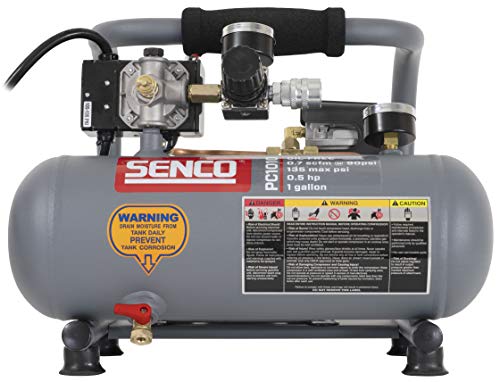
The PC1010 is the hot dog in its purest form: 1 gallon, 20 pounds, and a title that says finish and trim because that is exactly its envelope. Senco rates the running motor at 1/2 horsepower, the pump is oil-less, and the whole unit carries in one hand from room to room without planning the trip. For an installer hanging casing, setting base or firing a pin nailer through a day’s punch list, that lightness is a working feature, not a compromise. It simply asks you to respect its small appetite for air.
Specs
- Tank: 1 gallon, hot dog shape
- Motor: 1/2 HP running (1 HP peak)
- Max pressure: 125 PSI
- Pump: oil-less (oil-free)
- Weight: 20 lbs
- Intended use per listing: finish and trim
Best for: Finish carpenters who move room to room and want the lightest possible nailer supply.
Watch out for: The 1-gallon tank cycles the motor frequently under steady nailing; confirm the current listing’s configuration, since Senco also sells a revised PC1010N variant.
Which One Fits Your Situation
You Install Trim in Occupied Homes All Week
Choose the California Air Tools 2010A. Its 60 dBA operation lets the compressor share the room with you, and its 3.10 CFM at 90 PSI is the only delivery here with real headroom above nailer demand. The Makita MAC210Q matches the quiet rating if your priority shifts toward surviving drops and daily truck duty.
Your Compressor Rides in the Truck Every Single Day
Take the Makita MAC210Q. The roll cage, low-RPM induction motor and dual piston pump are built for repeated loading, unloading and rough floors. You pay in carry weight, but for a tool that earns money daily, that protection and a longer-lived pump outweigh a lighter frame that needs gentler handling on every single trip.
You Work Alone Through Punch Lists and Small Repairs
The DEWALT D55140 fits this rhythm: small tank, modest draw, quick to set down and quick to stow. Its airflow ceiling rules out thirsty tools, but punch-list work is brad nails, staples and a blow gun, all of which it covers. The Senco PC1010 is the alternative when even the DEWALT feels like more than the job needs.
You Want the Lightest Possible Carry for Finish Nailing
Pick the Senco PC1010 at 20 pounds. Nothing else here comes close for staircases and room-to-room moves. Accept its frequent cycling as the direct cost of that low weight, and keep it on finish tools; asking it to feed a framing crew turns its lightness into a bottleneck for everyone on site.
Common Mistakes
- Shopping by maximum PSI instead of CFM at 90 PSI, then discovering the tool outruns the pump within a minute.
- Expecting a 1- or 2-gallon hot dog to run a spray gun, sander or die grinder, which are continuous-draw tools far beyond this class.
- Ignoring noise ratings until the first job in an occupied home, where a loud compressor gets exiled to the yard and hoses multiply.
- Forgetting that oil-free still needs draining; moisture collects in any tank, and an undrained hot dog tank rusts from the inside.
- Running two hungry tools off one small compressor with a splitter and blaming the tools for weak drives.
Frequently Asked Questions
What tools can a hot dog compressor actually run on a jobsite?
Nailers and staplers are its home ground: pin, brad and finish nailers, narrow-crown staplers, plus intermittent tools like blow guns and tire inflators. These draw air in bursts, so a small tank and modest CFM keep pace. Continuous tools such as grinders, sanders and spray guns need a much larger compressor and tank.
Is 2 CFM at 90 PSI enough for a framing nailer?
For occasional framing shots, a 2 CFM unit with a 2-gallon tank can keep up in bursts, but sustained framing pace will pull the tank down and force recovery pauses. The California Air Tools 2010A at 3.10 CFM gives more headroom. A dedicated framing crew should step up to a larger twin stack or wheelbarrow compressor instead.
Why choose a hot dog tank over a pancake compressor?
The hot dog’s long horizontal tank slides into truck beds, under benches and onto shelves where a pancake’s round footprint will not fit, and it tends to sit stably on uneven ground. Performance at the same gallon size is similar, so the choice is mostly about storage shape and carry balance in your vehicle and workspace.
How loud is 60 decibels compared with a normal jobsite compressor?
Sixty decibels is roughly conversation level, while many standard portable compressors run 75 to 85 decibels or more, which forces raised voices and hearing protection indoors. Because brands measure noise differently, compare models as classes: the 60 dB units here are meaningfully quieter than the 69 dB class, and both are far easier to work beside all day.
Related guides
More from Amazon
Programs that pair well with the guide above. Offers and eligibility are set by Amazon and may change.
A free business account with business pricing and bulk-buying tools for work, shop or home office.
Create a business accountFree shipping on eligible items, Prime Video and more. Eligible new members can start with a free trial.
Start a Prime free trialAudiobooks and podcasts to listen to on the go. Eligible new members can start with a free trial.
Try Audible freeAd-free music streaming. Eligible new subscribers can start with a free trial.
Try Music Unlimited freeAs an Amazon Associate we earn from qualifying purchases.





Write Your Review
No reviews yet. Be the first to share your experience!