
Key takeaways
- Compare four contractor-grade 10-inch wet tile saws for large-format porcelain and stone, with rip capacity and specs taken from each Amazon listing.
What's inside
As an Amazon Associate I earn from qualifying purchases. This post may contain affiliate links at no extra cost to you.
The real decision behind a contractor tile saw is not blade size — it is whether the machine keeps a 24-inch porcelain plank tracking straight on the last cut of the day, after a week of slurry, loading, and unloading. Rip capacity decides which tile formats you can take on at all, cart and rail quality decides how much time goes to re-cuts, and water containment decides whether you can set up inside a finished home or get banished to the driveway.

This roundup is for tile setters, flooring crews, and remodelers who cut tile for a living and need a saw that earns its space in the truck. Every saw below is a 10-inch wet tile saw sold on Amazon, chosen from the capacity, motor, and weight figures printed on its own listing, so the numbers here match what each product page claims.
Quick Picks
As an Amazon Associate we earn from qualifying purchases.
| Product | Best for | Key spec from title |
|---|---|---|
| DEWALT Wet Tile Saw with Stand, 10 Inch, 15-Amp (D36000S) | Large-format floors and full-time tile crews | 37 in. rip cut capacity |
| DEWALT Wet Tile Saw with Stand, 10-Inch, Corded (D24000S) | Solo contractors who load and set up alone | 69 lbs, lightest in its class |
| Delta 10 in. Cruzer Wet Tile/Stone Saw (96-110) | Crews splitting work between tile and stone | 34 in. max rip cut |
| VEVOR Wet Tile Saw with Stand, 10-inch | Budget-conscious crews cutting big tile | 36 in. tile capacity |
How to Choose
Match Rip Capacity to the Tile You Actually Install
Rip capacity is the first filter, because it cannot be worked around later. A saw rated for a 24 or 25 inch rip handles standard 12×24 porcelain by cutting the long edge, but 36 inch planks and 24×48 panels demand a high-capacity frame or a plunge technique to finish the cut. Check the diagonal figure too: it tells you the largest square tile you can cut corner to corner without flipping the piece. Buy for the biggest format on your upcoming bids, not the average bathroom, or you will rent a bigger saw mid-job.
Judge the Cart, Rails, and Stated Accuracy
On a sliding-table saw, the tile rides into a fixed blade, so cut quality lives in the cart hardware. Stainless-steel rollers and a rigid frame resist the wobble that turns into chipped edges and drifting lines over a long rip. Some listings state an accuracy figure, such as holding within 1/32 inch over a 30 inch cut — that is the number that matters on visible grout lines. A cutline indicator helps you start the cut in the right place instead of creeping up on the mark and wasting a tile.
Plan Water Management Around Where You Set Up
Every wet saw makes slurry; the difference is where it lands. Rear and side water trays, adjustable nozzles, and a contained pan let you work inside a finished space without flooding the subfloor, while a basic reservoir setup belongs outdoors or in an unfinished shell. Think about drainage as well: a pan you can pull and dump speeds end-of-day cleanup, and a submersible pump in a separate fresh-water bucket keeps gritty recycled water off the blade. Crews doing occupied remodels should weight containment as heavily as capacity.
Weigh Portability Against Daily Setup Time
A saw that lives on a stand cuts faster all day, but someone still has to get it through the door and up the stairs. Published weight ranges from under 70 pounds for a one-person carry to well over 100 pounds for the biggest frames, and width matters too — a saw under 30 inches wide passes a standard doorway without disassembly. Caster wheels help on flat slabs, not on stairs. Match the machine to your typical access: walk-up condos punish heavy saws, while slab-on-grade work barely notices them.
The 4 Best Options
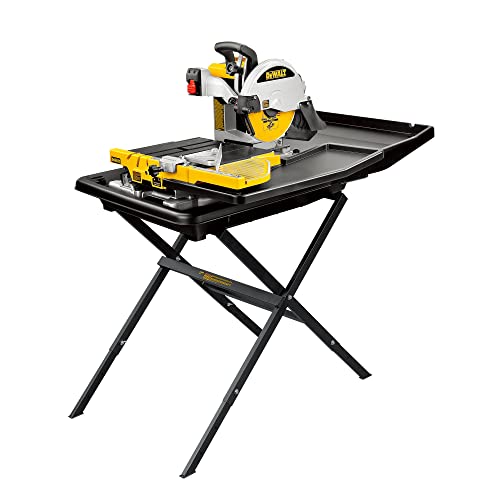
DEWALT Wet Tile Saw with Stand, 10 Inch, 15-Amp, 1,220 MWO, Corded (D36000S)
This is the high-capacity option for crews whose work has moved to large-format tile. The listing leads with a 37 inch rip capacity that stretches to 41 inches with a plunge, plus 18 inches of clearance left of the blade, so a 36×36 tile can be ripped in half without flipping it. Stainless-steel rollers, a rigid frame, and a cutline indicator support the stated accuracy, and the full tray system contains oversized tile indoors. At 91 pounds it is a two-stage lift, but the 28-7/8 inch width still passes a standard 30 inch doorway.
Specs
- Blade diameter: 10 inches
- Motor: 15-amp, 1,220 MWO, corded
- Rip capacity: 37 in. (41 in. with plunge)
- Crosscut capacity: 8-1/2 in.
- Cutting accuracy: within 1/32 in. over 30 in. cuts
- Weight: 91 lbs
- Includes: D24001 stand, DW4764 porcelain tile blade, submersible pump, water pan, side and rear water trays, cutting cart with side extension, angle/rip guide
Best for: Tile contractors ripping 36 inch tile and long planks every week.
Watch out for: The 91 lb frame and full tray setup take longer to assemble and break down than a compact saw.
ASIN: B08526D2PK
DEWALT Wet Tile Saw with Stand, 10-Inch, Corded (D24000S)
The D24000S is the long-running jobsite standard for installers who work alone. Its cantilevering rail and cart system delivers 25 inch rip cuts and 28 inch plunge cuts, and it handles an 18×18 inch tile on the diagonal — enough for the bulk of kitchen and bathroom work. The selling point is the 69 pound weight, the lightest in its class according to the listing, which makes one-person loading and setup realistic. Dual water nozzles and an integrated miter for 45 and 22.5 degree cuts round out a saw built around daily transport.
Specs
- Blade diameter: 10 inches
- Motor: 15-amp, 1.5 HP, corded
- No-load speed: 4,200 RPM
- Rip capacity: 25 in. (28 in. with plunge)
- Diagonal capacity: 18 in. x 18 in.
- Max depth of cut: 3-1/8 in.
- Arbor: 5/8 in.
- Weight: 69 lbs
- Includes: folding stand, integrated 45/22.5 degree miter, dual water nozzles
Best for: Solo tile setters and remodelers who set up and tear down daily.
Watch out for: Crews regularly installing tile longer than 24 inches will run out of rip capacity.
ASIN: B000J0BG7W
Delta 10 in. Cruzer Wet Tile/Stone Saw (96-110)
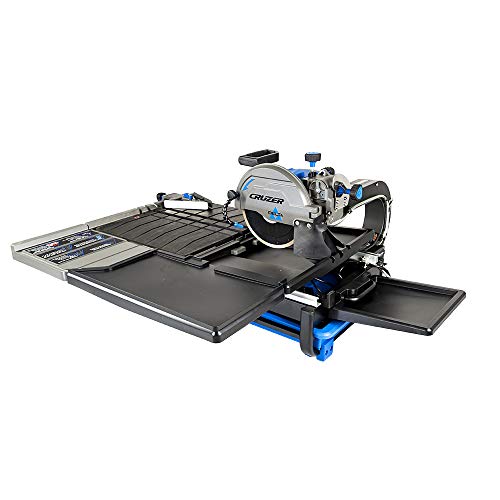
The Cruzer splits the difference between the two DEWALT designs and adds a stone rating to its name, which suits contractors who cut tile one week and pavers or stone veneer the next. Its listing claims a 34 inch maximum rip and a 24 inch square tile on the diagonal, both ahead of the compact DEWALT, with a 3-3/8 inch depth of cut at 90 degrees for thicker material. The tilting head covers 0, 22.5, and 45 degrees for bevel work, and the sliding table design keeps the operator’s hands off the feed path on long cuts.
Specs
- Blade diameter: 10 inches
- Motor: 15-amp, 120V
- No-load speed: 4,200 RPM
- Arbor: 5/8 in.
- Max rip cut: 34 in.
- Max depth of cut: 3-3/8 in. at 90 degrees, 1-7/8 in. at 45 degrees
- Diagonal capacity: 24 in. square tile
- Tilting range: 0°, 22.5°, 45°
Best for: Contractors mixing porcelain floors with stone and paver work.
Watch out for: Confirm which stand configuration the listing includes before ordering, since the saw is sold in more than one configuration.
ASIN: B07Y5TL11L
VEVOR Wet Tile Saw with Stand – 10-inch 65Mn Steel Blade
The VEVOR is the value play for a crew that needs big-format capacity on a second saw or a growing business watching equipment spend. The listing claims a 36 inch tile capacity and 24 inch diagonal cutting capacity, a 3.8 inch maximum cutting depth, and a 15-amp motor spinning the 65Mn steel blade at 4,500 RPM. An infrared guide line helps align cuts, the bevel adjusts from 0 to 45 degrees with marked stops, and caster wheels move the stand around a flat jobsite. The trade-off is heft: at 116.4 pounds it stays where you park it.
Specs
- Blade diameter: 10 inches, 65Mn steel
- Motor: 15-amp, 4,500 RPM
- Tile capacity: 36 in.
- Diagonal cutting capacity: 24 in.
- Max cutting depth: 3.8 in.
- Bevel range: 0°-45° (marked at 0°/22.5°/45°)
- Table material: die-cast aluminum
- Weight: 116.4 lbs
- Model: TC250VI-I
- Includes: stand with caster wheels, detachable water reservoir and pump, infrared guide
Best for: Crews adding a large-capacity saw for big tile without flagship money.
Watch out for: At 116.4 lbs it is the heaviest saw here, so plan on two people for stairs and truck loading.
ASIN: B0CGX5YXWC
Which One Fits Your Situation
You Install Large-Format Tile All Week
Choose the DEWALT D36000S. The 37 inch rip capacity and 18 inches of clearance left of the blade mean 36 inch tile goes through in one pass, and the tray system keeps that work indoors. The Delta Cruzer is the fallback if stone work shares the schedule, but for pure large-format volume the DEWALT’s stated accuracy over 30 inch cuts is the deciding figure.
You Work Alone and Move Jobs Every Few Days
Choose the DEWALT D24000S. At 69 pounds it is the only saw in this group one person can realistically carry, set up, and load back into the truck without help. Its 25 inch rip still covers standard 12×24 porcelain, which is most residential work. The compromise is real but narrow: oversized planks beyond its plunge range are the jobs you would have to pass on or rent for.
Your Schedule Mixes Tile, Stone, and Pavers
Choose the Delta 96-110 Cruzer. The 34 inch rip and 3-3/8 inch depth of cut handle thick stone and paver stock that shallower saws struggle with, and the 24 inch diagonal capacity covers big square formats. It gives up the DEWALT D36000S’s extreme rip length, but for a mixed-material contractor the deeper cut is the more useful number across a varied week.
You Need a Second Saw for a Growing Crew
Choose the VEVOR. Its 36 inch tile capacity lets an apprentice crew run big tile on site while your main saw stays on the primary job, and the infrared guide helps less experienced hands line up cuts. Park it on flat ground where its wheels work and its weight stops mattering, and treat it as a stationary station rather than a daily carry.
Common Mistakes
- Buying rip capacity for the tile you install today, then winning a large-format job the saw cannot finish in one pass.
- Ignoring diagonal capacity and discovering a 24 inch square tile only fits corner to corner on a bigger saw.
- Setting up a basic-reservoir saw inside a finished home and flooding the subfloor with slurry the trays were never designed to catch.
- Judging a saw by motor amps alone while the cart rollers and frame rigidity — the parts that hold a long cut straight — go unchecked.
- Forgetting access: a saw that cannot pass the doorway or climb the stairs in one piece costs setup time on every single job.
Frequently Asked Questions
What rip capacity does a contractor actually need?
Match it to your largest recurring format. A 25 inch rip covers 12×24 porcelain cut lengthwise, which is the residential standard. If your bids include 36 inch planks or 24×48 panels, step up to a high-capacity saw in the 34 to 37 inch range, or plan on plunge techniques and flipped cuts that cost time and accuracy on every piece.
Can one person move a contractor tile saw alone?
Only the lightest designs make that realistic. A saw around 69 pounds, like the D24000S above, is a genuine one-person carry for most installers. Saws over 90 pounds are a two-person lift in practice, especially on stairs, and the heaviest stand saws should be treated as park-and-leave equipment that moves on wheels between flat work areas.
Why does diagonal capacity matter if rip capacity is listed?
Rip capacity describes a straight cut along the fence; diagonal capacity describes the largest square tile that fits corner to corner under the blade. A 24 inch square tile needs roughly 34 inches of diagonal room. Saws publish both numbers because a model can rip a long plank yet still fail to diagonal-cut the big square format your layout requires.
Is a stand worth it for jobsite tile work?
For full-day cutting, yes. A stand puts the cart at working height, which speeds feeding and reduces back strain across hundreds of cuts, and it keeps the water pan level so containment works as designed. Tabletop use makes sense for a quick repair visit, but contractors cutting daily will feel the difference a stand makes before the first week ends.
Related guides
More from Amazon
Programs that pair well with the guide above. Offers and eligibility are set by Amazon and may change.
A free business account with business pricing and bulk-buying tools for work, shop or home office.
Create a business accountFree shipping on eligible items, Prime Video and more. Eligible new members can start with a free trial.
Start a Prime free trialAudiobooks and podcasts to listen to on the go. Eligible new members can start with a free trial.
Try Audible freeAd-free music streaming. Eligible new subscribers can start with a free trial.
Try Music Unlimited freeAs an Amazon Associate we earn from qualifying purchases.




Write Your Review
No reviews yet. Be the first to share your experience!