What's inside
- Top 3 Picks
- Quick Comparison
- How We Chose
- 1. SuperHandy Material Lift Stacker – Best for Tight Shops and Light Loads
- 2. BILT HARD Manual Pallet Stacker Material Lift – Best for Heavy Loads Without Power
- 3. Goodyear Material Lift Winch Stacker – Best for Rough Floors and Mixed Surfaces
- 4. VEVOR Full Electric Pallet Stacker – Best for Full Pallets to High Racking
- 5. AECOJOY Hydraulic Material Lift Winch Stacker – Best Budget Pick for 500 lb Loads
- 6. MMS Foldable Hydraulic Material Lift Winch Stacker – Best for Shops Short on Storage
- 7. VEVOR Hydraulic Material Lift Winch Stacker – Best Budget Pick With a Work Surface
- 8. BILT HARD Semi-Electric Pallet Stacker – Best for Very High Reach at Moderate Frequency
- 9. APOLLOLIFT Semi-Electric Pallet Stacker – Best for Open-Bottom Pallets and Skids
- 10. APOLLOLIFT Material Lift Winch Stacker – Best Low-Cost Winch Lift for Occasional Use
- 11. ELOMBR 122″ Material Lift Winch Stacker – Best for Tall Manual Lifts With Straddle Support
- 12. ELOMBR 122″ 400 lbs Hand Winch Lift Truck – Best for High-Reach Manual Work With Fixed-Leg Stability
- How to Choose
As an Amazon Associate I earn from qualifying purchases. This post may contain affiliate links at no extra cost to you.
The best stacker lift for most small workshops, garages, and light commercial back rooms is the SuperHandy Material Lift Stacker, a 330 lb unit with a 40-inch lift that rolls through a standard doorway, needs no battery or cord, and covers the height band where most real lifting happens — bench, tailgate, shelf, and light cart transfer. It suits a one- or two-person operation moving crates, engine parts, tile boxes, bagged material, or tooling, and it costs a fraction of a powered pallet stacker. It is the wrong tool if you move palletized freight above a few hundred pounds, or if you need to reach racking higher than a person can comfortably stack by hand. For that, step up to the BILT HARD 2,200 lb manual pallet stacker for heavy but infrequent lifts, or the VEVOR full electric 3,300 lb stacker if you move full pallets to 98 inches all day. Everything below is organized around the four numbers that actually decide a stacker purchase: rated capacity, lift height, power type, and aisle maneuverability.
Our Top Picks
 VEVOR Full Electric Pallet Stacker67.71 x 47.24 x 86.02 in67.8 x 47.09 x 70.59 inches1383.4 PoundsCheck on Amazon
 MMS Foldable Hydraulic Material Lift Winch Stacker33.5 x 21.3 x 47.6 inches100 PoundsCheck on Amazon


Top 3 Picks
Best Overall: SuperHandy Material Lift Stacker
The 330 lb capacity and 40-inch lift match the overwhelming majority of light workshop and small-business tasks, and the manual power type means no charging, no hydraulic power pack to service, and no outlet near the work area. It is the pick for anyone whose heaviest lift is a crate, a machine part, or a stack of stock rather than a loaded pallet, and who values a compact footprint over speed.
Best Budget: AECOJOY Hydraulic Material Lift Winch Stacker
With a 500 lb rating, the AECOJOY unit gives you more headline capacity than several mid-range competitors at a budget-tier price. The trade-off is a winch-driven lift rather than a powered or foot-pump system, so cycle times are slower and the finish and hardware are built to a lower cost target — but for occasional lifting it is the best value in this list.
Best Premium: VEVOR Full Electric Pallet Stacker
A 3,300 lb capacity and a 98.4-inch lift height put this in a different category entirely: it is a battery-powered walkie stacker that drives under its own power and lifts full pallets to standard racking height. It is the right answer for anyone whose throughput or load weight has outgrown a manual unit, and the price tier reflects the battery, drive motor, and heavier mast.
Quick Comparison
| Product | Best for | Key specs | Price tier |
|---|---|---|---|
| SuperHandy Material Lift Stacker | Light loads in tight spaces | 330 lb capacity; 40 in lift; manual; compact frame | Mid-range |
| BILT HARD Manual Pallet Stacker | Heavy loads lifted by hand, low frequency | 2,200 lb capacity; 63 in lift; manual hydraulic; adjustable forks | Premium |
| Goodyear Material Lift Winch Stacker | Rough floors and mixed surfaces | 330 lb capacity; 40 in lift; 8 in wheels; swivel casters | Mid-range |
| VEVOR Full Electric Pallet Stacker | Full pallets to high racking | 3,300 lb capacity; 98.4 in lift; battery drive and lift | Premium |
| AECOJOY Hydraulic Material Lift Winch Stacker | Budget buyers lifting up to 500 lb | 500 lb capacity; hydraulic winch; manual | Budget |
| MMS Foldable Hydraulic Material Lift Winch Stacker | Shops that must store the lift out of the way | 450 lb capacity; 35.8 in lift; 9 in wheels; 360° swivel casters; folds | Budget |
| VEVOR Hydraulic Material Lift Winch Stacker | Light loads plus a usable work surface | 450 lb capacity; winch; fork lift table | Budget |
| BILT HARD Semi-Electric Pallet Stacker | Very high reach at moderate frequency | 3,300 lb capacity; 118 in lift; semi-electric walkie | Premium |
| APOLLOLIFT Semi-Electric Pallet Stacker | Open-bottom pallets and skids | 3,300 lb capacity; 118 in lift; fixed legs; semi-electric | Premium |
| APOLLOLIFT Material Lift Winch Stacker | Occasional light lifting on a tight budget | 330 lb capacity; 40.5 in lift; manual winch | Budget |
| ELOMBR 122″ Material Lift Winch Stacker | Tall manual lifts with straddle support | 400 lb capacity; 122 in lift; fixed straddle; hand winch | Mid-range |
| ELOMBR 122″ 400 lbs Hand Winch Lift Truck | High-reach manual work with fixed-leg stability | 400 lb capacity; 122 in lift; fixed-leg; hand winch | Mid-range |
How We Chose
Selection here is based on published specification sheets, manufacturer documentation, and established category knowledge about how each class of lift behaves in service — not on physical testing. Four criteria drove every pick. First, specification honesty: capacity and lift height were taken at face value from the listing, and where a number was ambiguous (for example, whether a capacity is rated at a 24-inch load center), we treated it as a class characteristic rather than a guarantee. Second, category fit: a 330 lb material lift and a 3,300 lb pallet stacker solve different problems, so each product was judged against the job it is actually built for rather than against the whole list. Third, use case and frequency: occasional lifts favor manual power, daily pallet movement favors powered drive. Fourth, upgrade path: we favored products whose capacity and height class make sense for a buyer who may grow into a larger unit later, so the money spent at the entry level is not wasted.
1. SuperHandy Material Lift Stacker – Best for Tight Shops and Light Loads
As an Amazon Associate we earn from qualifying purchases at no extra cost to you.

This is the unit most people should buy first. The SuperHandy Material Lift Stacker is rated for 330 lb and lifts to 40 inches, which maps almost exactly onto the height of a typical workbench, a pickup tailgate, a van floor, and the lower two shelves of a standard storage rack. It is a manual lift with no battery and no cord, so it works in a garage with one outlet, in a trailer, or on a job site where power is not available. The frame is compact enough to store against a wall and to roll through a standard doorway with the mast upright.
Key specs
- Rated capacity: 330 lb (150 kg class)
- Maximum lift height: 40 in
- Power type: manual — no battery, no cord, human-powered pump/crank
- Configuration: compact straddle-style frame with forks, sized for crates, cartons, and small skids rather than full pallets
- Mobility: caster-mounted for smooth concrete and shop floors
- Best surface: sealed concrete, epoxy shop floor, tile, asphalt
The strengths are simplicity and fit. Because nothing needs charging, the unit is always ready, which matters more than raw speed for anyone lifting five or ten times a day. The 40-inch lift height is also the sweet spot for ergonomics: it takes the load off your back at exactly the height where manual lifting causes the most strain, without paying for mast height you will never use. The 330 lb rating comfortably covers a loaded hand truck’s worth of material, a small engine, a stack of tile, or a full crate of fasteners.
Pros
- No battery, no charger, no power cord — always ready to use
- Compact enough to store in a small shop and roll through a standard doorway
- 40-inch lift covers bench, tailgate, and low-shelf work
- Simple mechanism means few failure points and easy field maintenance
- Mid-range price tier for a lift that covers the most common light tasks
Cons
- 330 lb capacity rules out loaded pallets and heavy machinery
- Manual power means slower cycle times than a powered stacker
- 40-inch maximum lift will not reach racking beams or truck beds on lifted vehicles
- Small casters are not suited to gravel, dock plates, or badly broken concrete
Against the nearest alternative in this list, the Goodyear Material Lift Winch Stacker, the SuperHandy wins on footprint and price tier, while the Goodyear unit wins on rolling resistance because of its larger 8-inch wheels and swivel casters. If your floor is smooth and your space is tight, choose the SuperHandy; if you regularly cross expansion joints, ramps, or rough outdoor concrete, the bigger wheels on the Goodyear are worth the extra money. Compared with the budget APOLLOLIFT Material Lift Winch Stacker, the SuperHandy costs more but sits in a higher build class and a better-supported brand ecosystem.
2. BILT HARD Manual Pallet Stacker Material Lift – Best for Heavy Loads Without Power

The BILT HARD Manual Pallet Stacker is the bridge between a light material lift and a true pallet stacker. It is rated for 2,200 lb and lifts to 63 inches, and it uses adjustable forks, which means it can pick up a real pallet rather than only a crate or a skid. Crucially, it is still a manual machine — no battery, no charger, no electric drive motor to service — which makes it the pick for a farm shop, a fabrication bay, or a warehouse corner where lifting happens a few times a day rather than a few times an hour.
Key specs
- Rated capacity: 2,200 lb
- Maximum lift height: 63 in
- Power type: manual hydraulic — foot or hand pump with a controlled lowering valve
- Forks: adjustable spread, pallet-capable
- Best for: palletized stock, bagged material, drums on pallets, machinery components
- Footprint: significantly larger and heavier than a 330 lb material lift
The value proposition is straightforward: you get pallet-scale capacity and van-height lifting without buying into batteries, chargers, or motor replacement. The 63-inch lift covers loading a box truck or trailer, working at the top of a bench, and servicing equipment at chest height. The hydraulic system is also the part most users can maintain themselves — a pump, a cylinder, a release valve, and a reservoir, all of which are understandable and serviceable with basic tools.
Pros
- 2,200 lb capacity handles genuine palletized freight
- 63-inch lift covers truck beds, trailers, and low racking
- Adjustable forks accept standard pallets rather than only custom skids
- No battery means no charging routine and no runtime limit
- Hydraulic system is field-serviceable with common tools
Cons
- Premium price tier for a non-powered machine
- Manual pumping a 2,200 lb load is slow and physically demanding
- Heavy and bulky — needs real floor space and a solid surface
- 63 inches is well short of standard 96-inch and 120-inch racking beams
Compared with the VEVOR Full Electric Pallet Stacker, the BILT HARD manual unit costs less, never needs a charge, and is simpler to keep running — but it cannot match the electric unit’s 98.4-inch reach or its throughput. If you lift more than roughly twenty pallets a day, the manual unit becomes an ergonomic liability and the electric unit earns its price. Against the lighter SuperHandy lift, this BILT HARD machine is a full category step up in capacity and height, and the two are complementary rather than competing: many shops eventually own one of each.
3. Goodyear Material Lift Winch Stacker – Best for Rough Floors and Mixed Surfaces
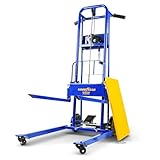
The Goodyear Material Lift Winch Stacker is a 330 lb, 40-inch-lift unit with one meaningful difference from the rest of the light class: 8-inch wheels and swivel casters. That combination changes where the machine can go. Large wheels roll over expansion joints, dock plates, cracked concrete, and short gravel runs that would stop a small-caster lift dead, and swivel casters make it far easier to position in a tight corner. For a shop that moves loads between a building and a yard, or across a loading area, this is the light-duty pick.
Key specs
- Rated capacity: 330 lb
- Maximum lift height: 40 in
- Power type: manual winch — no battery, no cord
- Wheels: 8 in, with swivel casters for tight maneuvering
- Form factor: pallet truck dolly / stacker hybrid with forks
- Best surface: mixed — sealed concrete, asphalt, dock plates, packed gravel
Winch operation is the other distinguishing feature. A winch gives smooth, controlled lifting and a predictable lowering rate, and it holds position without a hydraulic valve creeping down over time. The trade-off is speed: a winch is slower per lift than a foot-pump hydraulic, and at 330 lb you will notice the effort at the top of the stroke. The larger wheels partly compensate by reducing the energy spent just moving the machine around.
Pros
- 8-inch wheels handle surfaces that defeat small-caster lifts
- Swivel casters make tight-corner positioning much easier
- Winch holds load position securely without hydraulic creep
- Well-known brand with broad parts and accessory availability
- Mid-range price tier for a genuinely more mobile machine
Cons
- 330 lb capacity and 40-inch lift keep it in the light-duty class
- Winch lifting is slower than a hydraulic foot pump
- Larger wheels raise the deck height slightly, which affects low-clearance work
- Overkill if your floor is smooth and your space is generous
Against the SuperHandy Material Lift Stacker, the Goodyear gives up nothing in capacity or height and gains real mobility — the difference is entirely in the wheels and the lifting mechanism. Choose the Goodyear when the machine has to travel; choose the SuperHandy when it lives in one bay. Against the budget APOLLOLIFT Material Lift Winch Stacker, the Goodyear costs more but the wheel and caster package is the single most noticeable upgrade in this entire price band for anyone working on imperfect floors.
4. VEVOR Full Electric Pallet Stacker – Best for Full Pallets to High Racking

The VEVOR Full Electric Pallet Stacker is a different animal from everything above it in this list. At 3,300 lb capacity and a 98.4-inch lift height, it is a battery-powered walkie stacker that drives under its own power and lifts full pallets to standard racking height. This is the pick for a small warehouse, a distributor, or a growing shop that has moved past manual handling and needs to place and retrieve palletized goods on beams rather than at floor level.
Key specs
- Rated capacity: 3,300 lb
- Maximum lift height: 98.4 in
- Power type: full electric — battery-powered drive and lift
- Form factor: walkie pallet stacker with forks
- Runtime class: battery packs in the 24 V to 48 V class typical of walkie stackers, sized for a working shift of intermittent use
- Best for: standard pallet racking, loading docks, high-density storage
Two things justify the premium tier. The first is height: 98.4 inches reaches typical racking beams at 96 inches with a few inches to spare for fork and pallet thickness, which is exactly the number that matters when you are comparing units. The second is throughput. Because the machine drives and lifts electrically, a full put-away-and-retrieve cycle takes a fraction of the time a manual stacker needs, and the operator is not exhausted by mid-shift. For anyone doing more than a couple of dozen pallet moves a day, that difference in labor is the real return on the purchase.
Pros
- 3,300 lb capacity covers genuine loaded pallets
- 98.4-inch lift reaches standard racking beams
- Electric drive and lift dramatically reduce operator fatigue
- Much higher throughput than any manual unit in this list
- Scales with a growing operation instead of being outgrown
Cons
- Premium price tier — the highest investment class here
- Requires charging infrastructure and a battery maintenance routine
- Heavier and longer than a material lift, so aisle width matters more
- Overkill for a shop that lifts a few crates a week
Against the BILT HARD Manual Pallet Stacker, this VEVOR unit is faster, reaches 35 inches higher, and lifts 1,100 lb more — but it costs far more and adds a battery to your maintenance list. The decision is almost entirely about frequency: under roughly twenty lifts a day, the manual unit is fine; above that, the electric pays for itself in labor and in backs. Against the BILT HARD Semi-Electric Pallet Stacker, the VEVOR trades 20 inches of maximum height for powered drive, which is the better trade if your racking tops out at 96 inches and your aisles are long.
5. AECOJOY Hydraulic Material Lift Winch Stacker – Best Budget Pick for 500 lb Loads

The AECOJOY Hydraulic Material Lift Winch Stacker is the best value in this list for anyone who needs a little more than the standard 330 lb light-duty capacity. It is rated for 500 lb, which is enough for a filled drum, a heavy crate, a small engine on a pallet, or a stack of dense material, and it does it at a budget-tier price. It is a manual machine — hydraulic winch, no battery — so it suits occasional lifting rather than daily production work.
Key specs
- Rated capacity: 500 lb — the highest in the budget group
- Power type: manual hydraulic winch
- Form factor: material lift winch stacker with forks
- Best for: garages, small workshops, storage units, occasional loading
- Build class: budget-tier steel frame and hardware; expect a lighter finish than mid-range units
The 500 lb rating is the headline, and it is a real advantage: it sits about 50 percent above the 330 lb class that dominates light-duty stackers, which means it covers the awkward loads that are just too heavy for a standard lift. For a home shop or a small business that lifts a heavy item a few times a week, that extra margin removes a lot of guesswork. The hydraulic winch gives controlled raising and lowering, and the manual power type means nothing to charge and nothing to plug in.
Pros
- 500 lb capacity beats most competitors at this price tier
- Hydraulic winch gives controlled lift and lower
- No battery, no charger, no cord
- Compact and storable compared with a full pallet stacker
- Best entry point if your loads are heavier than typical light-duty work
Cons
- Budget-tier build quality and finish
- Winch lifting is slow under a full 500 lb load
- Lift height is in the light-duty band, not racking height
- Limited documentation and parts support compared with major brands
Against the MMS Foldable Hydraulic Material Lift Winch Stacker, the AECOJOY wins on raw capacity (500 lb versus 450 lb) but loses on storage — the MMS folds, the AECOJOY does not. If floor space is your constraint, the MMS is the better budget buy; if load weight is your constraint, the AECOJOY is. Against the SuperHandy unit one tier up, the AECOJOY gives you 170 lb more capacity for less money, but the SuperHandy is the more refined machine with better long-term support.
6. MMS Foldable Hydraulic Material Lift Winch Stacker – Best for Shops Short on Storage

The MMS Foldable Hydraulic Material Lift Winch Stacker solves a problem most stacker reviews ignore: where the machine lives when it is not working. It is rated for 450 lb with a 35.8-inch maximum lift, rolls on 9-inch wheels with 360-degree swivel casters, and folds for storage. In a one-car garage, a service van, or a small stockroom, that folding feature is worth more than an extra few inches of lift height.
Key specs
- Rated capacity: 450 lb
- Maximum lift height: 35.8 in
- Power type: manual hydraulic winch
- Wheels: 9 in, with 360° swivel casters
- Storage: folds down for compact stowing
- Best for: home garages, mobile service setups, small stockrooms
The 9-inch wheels and full-swivel casters make this one of the more maneuverable units in the budget group — you can pivot it in place in a tight aisle, which matters when the machine has to be pushed into a corner and folded away. The 450 lb capacity sits comfortably above the 330 lb class, and the 35.8-inch lift height covers bench and tailgate work, though it is the lowest maximum lift in this roundup and should be checked against your actual target height before buying.
Pros
- Folds for storage — genuinely useful in small spaces
- 9-inch wheels roll well on imperfect concrete
- 360° swivel casters allow pivoting in tight aisles
- 450 lb capacity above the standard light-duty class
- Budget price tier
Cons
- 35.8-inch maximum lift is the lowest here
- Folding mechanism adds joints that need occasional checking
- Manual winch is slow under full load
- Not suitable for palletized freight or racking work
Compared with the AECOJOY Hydraulic Material Lift Winch Stacker, the MMS gives up 50 lb of capacity and some lift height in exchange for foldability, larger wheels, and better swivel maneuverability. If your garage doubles as a workshop and you cannot dedicate a permanent footprint to a lift, the MMS is the smarter purchase. Against the VEVOR Hydraulic Material Lift Winch Stacker, the MMS is the more mobile machine, while the VEVOR offers a fork lift table that doubles as a work surface.
7. VEVOR Hydraulic Material Lift Winch Stacker – Best Budget Pick With a Work Surface

The VEVOR Hydraulic Material Lift Winch Stacker is a 450 lb manual winch lift built around a fork lift table, which means the platform does double duty: it lifts your load, and once raised it provides a stable surface to work from. That combination suits anyone who needs to raise something to a comfortable height and then do something to it — sanding, assembling, painting, or servicing a part — rather than simply moving it from A to B.
Key specs
- Rated capacity: 450 lb
- Power type: manual hydraulic winch
- Platform: fork lift table — serves as both lifting forks and a work surface
- Form factor: pallet truck dolly / stacker hybrid
- Best for: assembly, finishing, and part-handling tasks at bench height
- Price tier: budget
The work-surface angle is the reason to choose this unit over other budget lifts. Raising a heavy component to a comfortable working height is one of the most consistent ergonomic wins in a small shop, and it is exactly what a stacker with a flat table does best. The manual winch gives smooth, controlled positioning, and the lowering valve lets you bring the load down gently rather than dropping it. The 450 lb rating is generous for this class.
Pros
- Fork lift table doubles as a mobile work surface
- 450 lb capacity in the budget tier
- Winch gives smooth, controlled height adjustment
- No battery or cord — usable anywhere
- Good ergonomic solution for repetitive assembly work
Cons
- Manual winch is slow for high-repetition lifting
- Lift height is in the light-duty band
- Budget-tier finish and hardware
- Table configuration is less suited to awkward or irregular loads than open forks
Against the MMS Foldable unit, the VEVOR trades foldability for a flat working platform — if you need to stow the lift, take the MMS; if you need to work on the load once it is raised, take the VEVOR. Against the APOLLOLIFT Material Lift Winch Stacker, the VEVOR offers more capacity (450 lb versus 330 lb) and the table feature, while the APOLLOLIFT is the simpler and often cheaper machine.
8. BILT HARD Semi-Electric Pallet Stacker – Best for Very High Reach at Moderate Frequency

The BILT HARD Semi-Electric Pallet Stacker pairs a 3,300 lb capacity with a 118-inch lift height, which is the tallest reach in this roundup. Semi-electric means the lifting is powered by the battery while travel is by hand — you walk the machine into position and let the electric pump raise the load. That is a sensible compromise for operations that need real height but do not move pallets far enough to justify paying for powered drive.
Key specs
- Rated capacity: 3,300 lb
- Maximum lift height: 118 in — reaches beams above standard 96-inch racking
- Power type: semi-electric — battery-powered lift, manual travel
- Form factor: walkie stacker with forks
- Best for: tall racking, mezzanine loading, double-stacked storage
- Runtime class: walkie-class battery pack sized for intermittent lifting rather than continuous travel
The 118-inch lift height is the reason to buy this unit. If your racking has beams at 96 inches or 108 inches and you stack tall pallets, a 98-inch stacker is marginal and a 118-inch machine is comfortable. Because travel is manual, the battery is only loaded when the forks move, which extends practical runtime compared with a fully powered unit doing the same number of lifts. The 3,300 lb capacity is standard for this class and matches the other heavy stackers here.
Pros
- 118-inch lift reaches the highest racking in this comparison
- 3,300 lb capacity handles loaded pallets
- Semi-electric design extends battery runtime by limiting power use to lifting
- Powered lifting removes the main physical strain of manual stacking
- Less expensive than a comparable full electric unit
Cons
- Manual travel is tiring over long distances
- Premium price tier
- Still requires charging and battery care
- Long machine — needs generous aisle width to maneuver
Against the VEVOR Full Electric Pallet Stacker, this BILT HARD unit reaches 20 inches higher and costs less, but you push it instead of driving it. That trade favors anyone whose pallet moves are short and whose racking is tall. Against the APOLLOLIFT Semi-Electric Pallet Stacker, the two are close cousins in capacity and height; the APOLLOLIFT’s fixed-leg design is the deciding difference, and the next section covers exactly when that matters.
9. APOLLOLIFT Semi-Electric Pallet Stacker – Best for Open-Bottom Pallets and Skids
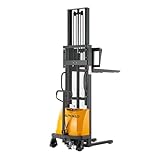
The APOLLOLIFT Semi-Electric Pallet Stacker matches the previous unit on the headline numbers — 3,300 lb capacity, 118-inch lift — and separates itself with fixed legs. Fixed-leg (straddle) stackers place their support legs outside the pallet footprint, which means the machine can approach a pallet from the side or the end and pick it up without needing a fork pocket underneath the load. For open-bottom pallets, skids, and custom platforms that a standard pallet-jack style stacker cannot enter, this is the configuration that works.
Key specs
- Rated capacity: 3,300 lb
- Maximum lift height: 118 in
- Power type: semi-electric — powered lift, manual travel
- Leg configuration: fixed legs (straddle) — legs pass outside the load footprint
- Best for: open-bottom pallets, skids, crates, and non-standard platforms
- Price tier: premium
The fixed-leg geometry is the whole story. A straddle stacker needs enough clear aisle to fit its legs on either side of the pallet, and it needs a pallet whose bottom is open enough for the forks to slide in above the legs. When those conditions are met, it is more flexible than a closed-fork design because it can handle loads that have no bottom entry. When they are not met, the machine simply will not pick the load up, which is the single most common purchasing mistake in this category.
Pros
- Fixed legs handle open-bottom pallets and skids
- 3,300 lb capacity for genuine palletized loads
- 118-inch lift reaches high racking
- Powered lifting with manual travel keeps battery demand low
- Flexible approach angles from side or end
Cons
- Requires clear space beside the pallet — wider effective aisle than a closed-fork unit
- Will not lift closed-bottom pallets or loads sitting flush on the floor
- Premium price tier
- Manual travel over distance is tiring
Against the BILT HARD Semi-Electric Pallet Stacker, the difference is leg geometry rather than capacity or height: pick the APOLLOLIFT if your loads are open-bottom, and the BILT HARD if they are standard closed-bottom pallets in tight aisles. Against the VEVOR Full Electric Pallet Stacker, the APOLLOLIFT gives you 20 more inches of lift and a straddle configuration in exchange for powered drive and a shorter chassis.
10. APOLLOLIFT Material Lift Winch Stacker – Best Low-Cost Winch Lift for Occasional Use

The APOLLOLIFT Material Lift Winch Stacker is the simplest machine in this roundup: 330 lb capacity, a 40.5-inch lift height, and a manual winch. It exists for one purpose — lifting light loads to bench height a few times a week without spending mid-range money. If that describes your work, nothing else here is a better fit, and if it does not, nothing here is a worse one.
Key specs
- Rated capacity: 330 lb
- Maximum lift height: 40.5 in — slightly above the common 40-inch standard
- Power type: manual winch
- Form factor: compact material lift with forks
- Best for: home garages, hobby shops, light retail stockrooms
- Price tier: budget
The case for this unit is entirely about not overbuying. A 330 lb, 40-inch lift covers bench-height work, tailgate loading, and low-shelf stocking, and the winch mechanism has fewer parts to fail than a hydraulic system. The 40.5-inch maximum lift is a half inch above the class standard, which is a small but real advantage when you are matching a specific shelf or bench height. It is light enough for one person to reposition and small enough to store against a wall.
Pros
- Lowest-cost way to get a functioning material lift
- Simple winch mechanism with few failure points
- 40.5-inch lift covers bench and tailgate work
- Compact and easy to store
- No battery or power requirement
Cons
- 330 lb capacity and 40.5-inch height limit it to light work
- Budget-tier build and finish
- Winch is slow under load
- Not suited to pallets, rough ground, or frequent use
Against the SuperHandy Material Lift Stacker, the APOLLOLIFT saves money and gives up a half inch of nothing — the real difference is build class and support. If you lift a few times a month, buy the APOLLOLIFT; if you lift daily and want the machine to last a decade, buy the SuperHandy. Against the Goodyear unit, the APOLLOLIFT loses badly on wheels and maneuverability, which is the upgrade you are paying for one tier up.
11. ELOMBR 122″ Material Lift Winch Stacker – Best for Tall Manual Lifts With Straddle Support

The ELOMBR 122″ Material Lift Winch Stacker is unusual: it combines a light 400 lb capacity with a 122-inch lift height and a fixed straddle configuration. That combination exists for a specific job — lifting relatively light but bulky items high up, such as panels, ducts, signage, or light crates, onto a mezzanine, a high shelf, or a truck bed on a raised vehicle. No other unit in this list mixes that height with that weight class.
Key specs
- Rated capacity: 400 lb
- Maximum lift height: 122 in — the highest in this roundup
- Power type: manual hand winch
- Leg configuration: fixed straddle — legs pass outside the load
- Best for: mezzanine loading, high shelving, panel and duct handling
- Price tier: mid-range
The value here is reach without power. A 122-inch lift height normally means a semi-electric or full electric machine with a battery, a charger, and a premium price. This ELOMBR unit gets you that height mechanically, which makes sense when the loads are light and the lifts are infrequent. Because the legs straddle the load rather than sliding under it, the machine can pick up items that sit flat on the floor with no bottom clearance — a real advantage for panels and crates.
Pros
- 122-inch lift height at a mid-range price tier
- Fixed straddle legs handle open-bottom and floor-flush loads
- No battery, charger, or power requirement
- Manual winch gives controlled raising and lowering
- Reaches mezzanine and high-shelf heights no light-duty lift can touch
Cons
- 400 lb capacity is modest for the height
- Hand winching to 122 inches is slow and physically demanding
- Tall mast is a stability and storage consideration
- Straddle legs need clear space beside the load
Against the BILT HARD Semi-Electric Pallet Stacker, the ELOMBR reaches four inches higher but lifts 2,900 lb less and requires manual effort for every inch. The comparison is really about load weight: light and tall favors ELOMBR, heavy and tall favors BILT HARD. Against the second ELOMBR unit below, the difference is the leg configuration and the form factor, and that choice depends entirely on how your loads sit on the floor.
12. ELOMBR 122″ 400 lbs Hand Winch Lift Truck – Best for High-Reach Manual Work With Fixed-Leg Stability

The second ELOMBR unit in this list shares the 122-inch lift height and 400 lb capacity but is configured as a hand winch lift truck with fixed legs. It is a mobile lifter first and a stacker second: the emphasis is on moving a light load to a high position and holding it there while you work, rather than on rapid put-away cycles. For solo operators handling tall, awkward items, that framing is the useful one.
Key specs
- Rated capacity: 400 lb
- Maximum lift height: 122 in
- Power type: manual hand winch
- Leg configuration: fixed-leg
- Form factor: hand winch lift truck / manual material lifter
- Best for: one-person high-reach lifting, installation work, maintenance access
- Price tier: mid-range
The fixed-leg design gives the machine a stable base at full extension, which is the main safety consideration when you are working at 122 inches with a light load. The hand winch holds position reliably, so you can raise a component, lock it, and then work on it without needing a second person to steady the load. As with the other ELOMBR unit, the trade-off is speed: raising 400 lb to ten feet by hand takes time, and the effort is real if you do it repeatedly.
Pros
- 122-inch reach for high installation and maintenance work
- Fixed legs provide a stable base at full height
- Winch holds position so one person can work solo
- No power required — usable anywhere
- Mid-range price tier for an unusual height class
Cons
- 400 lb capacity and manual power limit throughput
- Slow to raise loads to full height
- Tall mast needs vertical clearance and careful storage
- Not a substitute for a pallet stacker on heavy freight
Against the APOLLOLIFT Semi-Electric Pallet Stacker, this ELOMBR unit reaches four inches higher, lifts 2,900 lb less, and costs far less — a completely different tool for a completely different job. Against its ELOMBR sibling, the choice comes down to how the load presents itself: straddle legs for floor-flush and open-bottom items, fixed legs for stable high-reach work on loads that can be picked from beneath.
How to Choose
Four specifications decide whether a stacker lift works for you or sits unused in a corner: rated capacity, lift height, power type, and aisle maneuverability. Get any one of them wrong and the machine will not do the job, no matter how good the rest of the spec sheet looks.
Start with capacity, then add margin
Rated capacity is a maximum, not a target. A sensible rule is to buy at least 25 percent more capacity than your heaviest routine load, and 50 percent more if the load is awkward, off-center, or lifted to full height. A 500 lb load wants a 625 lb machine at minimum, which in practice means stepping up a class rather than buying exactly at the limit.
Capacity also depends on where the weight sits. Stacker capacities are commonly rated at a load center of about 24 inches from the fork face. Move the center of gravity outward and the effective capacity drops. As a rule of thumb, a load centered at 30 inches reduces usable capacity by roughly 20 percent, and one at 36 inches by roughly 35 percent. A machine rated 500 lb at 24 inches is therefore only good for about 400 lb with a 30-inch load center — which is why a 450 lb load on a 500 lb lift can still be an overload.
| Heaviest routine load | Recommended rated capacity | Typical class to shop in |
|---|---|---|
| Up to 250 lb | 330 lb | Light material lift (SuperHandy, Goodyear, APOLLOLIFT) |
| 250–400 lb | 450–500 lb | Budget hydraulic winch stacker (AECOJOY, MMS, VEVOR) |
| 400–500 lb, awkward shape | 600–800 lb | Heavy light-duty or entry pallet stacker |
| 500–1,500 lb | 2,200 lb | Manual pallet stacker (BILT HARD manual) |
| 1,500–2,500 lb | 3,300 lb | Powered or semi-electric pallet stacker |
| Standard loaded pallets, daily | 3,300 lb | Full electric walkie stacker (VEVOR electric) |
Match lift height to the real target, not the shelf
The number that matters is not your shelf height — it is shelf height plus clearance plus the thickness of the forks and pallet. A beam at 96 inches needs roughly 6 inches of clearance to lift a pallet off and set it down cleanly, plus about 3 inches for fork and pallet thickness. That is 105 inches of required lift, which a 98.4-inch machine cannot deliver but a 118-inch or 122-inch machine can.
| Target height | Required lift (with clearance) | Machine class |
|---|---|---|
| Bench / tailgate (30–38 in) | 36–42 in | 40-inch light material lift |
| Van or trailer floor (40–48 in) | 46–54 in | Manual pallet stacker (63 in) |
| Low rack
Best Stacker Lifts Affiliate disclosure. As an Amazon Associate we earn from qualifying purchases at no extra cost to you. Prices accurate as of the date shown. Best Stacker LiftsCheck price on Amazon Related guidesMore ways to save on Amazon |