What's inside
As an Amazon Associate I earn from qualifying purchases. This post may contain affiliate links at no extra cost to you.
A Briggs & Stratton electric pressure washer is a sensible pick for homeowners who clean cars, patio furniture, grills and small decks a few times a season, but it is not a substitute for the brand’s gas machines on large driveways, stained concrete or paint prep. Briggs & Stratton is best known for small engines and gas pressure washers; its electric models sit in the same 1,700 to roughly 2,100 PSI class as most plug-in washers, running on a standard 120V household outlet. This review explains what that class of machine does well, where it runs out of steam, and how it stacks up against the brand’s gas units and other popular electric washers.
As an Amazon Associate we earn from qualifying purchases at no extra cost to you.

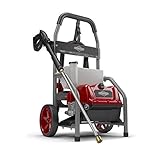


What you get in the Briggs & Stratton electric range
Specifications vary by model year and retailer bundle, so treat the figures below as the typical spread for the brand’s electric lineup rather than a single model’s spec sheet.
| Spec | Typical Briggs & Stratton electric | What it means in practice |
|---|---|---|
| Max pressure | About 1,700-2,100 PSI | Enough for siding, vehicles, outdoor furniture and lightly soiled concrete |
| Flow rate | About 1.1-1.3 GPM | Rinsing speed; lower flow means slower work on big surfaces |
| Motor | 120V, 13-15 amp universal motor | Plugs into any household GFCI outlet; louder than an induction motor |
| Hose | 20-25 ft high-pressure hose | Keep the unit close to the job; use the garden hose for reach |
| Nozzles | Quick-connect tips (0, 15, 25, 40 degree and soap) or an adjustable wand | Covers stripping to gentle rinsing |
| Detergent | Onboard tank or soap nozzle | Low-pressure soap application |
| Weight | About 18-30 lb | Easy to carry or wheel and store on a shelf |
| Typical price | About $130-$250 | Roughly a third to half of a comparable gas unit |
Cleaning power: how to compare it fairly
PSI on the box is a peak figure. A more honest comparison is cleaning units (CU): PSI multiplied by GPM. It explains why a 2,000 PSI electric feels much slower than a 2,800 PSI gas washer even though the pressure numbers look close.
| Machine class | PSI | GPM | Cleaning units | Relative speed on concrete |
|---|---|---|---|---|
| Briggs & Stratton electric (typical) | 1,900 | 1.2 | ~2,280 | 1x (baseline) |
| Sun Joe SPX3000-class electric | 2,030 max | 1.76 max | ~3,570 max | Up to ~1.5x |
| Entry gas (Briggs & Stratton 2,800 PSI class) | 2,800 | 2.3 | ~6,440 | ~2.8x |
| Mid gas (3,100-3,300 PSI class) | 3,200 | 2.5 | ~8,000 | ~3.5x |
In plain terms, a two-car driveway of about 600 sq ft that a mid-size gas washer with a surface cleaner finishes in 30 to 45 minutes can take two hours or more with a typical electric unit and a wand. For a 150 sq ft patio, the difference is small enough not to matter.
Jobs it handles well and jobs to skip
Good fits
- Cars, motorcycles, bikes and boats (use the 25 or 40 degree tip, keep 12 inches or more away from paint)
- Vinyl siding and gutters (40 degree tip, spray downward, never up under laps)
- Patio furniture, grills, trash cans, garden tools
- Small composite or sealed wood decks with the widest tip
- Light mildew on concrete steps and walkways, especially with a detergent pre-soak
Poor fits
- Oil-stained driveways and large concrete pads
- Stripping paint or deep cleaning brick and pavers in bulk
- Running a large surface cleaner (most need 2.0+ GPM to work properly)
- Remote jobs where there is no outlet within reach of the cord
Electric or gas Briggs & Stratton: decision matrix
| Your situation | Better choice | Reason |
|---|---|---|
| Townhouse or small yard, mostly car and furniture washing | Electric | Quiet, light, no fuel or oil to manage |
| Need to store indoors or in a closet | Electric | No fuel fumes; compact frame |
| Driveway plus sidewalk over 800 sq ft | Gas, 2,800 PSI+ | Two to three times the cleaning units |
| Annual deck stripping and fence cleaning | Gas | Higher flow rinses residue faster |
| Noise rules or early-morning cleaning | Electric | Noticeably quieter, nothing running when trigger is released |
| No nearby outlet | Gas | Extension cords cut motor performance |
Ownership realities
Most plug-in pressure washers in this price range share the same weak points, and Briggs & Stratton’s electric models are no exception.
- Pump life. Consumer electric washers use compact axial pumps that are not designed to be rebuilt. Expect years of occasional use, not daily duty. Never run the pump without water flowing, and do not leave it in bypass (trigger released, motor running) for more than a minute or two; most units have auto-stop to prevent this.
- Freezing. Water left in the pump can crack it. Drain everything and store above freezing, or use a pump saver antifreeze product before winter.
- Extension cords. If you must use one, keep it short and heavy (12 or 14 gauge, 25 ft or less). Thin, long cords starve the motor and can trip the GFCI.
- Inlet filter. The small screen at the garden-hose inlet clogs with sediment. Clean it whenever pressure starts to pulse.
- O-rings and quick-connect fittings. These are the most common leak points. A cheap assorted O-ring kit solves most drips.
Safety basics
Even a 1,900 PSI stream can cut skin, so never point the wand at people or pets, and do not use the 0 degree tip on anything soft. Plug only into a GFCI-protected outlet, keep connections off wet ground, and wear eye protection and closed shoes. Test any new surface in an inconspicuous spot with the widest tip first.
Verdict
If you want an easy, low-maintenance machine for routine home cleaning and you value quiet operation and simple storage, a Briggs & Stratton electric pressure washer in the 1,700-2,100 PSI range fits the bill at a modest price. If your main target is a large or stained concrete driveway, put the money toward one of the brand’s gas units in the 2,800 PSI and above class instead; the extra flow is what saves you hours.
Related guides
- Longest Lasting Lawn Mower Battery: AGM vs Lithium vs Flooded Lifespan and Cost per Season
- Duralast Gold Lawn Mower Battery Review: U1 Fit, CCA and When to Pay for AGM
- Greenworks Pro 80V 21-Inch Mower Review: Runtime Math, Push vs Self-Propelled and Yard Fit
- Bosch High Pressure Washer Gun Replacement: Fittings, Adapters and What Fits Your Model