What's inside
As an Amazon Associate I earn from qualifying purchases. This post may contain affiliate links at no extra cost to you.
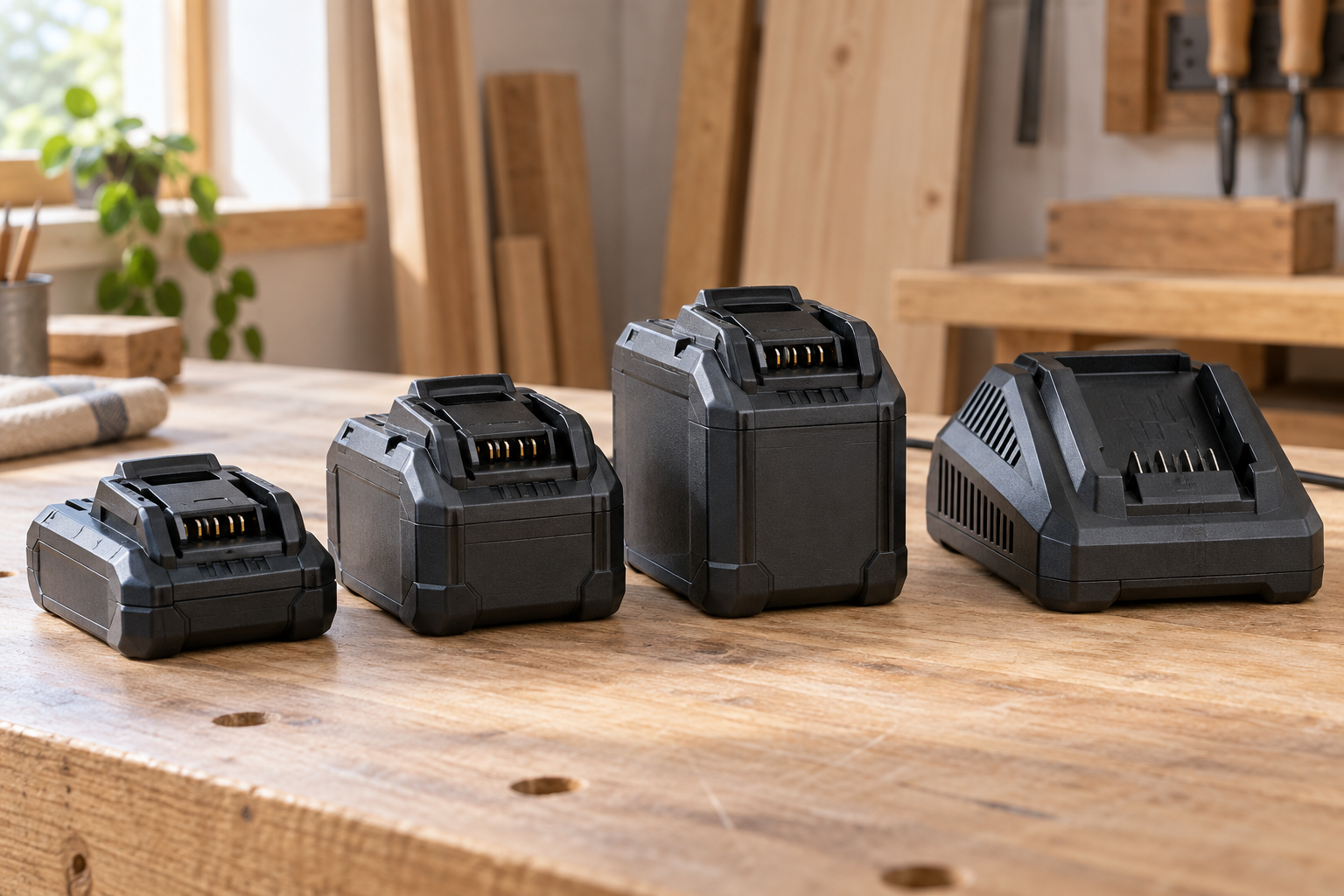
Battery capacity and charger speed can make two cordless kits with similar tools behave very differently. A larger battery usually runs longer, but it also adds weight and cost. A fast charger can shorten breaks, but only if you have enough batteries—and the battery itself supports the charging rate. Compare the complete battery-and-charger setup, not just the largest amp-hour number on the box.
Read the battery rating correctly
A battery’s amp-hour rating (Ah) estimates how much charge it can store at its rated voltage. Within the same battery platform, a 4.0Ah battery has roughly twice the capacity of a 2.0Ah battery. It does not necessarily deliver twice the runtime in every tool: a saw under heavy load may drain a battery much faster than a drill driving small screws.
For a rough energy comparison across different voltages, multiply nominal voltage by amp-hours to get watt-hours (Wh). A 18V-class 5.0Ah battery is about 90Wh; a 12V 5.0Ah battery is about 60Wh. Actual usable energy varies with the battery design, tool, temperature, and workload. Check the manufacturer’s voltage convention too: some brands market a platform using its maximum voltage and others use nominal voltage.
Do not treat Ah as a direct measure of power. A higher-capacity pack may sustain demanding work better, but battery design and the tool’s motor and electronics also matter. If you are choosing a cordless tool kit with two batteries, check the rating of each included pack. A kit listing “two batteries” could include two small packs, not two high-capacity ones.
Match capacity to the job
Small packs are often the sensible choice for drills, impact drivers, and overhead work. A 2.0Ah pack is lighter and easier to handle in a drill used for assembling furniture or installing hardware. Moving up to a 4.0Ah or 5.0Ah pack can reduce swaps during long sessions, but the extra weight is noticeable when working above shoulder height or on a ladder.
High-draw tools change the calculation. Circular saws, angle grinders, and outdoor equipment can consume charge quickly under sustained load. A larger pack may mean fewer interruptions, but one big battery is not always better than two moderate packs: the second pack lets you keep working while the first charges. For occasional DIY, the included small packs may be enough; paying extra for large batteries can be wasted money if the tool is used for only a few cuts at a time.
| Battery setup | Typical advantage | Trade-off | Often suits |
|---|---|---|---|
| One 2.0Ah pack | Low weight and cost | More frequent charging or swaps | Drilling, driving, occasional repairs |
| Two 2.0Ah packs | One can charge while the other is in use | Still limited runtime per pack on demanding tools | Light, intermittent work |
| Two 4.0–5.0Ah packs | Longer sessions and fewer swaps | More weight, bulk, and upfront cost | Frequent use or higher-draw tools |
| One large pack plus one small pack | Balances runtime with a lighter option | Requires swapping packs to suit the task | Mixed work, including overhead tasks |
Compare the charger, not just its label
Charger output is usually stated in amps, but that number alone does not tell you how quickly a particular battery will be ready. Charging time depends on battery capacity, charger output, temperature, and the battery’s charge-control electronics. As a rough estimate, divide battery Ah by charger amps and allow extra time for the final part of the charge. A 4.0Ah battery on a 2A charger might take around two hours or longer; the exact time varies by platform and conditions.
Look up the manufacturer’s published charge times for the exact battery and charger combination. Some chargers reduce current near full charge to protect the pack, so charging is not a perfectly straight calculation. A fast charger may also be less useful if the battery limits charging speed or if you have only one pack and use the tool continuously.
For occasional home repairs, a basic charger is usually fine if the battery can recharge between jobs. For a workday with steady tool use, a faster charger and at least two usable batteries can help avoid downtime. Compare the kit’s included charger against a compatible fast charger, but confirm compatibility with the specific battery platform and pack. “Fast charger” does not mean every battery in the brand’s range charges at the same speed.
Check the battery platform before buying
Battery compatibility can make a kit a better long-term buy—or leave you with an expensive battery collection you cannot use together. Confirm that the batteries fit the tools you already own, not merely that they come from the same brand. Some brands have multiple voltage platforms, and packs from one platform generally do not fit tools from another. A few brands also divide products into separate ranges that use different batteries despite similar-looking names.
Check whether bare tools are available for the platform. If you already own compatible batteries and a charger, a tool-only purchase may cost less than buying another kit. If this is your first cordless tool, compare the kit price with the cost of its batteries and charger purchased separately. Battery replacements can be a substantial ongoing cost, especially when a kit includes unusually small packs that you may want to upgrade soon.
Avoid common buying mistakes
One common mistake is buying the largest battery available for every tool. A heavy pack can make a compact drill tiring, and it may not be worthwhile for short tasks. Another is assuming a charger included in a kit is fast because it is compact or has a prominent “rapid” label. Check the actual charge-time chart instead.
Heat is another practical limit. A battery that is hot after heavy cutting may need time to cool before it accepts a charge. Repeatedly swapping a hot pack onto a charger will not necessarily restore it faster and can trigger a temperature delay. Cold conditions can also reduce available runtime and slow charging. Keep packs within the manufacturer’s recommended temperature range, and do not leave them in a very hot vehicle.
For occasional DIY, a kit with two modest batteries and a standard charger is often the better value. For frequent work, compare watt-hours, the weight of each pack, published charge times, and the number of batteries you can rotate through the day. Choose capacity for the tools and workload you actually have, rather than paying for the biggest number on the package.
Related guides
- Longest Lasting Lawn Mower Battery: AGM vs Lithium vs Flooded Lifespan and Cost per Season
- Duralast Gold Lawn Mower Battery Review: U1 Fit, CCA and When to Pay for AGM
- Greenworks Pro 80V 21-Inch Mower Review: Runtime Math, Push vs Self-Propelled and Yard Fit
- Bosch High Pressure Washer Gun Replacement: Fittings, Adapters and What Fits Your Model