What's inside
As an Amazon Associate I earn from qualifying purchases. This post may contain affiliate links at no extra cost to you.
The quick answer
A cordless tool battery can take anywhere from about 20 minutes to several hours to charge. A small pack on a fast charger may be ready in 20–40 minutes; a large pack on a basic charger can take two to four hours or longer. The exact time depends mainly on battery capacity, charger output, and how deeply discharged—or hot—the pack is.
Check the charger’s label or manual for its output and the battery’s capacity. Brand names such as “rapid” or “standard” are less useful than the actual charging current and the battery size.
What determines charge time?
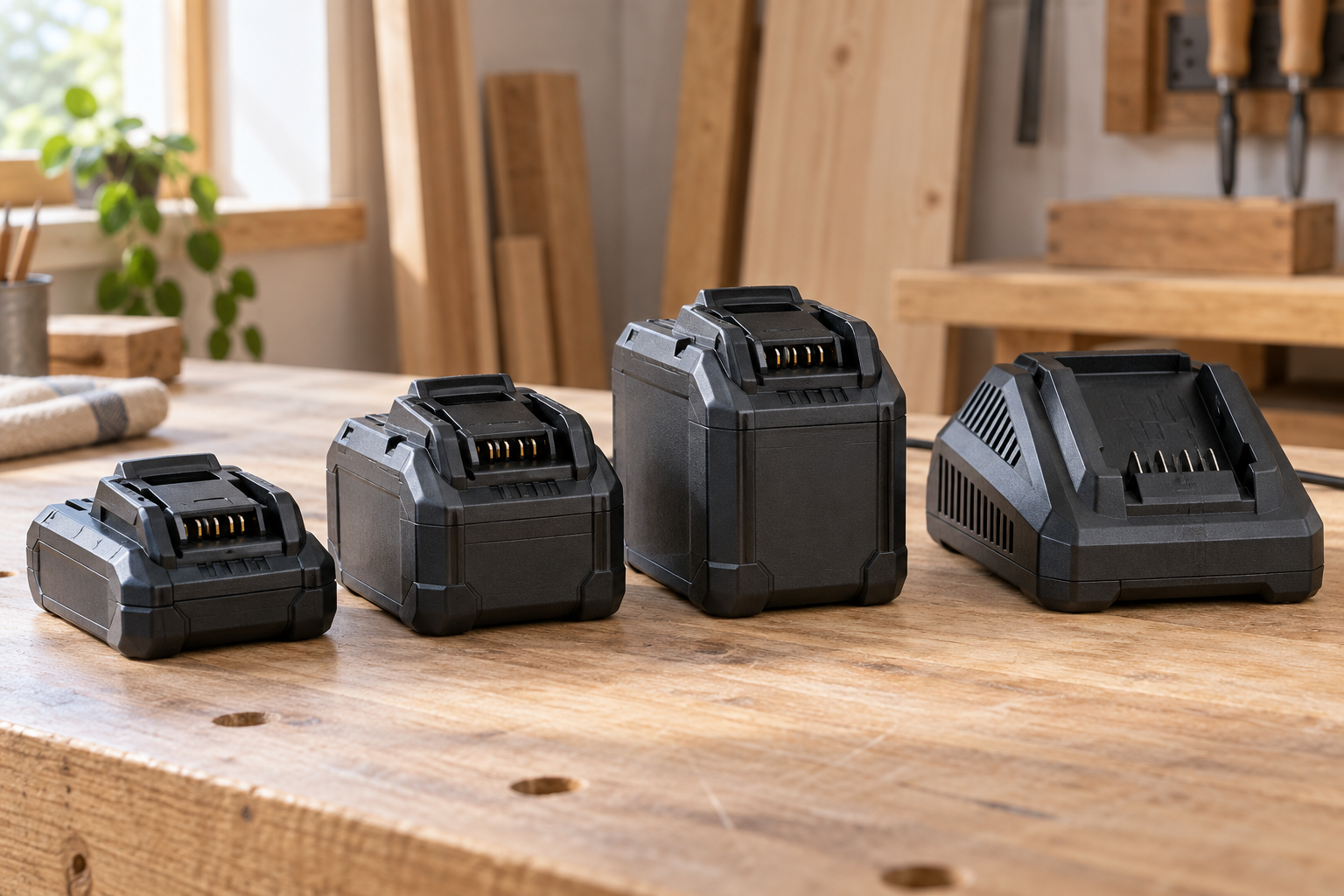
Battery capacity is usually listed in amp-hours (Ah). A 5 Ah pack stores roughly twice the charge of a 2.5 Ah pack, so it generally takes about twice as long to charge under otherwise similar conditions.
Chargers are commonly rated in amps. As a rough planning estimate, divide battery capacity in amp-hours by charger output in amps, then add time for the final part of the charge. For example, 5 Ah ÷ 2 A suggests 2.5 hours before that extra time. This is only an estimate: chargers reduce current as the battery approaches full, and battery management electronics may limit charging to protect the pack.
Temperature can add a delay. A pack that has just come off a demanding job may be too warm to charge, while a cold battery may also pause or charge slowly. Let it reach the temperature range specified in the manual rather than forcing it onto a charger. If the charger’s status light indicates a temperature delay, wait; repeatedly removing and reinserting the pack will not make it charge faster.
Typical charge times
These ranges are useful for planning, not guarantees. They assume a compatible charger, a healthy battery, and room-temperature conditions.
| Battery capacity | Basic charger (about 1–2 A) | Faster charger (about 4–8 A) |
|---|---|---|
| 2–2.5 Ah | 1–2 hours | 20–45 minutes |
| 4–5 Ah | 2.5–5 hours | 45–90 minutes |
| 6–8 Ah | 4–8 hours | 1–2.5 hours |
| 9–12 Ah | 6 hours or more | 1.5–3 hours or more |
Actual times vary by battery design and charger. Some packs charge faster than this simple math predicts, while others slow down substantially near full. A charger designed for one brand’s platform may not work with another brand’s battery, even if the packs look similar. Confirm compatibility before buying.
Does a faster charger make sense?
A fast charger is useful when one battery must keep up with a long workday, particularly for high-draw tools such as circular saws, grinders, and blowers. The trade-off is cost and, on some systems, more heat during charging. Follow the manufacturer’s guidance about which packs and chargers can be paired; a high-output charger does not necessarily charge every battery at its maximum rate.
For occasional drilling, assembly, or household repairs, a basic charger is often fine. If you have two batteries, charge one while using the other and let the first cool if necessary. That can be cheaper and kinder to the packs than buying a fast charger you rarely need. For a frequently used platform, a compatible rapid charger may be worth comparing with the standard charger.
Extra batteries can be a better solution than a faster charger if work cannot stop while a pack charges. A second pack also gives you a buffer when a battery needs to cool down. The downside is the added purchase cost, and batteries are most useful when they match tools you already own or plan to buy.
How to charge safely and avoid delays
Use a charger made for the battery’s brand and platform, and place both on a stable, dry surface with room for airflow. Don’t cover a charger, charge a damaged or swollen pack, or leave batteries in direct sun or beside a heater. Stop using a pack if its casing is cracked, it smells unusual, or it becomes excessively hot; contact the manufacturer about disposal or replacement.
Don’t assume that a battery is fully charged just because the charger light changes. Indicator meanings differ by brand, so check the manual. If you need the tool before a large pack is full, a partially charged battery may be adequate for light work, but runtime will be shorter. Avoid repeatedly running lithium-ion packs completely flat as a routine; the tool’s low-battery warning is a better point to swap packs.
When charging takes too long
First check the simple causes: confirm the outlet works, seat the battery fully, inspect the contacts for dirt, and check the charger’s lights. A pack that is hot or cold may be waiting for a safe temperature. Clean only as the manufacturer permits; don’t scrape contacts with metal tools or use liquids.
If a normally healthy pack takes much longer than usual, the battery may be aging, the charger may be faulty, or the pack may have an internal fault. Compare it with another compatible battery and charger if available. If both packs charge slowly on one charger, suspect the charger or power supply. If only one pack is affected, the battery is more likely the problem. Replace damaged packs rather than trying to open or repair them.
What to buy for your workload
For occasional home use, start with the charger included in a tool kit and add a second battery only if downtime becomes frustrating. If you regularly run a tool through multiple packs per day, compare a charger-and-battery kit for your existing platform against buying the pieces separately. Check the battery capacity, charger output, and platform compatibility—not just the advertised charge time.
For a busy shop, two or more packs and a charger positioned near the work area can be more dependable than relying on a single oversized battery. Choose the capacity that suits the tool: a small pack keeps a drill lighter, while a larger pack can reduce swaps in a saw or blower. Larger batteries take longer to recharge, so balance runtime against the time you can afford to wait.
FAQ
What determines charge time?
Does a faster charger make sense?
Related guides
- Longest Lasting Lawn Mower Battery: AGM vs Lithium vs Flooded Lifespan and Cost per Season
- Duralast Gold Lawn Mower Battery Review: U1 Fit, CCA and When to Pay for AGM
- Greenworks Pro 80V 21-Inch Mower Review: Runtime Math, Push vs Self-Propelled and Yard Fit
- Bosch High Pressure Washer Gun Replacement: Fittings, Adapters and What Fits Your Model