What's inside
As an Amazon Associate I earn from qualifying purchases. This post may contain affiliate links at no extra cost to you.
A cordless platform is more than a drill and a battery. In a cabinetmaking shop, it determines which tools you can add later, how many batteries stay in rotation, and whether a dead pack stops a job. The right choice depends less on peak voltage than on your work mix, battery size, charger capacity, and the tools you will need three years from now.
Start With Your Tool List
List the cordless tools you use weekly, then separate them from occasional convenience tools. Most cabinet shops need a drill/driver, impact driver, trim router, random-orbit sander, compact circular saw, oscillating multitool, and vacuum or dust extractor. A track saw, planer, or high-output router may also matter, but these tools place much heavier demands on batteries.
Do not choose a platform because it has the best drill. Choose it because it has acceptable versions of the five or six tools that consume the most shop time. Check the manufacturer’s current catalog, not just the tools on a store display. Some ecosystems have excellent drills but weak selections of cordless sanders, routers, or dust-management equipment.
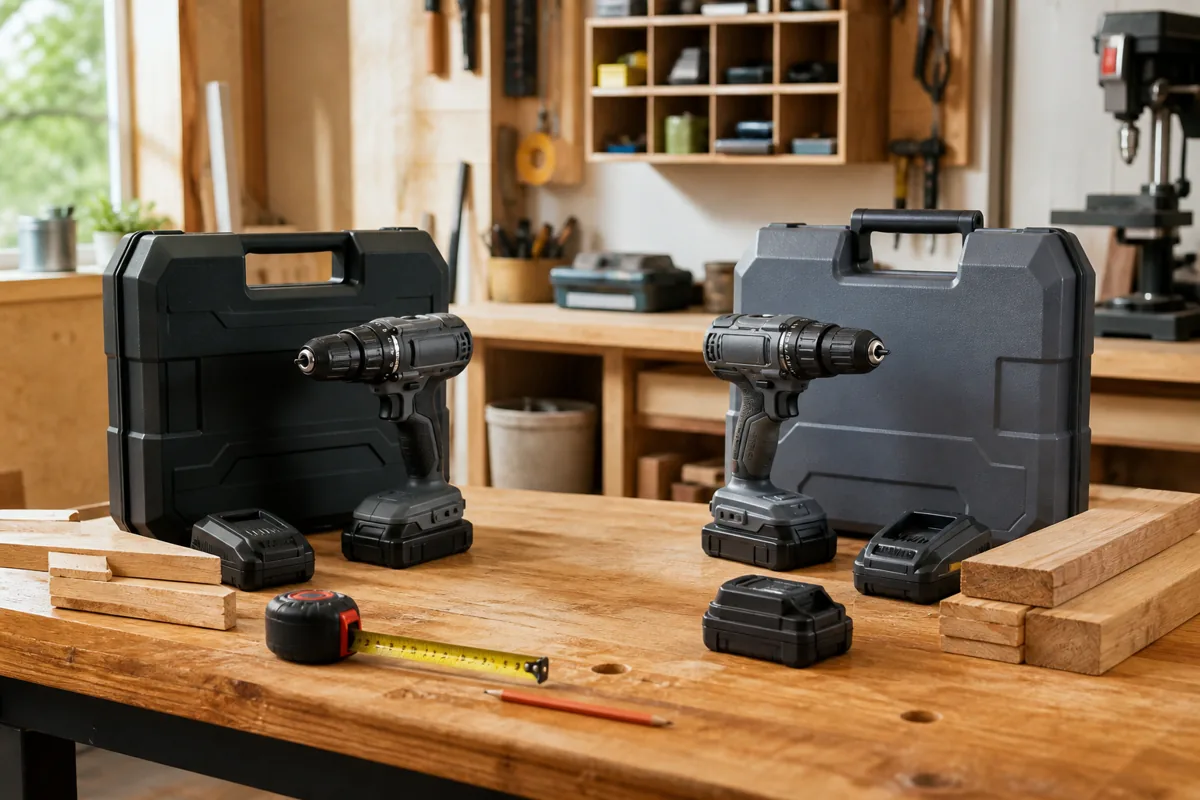
For a typical cabinet shop, a brushless cordless tool kit can be a good starting point if it includes two batteries, a charger, and tools you will actually use. Buying a kit saves money only when the included tools replace purchases you would otherwise make.
Voltage Is Only Part of the Battery Decision
Most professional cordless platforms fall into compact 12-volt-class systems and larger 18- or 20-volt-class systems. The nominal voltage labels differ by marketing convention; an 18V platform and a 20V MAX platform are broadly comparable in class. Battery capacity is usually stated in amp-hours (Ah), but Ah alone does not tell you how well a pack handles a demanding tool.
| Battery class | Best use | Typical trade-off |
|---|---|---|
| 1.5–2.0 Ah compact | Drilling, cabinet hardware, trim work, oscillating tools | Light and comfortable, but short runtime under heavy load |
| 3.0–5.0 Ah | General shop use, sanders, routers, circular saws | Good balance of runtime and weight |
| 6.0–8.0 Ah high-output | Track saws, large routers, extractors, repeated cutting | Longer runtime, higher cost, and more wrist fatigue |
A compact 2.0 Ah battery may be ideal on a drill used above a cabinet. The same battery can be frustrating on a random-orbit sander, which may run continuously for 20 to 35 minutes depending on the material and pressure. A 5.0 Ah pack often lasts substantially longer, but it can make a small tool feel top-heavy.
High-output battery lines are worthwhile for saws and routers, but not every tool benefits equally. If most of your work is drilling, hinge installation, and assembly, buying several compact and mid-size packs is usually more useful than buying the largest batteries available.
Match Chargers to Your Workflow
A charger is shop infrastructure. A single slow charger can leave you waiting if two batteries are depleted during a production run. Look for charging time, pack compatibility, and whether the charger can handle the larger batteries you expect to buy later.
Rapid chargers reduce downtime, but they may generate more heat and cost considerably more. Heat is hard on lithium-ion batteries, so let a hot pack cool before charging when practical. A two-port or four-port charger helps only if it charges packs simultaneously; some “multi-bay” units charge one battery at a time.
For a one-person shop, four to six batteries is a practical starting inventory: two compact packs for drills and assembly tools, two 4.0- or 5.0-Ah packs for general work, and one or two high-capacity packs if you use a saw or router heavily. Label packs by purchase date and retire any battery with swelling, cracked housing, damaged contacts, or abnormal heat.
Calculate Ecosystem Cost, Not Starter-Kit Price
Battery platforms lock you into a connector and electronic system. Batteries generally do not cross between brands, and adapters are a poor solution for a professional shop. They can interfere with protection electronics, add bulk, and create warranty or safety problems.
Compare the price of your likely complete setup: three drills or drivers, a router, sander, saw, multitool, six batteries, two chargers, and replacements for batteries after several years. A platform with inexpensive bare tools may still cost more if its batteries are expensive or its chargers are limited.
Also check battery availability locally. A platform that is cheap online is less useful if a failed pack requires a week of shipping. For a small shop where one tool can stop a job, local stock and dependable warranty service have real value.
Know When Corded Is Still Better
Cordless tools are excellent for installation, punch-list work, mobile assembly, and jobs where cords snag finished panels. They are not automatically the best choice for every stationary operation. A corded random-orbit sander, router, or dust extractor can run all day without battery changes and often costs less per hour of use.
A practical shop may use cordless drills, impact drivers, trim routers, and multitools while keeping a corded router table, sander, and dust collector. This hybrid approach avoids buying a large battery inventory for tools that rarely leave the bench. The cheaper corded option is fine when the tool stays in one location and a grounded outlet is close by.
For a cordless sander, give priority to dust collection and ergonomics over advertised speed. Battery runtime is wasted if the pad stalls under normal pressure or the tool leaves swirl marks. For a cordless router, verify bit capacity, base stability, depth adjustment, and whether the battery blocks your sightline.
Build the Platform in Stages
Buy the first kit around your highest-frequency tasks, then purchase bare tools only after the need is proven. Keep at least one charged battery reserved for the drill or driver that handles assembly and installation. That prevents a saw job from consuming every pack in the shop.
If you are starting from zero, compare 18V or 20V battery and charger kits from platforms with a broad cabinetmaking lineup. For frequent trim and hardware work, a 12V cordless drill and driver kit may be the more comfortable first purchase, provided the same brand also covers your heavier tools.
Before committing, hold the actual tools with the intended battery attached. Check trigger reach, balance, base visibility, and whether the pack hits the workpiece. A platform that saves 10 percent on batteries is not a bargain if its tools cause fatigue or force awkward cabinet positioning.
Related guides
- Longest Lasting Lawn Mower Battery: AGM vs Lithium vs Flooded Lifespan and Cost per Season
- Duralast Gold Lawn Mower Battery Review: U1 Fit, CCA and When to Pay for AGM
- Greenworks Pro 80V 21-Inch Mower Review: Runtime Math, Push vs Self-Propelled and Yard Fit
- Bosch High Pressure Washer Gun Replacement: Fittings, Adapters and What Fits Your Model