What's inside
As an Amazon Associate I earn from qualifying purchases. This post may contain affiliate links at no extra cost to you.
Start with the work, not the brand
A cordless platform is the battery system shared by a brand’s tools. For an automotive technician, the useful question is not which brand has the biggest tool lineup. It is whether the platform has the right mix of impact wrenches, ratchets, lights and batteries for the jobs you actually do—and whether it can keep up through a full shift.
List your regular tasks before comparing kits. A technician who mostly removes interior trim and services small fasteners has different needs from one who handles rusted suspension bolts. Check that the platform offers the tool sizes and drive types you need, then compare battery cost, charger capacity and warranty terms. A broad ecosystem is useful only if its tools suit your work.
Match tool capability to the fastener
Automotive work spans a wide range of fasteners. A compact 1/4-inch or 3/8-inch ratchet is handy in tight spaces, while a 1/2-inch impact wrench is better suited to wheel and chassis work. But a tool’s advertised breakaway torque is not a reliable tightening specification. Output varies with battery charge, fastener condition, socket choice and how long the tool is applied.
Use a torque wrench for final tightening wherever the vehicle procedure specifies a torque. An impact wrench can over-tighten small bolts, stretch wheel studs or damage threads before the operator reacts. For delicate work, a manual ratchet or a controlled low-speed tool may be the safer choice. If the platform offers multiple speed or fastening modes, check how easy they are to select and whether the tool behaves predictably at low speed.
Compare tool length and head shape as well as power. A shorter impact wrench may fit behind a brake assembly where a stronger, longer model cannot. For a starter set, consider a cordless 3/8-inch ratchet for repetitive fasteners and a cordless 1/2-inch impact wrench for heavier removal. Buy by access and workload, not by the highest torque figure on the box.
Compare batteries and chargers
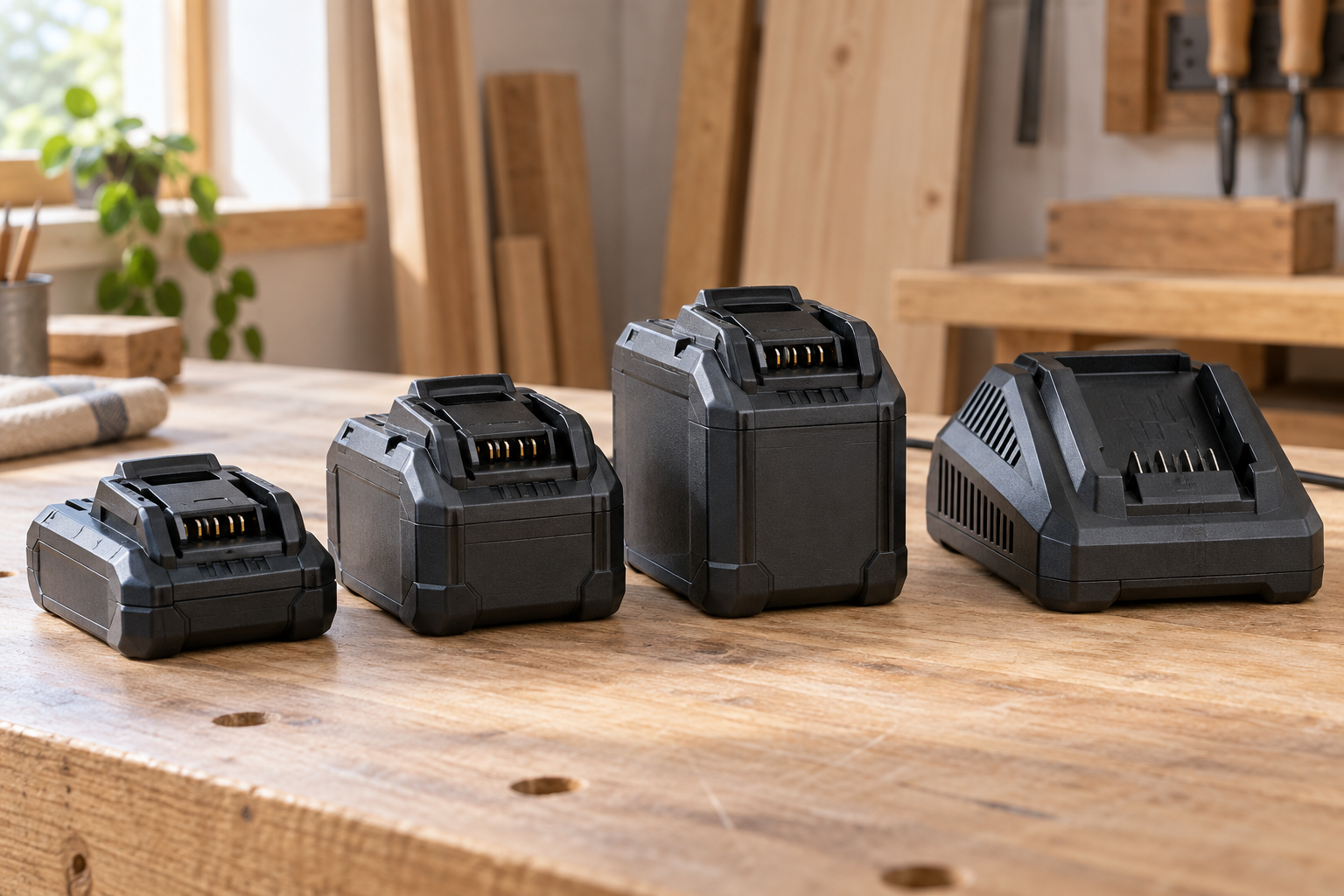
Battery voltage alone does not tell you how long a tool will run or how well it will hold power under load. Capacity, usually stated in amp-hours (Ah), is one useful clue: a 5 Ah battery stores more energy than a 2 Ah battery of the same voltage, but it is also larger and heavier. That extra weight matters on a ratchet held overhead or a light carried around a vehicle.
For shop use, compare at least one compact battery for confined work and one higher-capacity battery for demanding tools. Very small packs can be a sensible choice for an inspection light or low-load driver; they may run down quickly in a high-draw impact wrench. Conversely, the biggest pack is not automatically best if it makes a tool awkward to handle.
Chargers affect how many batteries you need. Check the stated charge time for the battery sizes you expect to use, not just the fastest time advertised for a smaller pack. A single-port charger may be adequate for occasional jobs or a home garage. A busy shop may need spare batteries or a charger that can replenish packs while other tools are in use. Do not charge a hot battery immediately after heavy use if the manufacturer says to let it cool first; heat can delay charging and shorten battery life.
Compare platform costs and trade-offs
| Factor | What to check | When it matters most |
|---|---|---|
| Automotive tool coverage | Ratchets, impact wrenches, lights and compact tools in the sizes you use | Before committing to a battery system |
| Battery options | Compact and high-capacity packs; price and availability of replacements | When balancing runtime against tool weight |
| Charger capacity | Charge time for your battery size and number of available charging bays | During back-to-back jobs or a full shift |
| Warranty and service | Coverage terms, exclusions and access to repairs or replacement parts | For tools used daily in a professional shop |
| Kit price | Tool, batteries and charger included; cost of adding a bare tool later | When comparing the actual first-year investment |
Compare complete setups, not sticker prices. A bare tool can look inexpensive but still require a battery and charger. A kit may cost more up front yet include two batteries, which is useful if one is charging during a job. Add the likely price of a replacement pack and the tools you expect to buy over the next few years. This gives a more realistic platform cost than comparing one impact wrench at a time.
If you already own several compatible batteries and chargers, staying within that ecosystem is often the economical choice, provided it has the tools you need. Buying a second platform can make sense when a specialist tool is unavailable or a different system fits a demanding job better. The trade-off is carrying, charging and replacing batteries for both.
Check reliability, fit and safety
Automotive shops are hard on equipment. Look for a battery that locks securely, a tool with a grip you can hold in oily gloves, and controls that are easy to reach without changing your grip. Check whether the tool has a belt hook or protective boot if it will be set down on concrete or dropped. A boot can reduce cosmetic damage but does not make a tool waterproof or impact-proof.
Battery protection circuitry can stop a pack from operating when it gets too hot, too cold or too depleted. That protects the battery, but a shutdown in the middle of a job is still inconvenient. Keep a charged spare available for high-draw tools, and use the battery maker’s charger rather than an unverified adapter. Do not force a hot, damaged or swollen battery into service.
Finally, verify the warranty and service route for your region. Read what is covered, how long coverage lasts and whether batteries have different terms from tools. For professional use, downtime matters: a nearby service centre or reliable replacement availability may be worth more than a small difference in advertised torque.
Choose a starter setup that fits the shop
For occasional repairs, one platform with a compact battery, a larger spare and a charger is usually enough. Add tools as jobs justify them; there is little value in buying a full kit of tools that will sit unused. A professional technician should prioritize the impact sizes and ratchet style used daily, then add batteries and charging capacity to match the pace of the shop.
Before buying, hold the tool if possible, check its overall length with a battery attached and confirm that replacement packs are easy to source. The best platform is the one that fits your hands, reaches your fasteners and stays available through the workday—not necessarily the one with the longest list of tools.
Related guides
- Longest Lasting Lawn Mower Battery: AGM vs Lithium vs Flooded Lifespan and Cost per Season
- Duralast Gold Lawn Mower Battery Review: U1 Fit, CCA and When to Pay for AGM
- Greenworks Pro 80V 21-Inch Mower Review: Runtime Math, Push vs Self-Propelled and Yard Fit
- Bosch High Pressure Washer Gun Replacement: Fittings, Adapters and What Fits Your Model