What's inside
As an Amazon Associate I earn from qualifying purchases. This post may contain affiliate links at no extra cost to you.
For a first-time cordless tool buyer, the advertised tool price is only part of the entry cost. A drill listed at $79 may require a $60 battery and charger before it can do any work. Another drill may cost $129 as a kit but include a battery, charger, case, and access to dozens of compatible tools.
The right comparison is not “Which drill is cheapest?” It is “What will it cost to become operational, and what will the next three tools cost?” That means comparing the battery platform, charger, included battery size, tool quality, and the price of expanding later.
Start With a Complete Kit, Not a Bare Tool
A bare tool includes no battery or charger. It is usually the lowest-priced listing and often makes sense only for someone who already owns compatible batteries. For a first-time buyer, compare it with a kit containing at least one battery and a charger.
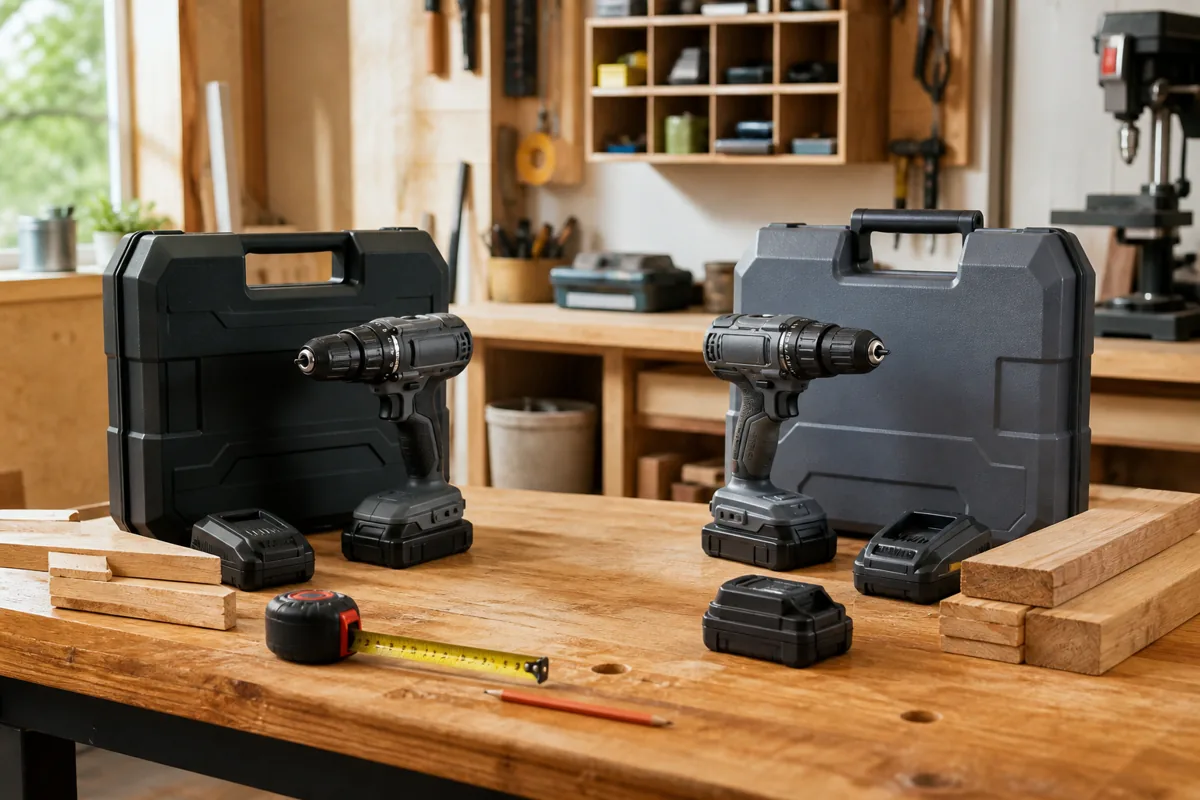
A practical starter kit normally includes a drill/driver, one battery, a charger, and sometimes an impact driver or case. A two-tool kit can be a better value if you expect to drive structural screws, assemble furniture, or do regular home maintenance. The impact driver handles long screws more comfortably, while the drill provides better control for small bits and hole saws.
Use cordless drill kits with a battery and charger as the baseline. Then price the same brand’s bare tools separately. Some “kit deals” are not actually cheaper once you account for a small battery that you would soon replace.
Calculate the Real Entry Cost
Write down four numbers: the kit price, the replacement battery price, the charger price, and the price of the next tool you are likely to buy. The first purchase should be judged over a two- or three-tool plan, not in isolation.
| Purchase path | Typical contents | Best use | Main drawback |
|---|---|---|---|
| Bare tool | Tool only | Adding to an existing platform | Expensive for a first-time buyer after battery and charger costs |
| Single-tool kit | Tool, one battery, charger | Occasional repairs and basic DIY | May include a small battery with limited runtime |
| Two-tool kit | Two tools, one or two batteries, charger | General home maintenance | Higher upfront cost and sometimes uneven tool quality |
| Tool-plus-battery starter bundle | One tool, battery, charger, promotional add-on | Building a platform during a sale | Promotional tools may not be the ones you actually need |
As an example, a $90 bare drill plus a $60 battery and $30 charger costs $180 before accessories. A $140 kit with the same type of drill, a battery, and charger is clearly cheaper at the starting line. But a $200 two-tool kit may be the better buy if the second tool would otherwise cost $100 bare later.
Compare Battery Size and Runtime
Battery capacity is usually expressed in amp-hours, or Ah. A 2.0Ah battery stores roughly half as much energy as a 4.0Ah battery on the same voltage platform. It will generally be lighter and charge faster, but it may run out quickly when drilling large holes, driving many screws, or cutting continuously.
For a drill used around the house, a 2.0Ah or 2.5Ah battery is often enough. It is easier to handle overhead and adds less weight to the tool. For a circular saw, recip saw, angle grinder, or leaf blower, a 4.0Ah or larger battery is more practical. High-output batteries can improve performance on demanding tools, but they cost more and add noticeable weight.
Do not compare Ah numbers across different voltage systems as if they were identical. Watt-hours are the more useful measure: voltage multiplied by amp-hours. A 20-volt nominal battery rated at 2.0Ah stores about 40 watt-hours; a 12-volt battery rated at 4.0Ah stores about 48 watt-hours. Marketing voltage labels and nominal voltage conventions can also differ, so use the manufacturer’s specifications when making close comparisons.
Judge the Battery Ecosystem
The platform matters because batteries are not universal, even when two tools have similar voltage labels. Once you own two or three batteries, switching brands means buying another charger and another set of packs.
Look for the tools you are realistically likely to need: drill, impact driver, circular saw, oscillating multi-tool, light, inflator, recip saw, and yard equipment. A platform with many tools is useful only if those tools are available at sensible prices. A large catalog full of expensive specialty tools does not help a homeowner who needs only a saw and an impact driver.
Check the battery warranty, charger speed, availability of replacement packs, and whether older batteries remain compatible with newer tools. Some platforms have compact batteries that fit every tool but deliver less power on saws and grinders. Others use physically larger packs for high-demand tools, which raises both cost and storage requirements.
Account for Charger and Battery Failure
Batteries are consumables. Heat, deep discharge, storage at full charge for long periods, and heavy use can shorten their life. A battery that lasts five years for occasional household work may last far less under daily construction use.
Do not buy a single battery if a dead or misplaced pack would stop the job. For regular use, two batteries are more practical: one runs the tool while the other charges. A slow charger may be fine for weekend repairs, but a rapid charger has value when you are using a saw or blower continuously.
Common failure points include a battery that will not accept a charge, a charger showing an error because the pack is too hot or cold, and a tool cutting out under load because the battery cannot supply enough current. Store packs indoors, let hot batteries cool before charging, and avoid generic replacement batteries with unclear safety testing.
Choose the Cheapest Sensible Platform
The cheapest platform is fine when your work is limited to assembling furniture, hanging shelves, drilling pilot holes, and occasional repairs. In that case, a single-tool kit with one compact battery can be entirely adequate. Buying a premium high-output system for six projects a year wastes money and adds weight.
Spend more when you expect to add saws, outdoor equipment, or several tools; when you work overhead for long periods; or when downtime matters. In those situations, battery availability, a second pack, and tool ergonomics are worth more than saving $30 at checkout.
Before buying, price a realistic three-item setup: the starter drill kit, the next tool, and one additional battery. You can compare cordless impact drivers and oscillating multi-tool kits as likely second purchases. That total exposes the real cost of joining a platform and prevents a cheap first tool from locking you into an expensive battery system.
Finally, avoid buying based only on a sale sticker. A discounted kit is useful when it contains the battery size, charger, and tools you need. If it includes an unwanted light or a tiny battery while the useful saw and larger battery remain expensive, the headline price is not a bargain. Compare the working setup, not the box.
Related guides
- Longest Lasting Lawn Mower Battery: AGM vs Lithium vs Flooded Lifespan and Cost per Season
- Duralast Gold Lawn Mower Battery Review: U1 Fit, CCA and When to Pay for AGM
- Greenworks Pro 80V 21-Inch Mower Review: Runtime Math, Push vs Self-Propelled and Yard Fit
- Bosch High Pressure Washer Gun Replacement: Fittings, Adapters and What Fits Your Model