What's inside
As an Amazon Associate I earn from qualifying purchases. This post may contain affiliate links at no extra cost to you.
Start with the work, not the battery label
A full day of cordless carpentry does not have one standard battery requirement. A day of trim installation, with occasional cuts and fastening, uses far less energy than framing with a circular saw and impact driver in steady rotation. Estimate the work first: list the tools, how long each will run, and whether they will be used continuously or in short bursts.
Battery capacity is usually marked in amp-hours (Ah), while energy is measured in watt-hours (Wh). For a rough comparison, multiply the battery’s nominal voltage by its amp-hour rating: a 20V-class 5Ah pack stores about 100Wh; an 18V-class 5Ah pack is about 90Wh. Those labels describe stored energy, not a promise of a particular number of cuts. Tool load, battery temperature, age, and workpiece material all affect runtime.
Estimate runtime in practical terms
If a tool’s average draw is known, divide battery watt-hours by watts to estimate hours. In practice, carpentry tools cycle on and off, and their draw varies sharply under load. A better field estimate is the number of cuts, fasteners, or holes a pack handles in your material. Use your own test on a representative piece, or treat published runtime figures as optimistic unless they match your tool and task.
As a starting point, a 5Ah pack may handle a substantial amount of intermittent trim work, but it can drain quickly in a circular saw making repeated cuts through thick stock. A compact 2Ah or 3Ah pack is often comfortable on a drill or impact driver; on a saw, it may feel underpowered or require frequent swaps. Keep a 20–30% reserve in your plan for dull blades, dense lumber, extra cuts, cold weather, and the last-minute task that always appears.
Build a workday budget
Write down expected output rather than guessing at hours. For example: 100 crosscuts, 250 screws, and occasional pilot holes. Run a sample batch with a fully charged pack, count what it completes, and scale the result. If one pack makes 50 comparable cuts, plan on roughly two packs for 100 cuts, then add reserve. Do not assume the same pack will make the same number of cuts in wet, treated, or unusually dense stock.
Also account for tools that overlap. A saw may draw heavily for a short time, while a drill or impact driver runs in bursts. If you have two batteries, one can be charging while the other works, but only if the charger can replenish it before the working pack is empty. Check charging time for the exact battery size: a charger that refills a small pack quickly may take much of a lunch break to charge a large one.
Compare capacity and handling
| Pack size | Best fit | Trade-off |
|---|---|---|
| 2–3Ah | Drills, impacts, light trim, overhead work | Light and often cheaper, but frequent changes on saw-heavy work |
| 4–5Ah | General carpentry and mixed-tool days | Useful balance of runtime and weight; may still fall short for continuous cutting |
| 6Ah or larger | Longer saw sessions and high-draw tools | More runtime, but heavier, costlier, and slower to recharge |
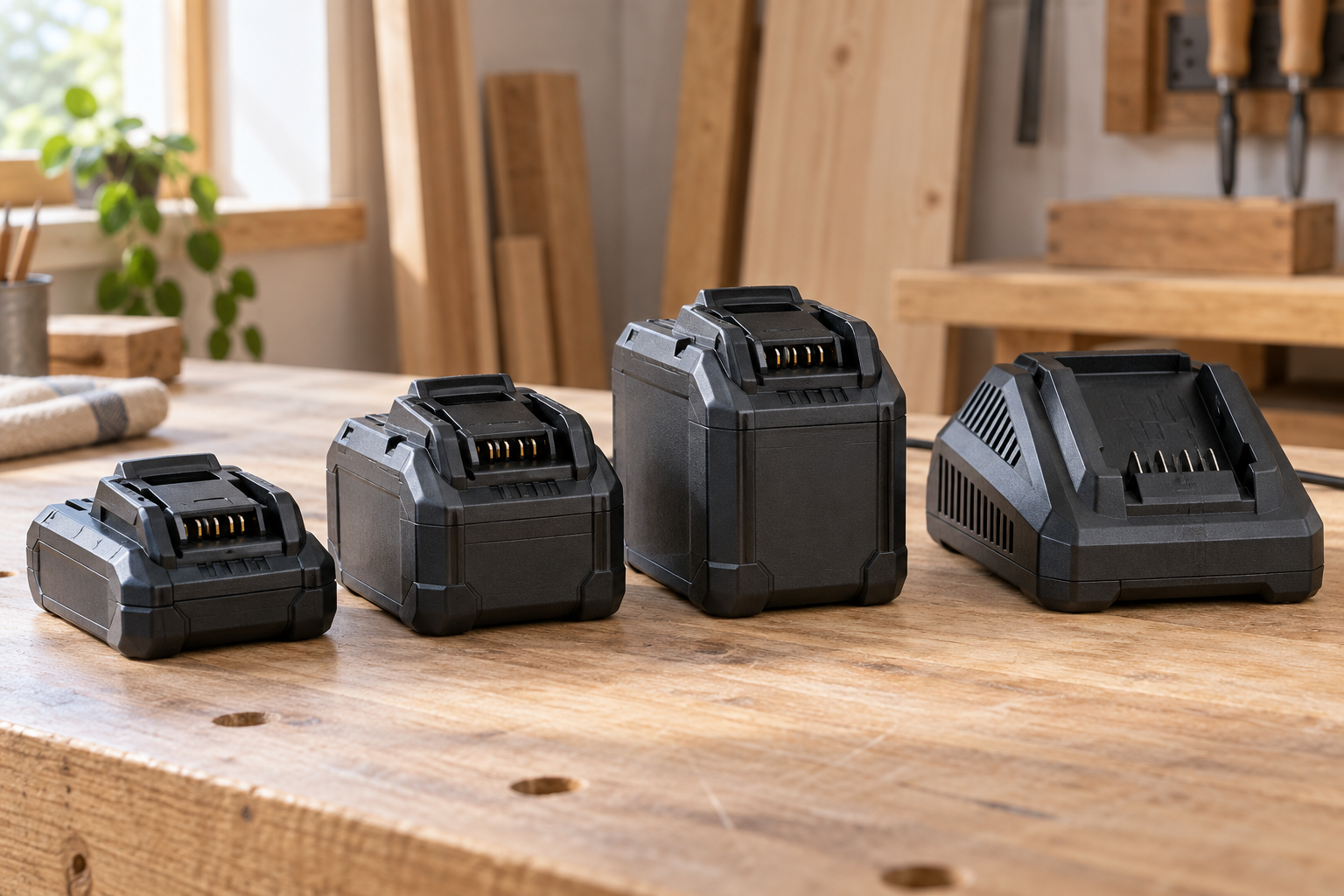
These are broad categories, not guarantees. Packs with the same Ah rating can differ in cell design and current delivery. A high-draw saw may perform better with a pack designed for that load, while a larger pack can add noticeable weight at the end of a drill or overhead tool. If your day involves lots of ladder work or fine trim, carrying several smaller packs may be more comfortable than hanging one large pack on every tool.
Choose a buying plan that fits the job
For occasional DIY carpentry, two mid-size batteries and a standard charger are often a sensible starting point. A spare pack limits interruptions without tying up money in capacity you rarely use. If you already own compatible batteries, use them before buying more; keeping one battery ecosystem can save money, but verify that the pack fits the tool and supports its power demands.
For a long day dominated by cutting, consider adding a high-capacity pack or a second charger. A high-capacity cordless tool battery can reduce swaps, though it is not automatically the best choice for every tool. If charging between tasks matters, compare compatible rapid chargers by their stated charge times for your pack size, not just the word “rapid” on the box. A faster charger is useful only if your job schedule gives it time to run and your site has reliable power.
Buying a larger battery is not always cheaper than buying a spare mid-size pack. Compare the price per watt-hour, but also consider whether one large pack can be shared across tools without creating a bottleneck. For a helper using a second tool, two batteries may keep both people working better than one oversized pack.
Avoid runtime surprises
Start with fully charged packs and rotate them rather than repeatedly draining one to empty. Lithium-ion batteries generally do not need full discharge, and deep discharge can stop the tool at the least convenient moment. Keep packs out of direct sun and extreme cold; cold batteries may deliver less power and can take longer to charge. Let an overheated pack cool before charging, and follow the manufacturer’s temperature guidance.
Watch for warning signs: slower cutting, repeated overload or temperature cutoffs, and a pack that seems to lose capacity suddenly. A sharp, appropriate blade often restores productivity more cheaply than another battery. For a circular saw, forcing a dull blade through stock can raise current draw and heat, shortening runtime and stressing the tool. Check the blade, alignment, and material before blaming the battery.
Make a final check before work
Count the charged packs, confirm they are compatible with the tools, and identify where charging can happen. For a mixed day of fastening and occasional cutting, two or three 4–5Ah packs may be enough; a production day of repeated saw cuts may call for more capacity, a charger in rotation, or access to mains power. The most reliable plan comes from a small test on the actual material, followed by a reserve—not from assuming the Ah number alone predicts a full day.
Related guides
- Longest Lasting Lawn Mower Battery: AGM vs Lithium vs Flooded Lifespan and Cost per Season
- Duralast Gold Lawn Mower Battery Review: U1 Fit, CCA and When to Pay for AGM
- Greenworks Pro 80V 21-Inch Mower Review: Runtime Math, Push vs Self-Propelled and Yard Fit
- Bosch High Pressure Washer Gun Replacement: Fittings, Adapters and What Fits Your Model