What's inside
As an Amazon Associate I earn from qualifying purchases. This post may contain affiliate links at no extra cost to you.
Charging charts look simple until you try to compare two batteries that use different capacities, chargers or test conditions. The useful question is not just “How many minutes?” It is “How long will this battery take on this charger, from what starting charge, and under what conditions?” Read the chart with those details in mind and you can avoid paying extra for speed you will rarely use—or buying a charger that leaves your tools waiting.
Start with the battery capacity
Battery capacity is usually listed in amp-hours (Ah). A 5 Ah battery stores roughly twice the charge of a 2.5 Ah battery in the same platform, so it generally takes longer to charge. The relationship is not perfectly proportional: charging slows near full, and a battery’s electronics may limit current based on temperature or cell condition.
Check that the chart covers the exact battery family and capacity you own. A chart for a compact 2 Ah pack does not tell you how long a 8 Ah pack will take, even if both fit the same tool. Some manufacturers also sell batteries with different cell designs under similar platform labels; their charging behavior can differ.
Identify the charger, not just the brand
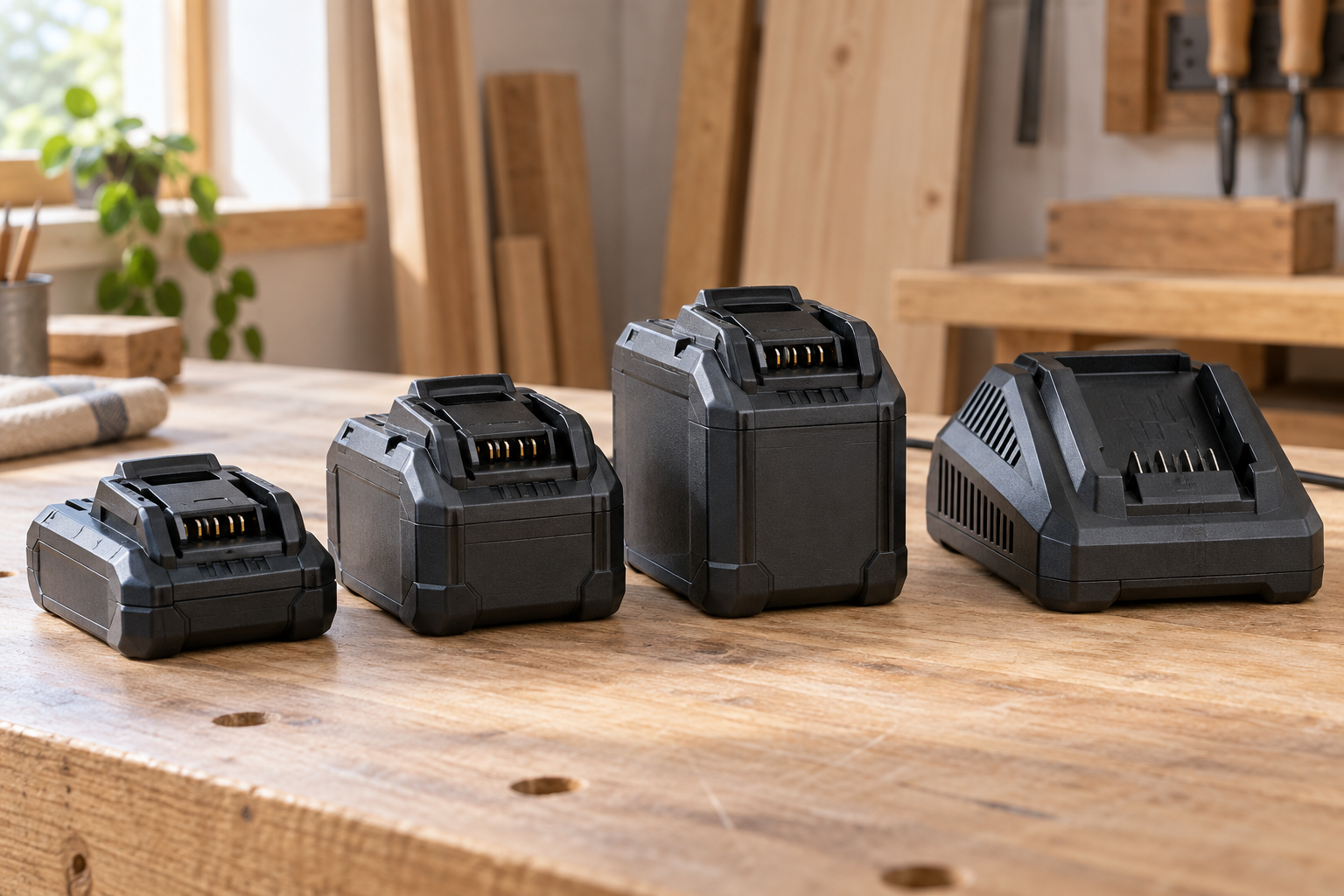
A platform may offer a basic charger, a faster charger, and a multi-port charger. The brand name alone does not indicate charging speed. Look for a charger model or category that matches the chart, and note whether its times apply to one battery at a time or several.
When a charger has multiple bays, read the fine print. It may charge batteries sequentially, share available power between bays, or prioritize one bay. A chart showing the time for one battery on a single-bay fast charger may not represent what happens when two packs are installed.
If you routinely rotate several batteries during a workday, a compatible fast charger can reduce downtime. If you charge overnight or between occasional DIY tasks, a standard charger may be cheaper and entirely adequate.
Read the start and finish points
Charging times are meaningful only when you know the starting and ending charge. A chart might give a time from empty to full, from 20% to full, or from empty to 80%. These are not interchangeable. A 30-minute figure for a partial charge can sound impressive beside a 60-minute full-charge figure, but it does not mean the first charger is twice as fast.
“Full” can also be defined differently. Many lithium-ion packs charge quickly through most of their capacity, then slow down as they approach full. That final portion protects the cells and helps balance them. If you need enough charge to finish a cut, the time to 80% may matter more than the time to 100%. If the chart gives only a full-charge time, do not assume that every fraction of capacity takes the same fraction of that time.
Compare figures on equal terms
Use the same battery capacity, starting percentage, target percentage and charging conditions when comparing chargers. The table below shows how to interpret common chart entries; the times are illustrative, not specifications for a particular brand.
| Chart entry | What it tells you | What it does not tell you |
|---|---|---|
| 2 Ah, empty to full: 40 minutes | Approximate full-charge time for that pack and charger | Time for a larger battery or a different charger |
| 5 Ah, empty to 80%: 45 minutes | Time to a useful partial charge under stated conditions | Time to full, or proof it is faster than the 2 Ah example |
| Two batteries: 90 minutes | Possibly the total time for both batteries in the tested setup | Whether they charged at once or one after the other |
| Charge rate: 4 A | Charger’s stated current under specified conditions | A guaranteed constant rate throughout the charge |
For a rough check, divide battery capacity by charger current to estimate hours: a 4 Ah pack at a stated 2 A would take about two hours at a constant rate. Real charging usually takes longer because current tapers and conversion is not perfectly efficient. Treat this calculation as a sanity check, not a replacement for the manufacturer’s chart.
Account for temperature and battery condition
Charts often come from controlled conditions. In a cold garage, the charger may delay charging until the pack warms to a safe range. A hot battery fresh from heavy use may also need time to cool. This pause is not necessarily a fault. Charging outside the temperature limits in the manual can harm the battery or trigger protective cutoffs, so do not try to defeat them.
Age matters too. A worn pack may charge unusually quickly because it no longer holds its original capacity, or it may take longer if its cells or electronics are struggling. If a battery repeatedly stops early, gets unusually hot, shows a fault indicator, or takes far longer than the chart suggests, check the manual and test with a known-good compatible charger or pack. Do not keep using a swollen or damaged battery.
Choose the setup that fits your work
Estimate your daily battery use before buying a faster charger. If one battery runs a drill for short household jobs and can recharge overnight, a basic charger is usually the sensible choice. If you use a saw or mower continuously and batteries are cycling through the day, charger speed and spare-pack capacity matter more than a small price difference. A battery-and-charger kit can be good value when it includes a pack size you will actually use.
Check compatibility before choosing a replacement charger. Similar-looking packs may belong to different voltage platforms or generations, and physical fit alone does not guarantee compatibility. Use the manufacturer’s compatibility list or manual. For shared workshops, a multi-port charger can keep several packs organized, but compare its per-bay behavior with the single-battery chart before assuming it saves time.
Use the chart as a planning tool
Charging charts are estimates, not timers. Leave a margin when planning a job, especially if the pack starts cold, is near the end of its life, or must charge alongside other batteries. For a quick decision, verify the battery capacity, charger, charge endpoints and number of packs first. Those four details explain most misleading comparisons—and help you decide whether a faster charger solves a real bottleneck or simply costs more.
Related guides
- Longest Lasting Lawn Mower Battery: AGM vs Lithium vs Flooded Lifespan and Cost per Season
- Duralast Gold Lawn Mower Battery Review: U1 Fit, CCA and When to Pay for AGM
- Greenworks Pro 80V 21-Inch Mower Review: Runtime Math, Push vs Self-Propelled and Yard Fit
- Bosch High Pressure Washer Gun Replacement: Fittings, Adapters and What Fits Your Model