What's inside
As an Amazon Associate I earn from qualifying purchases. This post may contain affiliate links at no extra cost to you.
The best Milwaukee M18 Sawzall for most demolition work is the M18 FUEL SAWZALL 2720-20, while the lighter 2621-20 suits occasional remodeling and the compact M18 FUEL HACKZALL 2719-20 is the better choice for one-handed cutting in tight spaces.
As an Amazon Associate we earn from qualifying purchases at no extra cost to you.

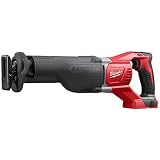


Milwaukee M18 Sawzall models compared
Milwaukee uses “SAWZALL” for its full-size reciprocating saws and “HACKZALL” for its shorter, more compact one-handed design. All of the models below use Milwaukee M18 batteries, but their cutting speed, stroke length, motor design, vibration control, and handling are not the same.
| Model | Motor | Stroke length | Speed | Tool weight | Best use |
|---|---|---|---|---|---|
| M18 SAWZALL 2621-20 | Brushed | 1-1/8 in. | 0–3,000 SPM | About 7.0 lb bare | General remodeling and occasional demolition |
| M18 FUEL SAWZALL 2720-20 | POWERSTATE brushless | 1-1/4 in. | 0–3,000 SPM | About 7.4 lb bare | Frequent demolition and heavy cutting |
| M18 FUEL SAWZALL with ONE-KEY 2721-20 | POWERSTATE brushless | 1-1/4 in. | 0–3,000 SPM | About 8.2 lb bare | Controlled professional use and fleet management |
| M18 FUEL HACKZALL 2719-20 | POWERSTATE brushless | 7/8 in. | 0–3,000 SPM | About 5.7 lb bare | Plumbing, electrical work, and confined spaces |
Weights are tool-only figures and can vary slightly by configuration or published specification. A battery, blade, and shoe pressure add noticeable weight, especially with a high-capacity M18 pack.
Head-to-head: which M18 reciprocating saw is strongest?
M18 FUEL SAWZALL 2720-20: the demolition pick
The 2720-20 is the strongest all-around choice for cutting framing lumber, nails, roofing materials, pipe, conduit, and sheet metal. Its 1-1/4-inch stroke removes more material per cycle than the 2621-20’s 1-1/8-inch stroke. Both reach 3,000 strokes per minute, so the longer stroke gives the FUEL model a practical advantage when the blade is loaded against thick wood or metal.
Its POWERSTATE brushless motor is more efficient than the brushed motor in the 2621-20, and Milwaukee’s electronic protection helps manage overload and overheating. The model also includes a counterbalance mechanism intended to reduce vibration. It is still a forceful demolition tool, not a low-vibration precision saw, but it is easier to control during long cuts than a basic reciprocating saw.
Choose it if the saw will regularly cut nail-embedded lumber, cast iron, thick pipe, or multiple layers of construction material. For light use, its higher purchase cost may not be justified.
M18 SAWZALL 2621-20: the value option
The 2621-20 uses a brushed motor and a slightly shorter 1-1/8-inch stroke, but it still offers variable speed up to 3,000 SPM and a full-size SAWZALL grip. It is capable of common remodeling tasks such as cutting PVC, copper pipe, studs, drywall backing, pallets, and small sections of metal.
The main ownership difference is motor efficiency and maintenance. Brushes eventually wear, particularly when the saw is used in dusty demolition environments. The brushed design can make sense when the tool is used only a few times a month and the lower tool-only market range—often roughly $100 to $180 depending on kit contents and promotions—is more important than maximum runtime.
M18 FUEL SAWZALL with ONE-KEY 2721-20: useful control, extra cost
The 2721-20 adds ONE-KEY connectivity and control features to the brushless full-size platform. The important point is not simply the phone connection: users can configure operating behavior, track the tool, and help manage a larger company fleet. That is useful for contractors, maintenance departments, and shared tool inventories.
For an individual homeowner, it does not cut fundamentally faster than the standard 2720-20. The extra weight and cost are harder to justify unless the digital controls, inventory management, or additional configuration options matter to you.
M18 FUEL HACKZALL 2719-20: the tight-space specialist
The 2719-20 is not a smaller replacement for a full-size SAWZALL. Its 7/8-inch stroke and shorter body make it easier to use between studs, under sinks, above ceilings, and around installed pipe. At about 5.7 pounds bare, it is substantially easier to hold at arm’s length.
The tradeoff is lower cutting reach and less aggressive material removal. It is excellent for cutting copper, PVC, EMT conduit, small dimensional lumber, and demolition openings where a full-size saw is awkward. For continuous heavy framing demolition, the longer-stroke SAWZALL models remain faster and steadier.
Vibration control, motor power, and real battery runtime
“Motor power” is difficult to compare using a single watt number because Milwaukee does not generally present these cordless tools as simple constant-wattage machines. In practical terms, the brushless FUEL models provide better sustained output under load, more efficient battery use, and stronger overload management than the brushed 2621-20. The saw’s blade, cutting technique, and material often make a larger difference than a catalog power figure.
Runtime also varies widely. A 5.0Ah M18 battery may deliver approximately 40 to 80 minutes of intermittent trigger time in mixed remodeling work, but that does not mean 40 to 80 minutes of continuous cutting. Hard demolition cuts can reduce effective work time sharply. A reasonable planning estimate is:
- 5.0Ah battery: roughly 20 to 40 heavy cuts in nail-embedded 2-by lumber, or substantially more light PVC and thin-metal cuts.
- 8.0Ah high-output battery: commonly about 1.4 to 1.7 times the work of a 5.0Ah pack, with more sustained power under load.
- 12.0Ah high-output battery: best for extended demolition, but adds considerable weight and can make a full-size saw tiring overhead.
These are planning ranges rather than guarantees. A dull blade, excessive shoe pressure, frozen lumber, thick steel, and cold temperatures can all reduce output. For the best balance, a 5.0Ah or 8.0Ah pack suits most full-size M18 saws; use a compact pack when maneuverability matters more than runtime.
Decision matrix for choosing an M18 Sawzall
| Your situation | Recommended model | Why |
|---|---|---|
| Lowest sensible cost and occasional use | 2621-20 | Capable full-size saw without the FUEL premium |
| Weekly demolition or renovation work | 2720-20 | Longer stroke, brushless efficiency, and better sustained performance |
| Professional fleet or shared tools | 2721-20 | ONE-KEY tracking and configurable management features |
| Confined spaces or overhead cutting | 2719-20 | Shorter, lighter body and easier one-handed positioning |
| Longest demolition sessions | 2720-20 with 8.0Ah battery | Good balance of cutting power, runtime, and manageable weight |
Blade choice and setup matter more than many buyers expect
Use a pruning blade for green wood, a demolition blade for nail-embedded lumber, a bi-metal blade for mixed metal, and a carbide-grit blade for cast iron or especially abrasive materials. A long blade is not automatically better: use the shortest blade that reaches through the work while leaving enough teeth engaged.
- Install the correct blade with the teeth facing the intended cutting direction.
- Set the adjustable shoe so only a controlled portion of the blade extends beyond the material.
- Start at low speed to establish the cut, then increase speed once the blade is tracking correctly.
- Keep the shoe firmly against the work. Let the blade cut rather than forcing the housing forward.
- Release the trigger before withdrawing the blade and allow the tool to stop completely.
Using a worn blade is one of the most common mistakes. It increases vibration, heat, battery drain, and motor load while cutting more slowly. Replace the blade when teeth are rounded, the cut begins wandering, or the tool requires noticeably more pressure.
Durability and ownership considerations
Demolition dust is hard on every reciprocating saw. Brush the tool after use, clear debris around the shoe and blade clamp, and avoid blowing high-pressure air directly into the housing because it can drive dust deeper into the bearings and electronics. Inspect the blade clamp for packed debris and confirm that the blade locks fully before each cut.
On the brushed 2621-20, motor brushes are a normal wear item over long ownership. On FUEL models, the brushless motor eliminates brush replacement, but the blade clamp, shoe assembly, gearbox, and reciprocating mechanism still experience mechanical wear. Excessive side loading, prying with the blade, and forcing a dull blade are more likely to shorten tool life than ordinary cutting.
For most buyers searching for an M18 SAWZALL, the 2720-20 is the best balance of cutting performance and price. Pick the 2621-20 for occasional work, the 2719-20 when access and low weight dominate, and the 2721-20 only when ONE-KEY features provide a real ownership benefit.