What's inside
As an Amazon Associate I earn from qualifying purchases. This post may contain affiliate links at no extra cost to you.
Cross-brand cordless battery adapters can make an old tool useful again, but they are not a free upgrade. An adapter usually changes the physical connection between a battery and a tool; it does not turn one battery platform into another. That distinction matters because cordless tools depend on more than voltage. Current limits, temperature sensing, battery communication, and low-voltage shutdown all affect how much work the tool can do safely.
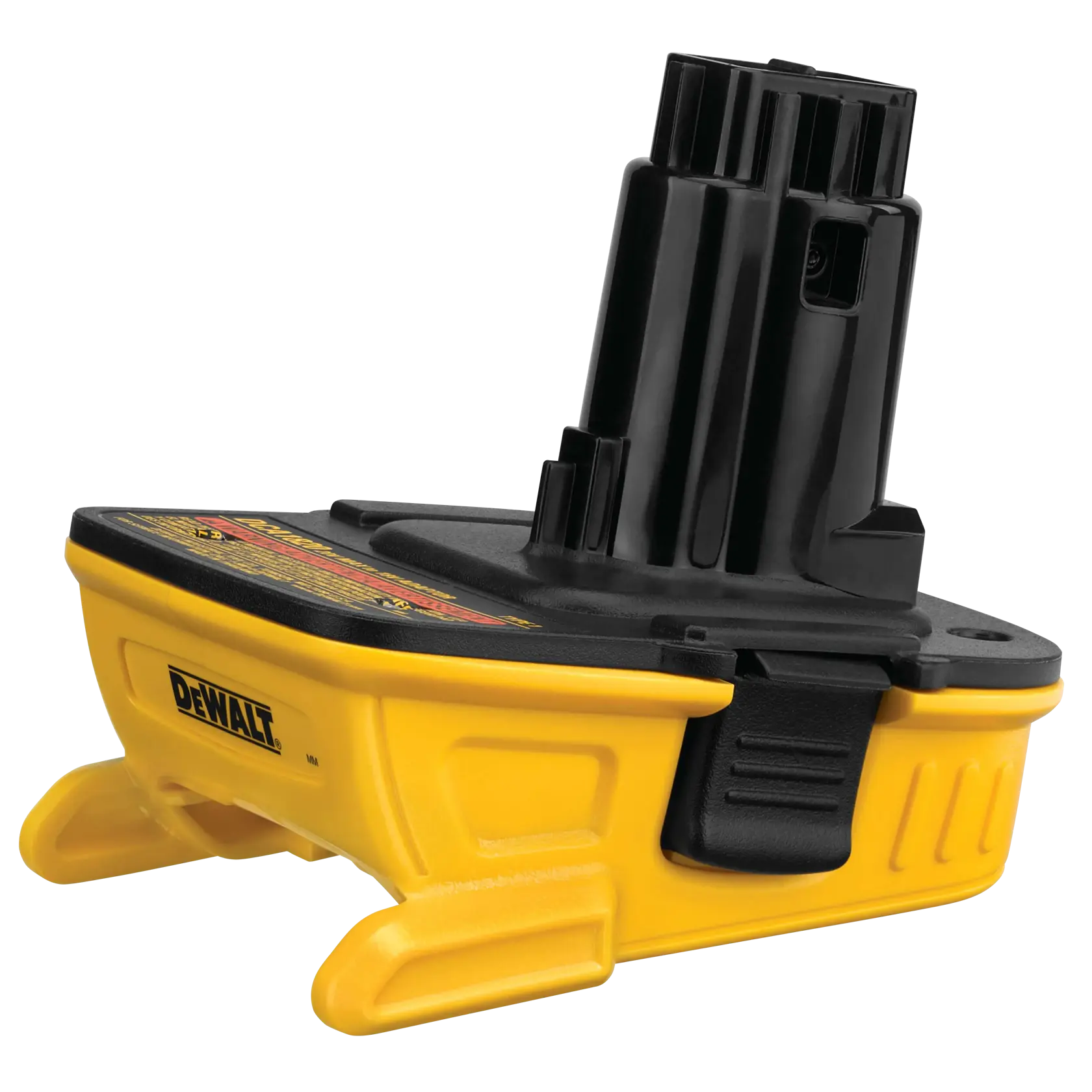
What an adapter actually changes
Most cross-brand adapters provide a mechanical connection between the battery’s rails and the tool’s contacts. Some include simple wiring, while others contain electronics intended to imitate a battery signal or control when power is available. In either case, the adapter generally does not increase battery capacity or convert a 20-volt-class pack into a higher-voltage supply.
Nominal voltage is only part of the calculation. A typical lithium-ion pack sold as an 18- or 20-volt class battery has five cells in series and measures about 18 volts nominally, with a full-charge voltage near 21 volts. A tool designed for that range may run, but the battery still needs to deliver the required current. A compact pack rated at 2 amp-hours may have much more voltage sag under load than a 5- or 8-amp-hour pack.
For example, a tool drawing 30 amps from a battery with 0.10 ohms of combined internal resistance can lose roughly 3 volts inside the battery and connections. That loss shows up as slower acceleration, reduced torque, earlier shutdown, and more heat. An adapter adds another set of contacts and wires, so its resistance matters too.
Where performance is commonly lost
| Limitation | What you may notice | Most affected tools |
|---|---|---|
| Small or aging battery | Slow startup, short runtime, early cutout | Saws, grinders, impact wrenches |
| Thin adapter wiring or weak contacts | Hot plug, intermittent power, reduced torque | High-current tools |
| Missing communication or temperature signals | Tool will not start, or protection is less predictable | Smart battery platforms and newer tools |
| Tool-specific electronics | Lower speed, pulsing, error indication | Brushless tools with electronic controls |
High-draw tools expose adapter weaknesses first. A drill running a small bit may work normally, while a circular saw stalls in thick lumber. An impact wrench may spin without a fastener but fail to reach its advertised fastening speed or torque once it meets resistance.
The adapter itself can also become the bottleneck. A loose-fitting rail, undersized wire, poorly crimped terminal, or spring contact with limited pressure creates resistance. At 25 amps, even 0.05 ohms produces 31 watts of heat at the connection. That is enough to soften plastic, discolor terminals, or cause a thermal shutdown.
Battery communication and protection are not optional details
Many battery platforms use more than positive and negative terminals. The tool and pack may exchange temperature, state-of-charge, identification, or current-limit information. Some tools can run with only the main power contacts; others refuse to start when the expected signal is missing.
A simple adapter may bypass the original battery’s low-voltage cutoff. That can leave the tool running until the cells are driven below a healthy discharge level, particularly if the tool has no independent protection. Repeated over-discharge reduces lithium-ion battery life and can make a damaged pack unsafe to recharge.
Temperature protection is another concern. A battery can heat quickly during cutting or grinding, and the original tool ecosystem may stop operation when the pack reaches a defined temperature. An adapter that does not pass that information through may remove or weaken that safeguard. Do not assume a tool’s normal shutoff behavior still applies after changing platforms.
When an adapter is a reasonable choice
An adapter can be sensible for light and intermittent work, especially when you already own several batteries from one platform. A drill, small driver, inspection light, radio, or low-load oscillating tool is generally a more forgiving match than a saw or grinder. The savings are real if the adapter costs less than buying a complete battery and charger for a second ecosystem.
Use the adapter with a battery that matches the tool’s nominal voltage and has enough capacity for the load. A newer 5-amp-hour pack is usually a better choice for demanding work than a tired 2-amp-hour pack, even if both fit. If you are building around one battery family, compare 5Ah cordless tool batteries by their platform, not just the printed capacity.
Adapters also make practical sense for occasional specialty tools. Buying one adapter for a seldom-used light or inflator is different from relying on an adapter every day for production cutting. For frequent use, the platform-matched battery is normally the better engineering choice.
When the matching battery is worth the extra cost
Buy the tool’s intended battery when the tool has a brushless motor, electronic speed control, high stall current, or a safety-critical role. Circular saws, reciprocating saws, grinders, planers, and high-torque impact wrenches can demand 20 to 50 amps in short bursts, depending on the design and load. These tools benefit from the pack, contacts, and firmware being designed as one system.
The same applies when runtime matters. Battery capacity is measured in amp-hours, but usable energy falls as current rises and the pack heats. A matched high-output battery may deliver more practical runtime than an adapter-fed pack with the same printed capacity. If you need an extra battery, search for a battery and charger kit for your tool platform; the bundle often costs less than buying both separately.
Safer adapter use and charging rules
Never charge a battery through a cross-brand adapter unless the adapter manufacturer explicitly provides a charging system designed for that purpose. Put the battery on its own matching charger. Chargers use pack-specific voltage, temperature, and identification requirements; a tool adapter does not make an incompatible charger safe.
Before use, inspect the adapter for cracked plastic, loose rails, exposed wire, or blackened contacts. Stop if the adapter, battery, or tool connector becomes unusually hot, smells of overheated plastic, or cuts out repeatedly. Do not modify the adapter to defeat a thermal or low-voltage protection feature. Keep the battery locked firmly in place, and avoid using an adapter where a fall could pull the pack loose.
For heavy work, check the adapter after several minutes rather than waiting for failure. Warmth is expected; a connector too hot to comfortably touch is a warning. If an adapter makes a tool usable but noticeably weaker, treat that as a limitation—not something to solve by forcing a larger fuse or bypassing protection. For demanding applications, a reputable cross-brand battery adapter is preferable to an unmarked unit, but neither replaces the compatibility and protection of the original battery platform.
Making the buying decision
Match voltage first, then consider current demand, battery capacity, communication requirements, and how often the tool will be used. The cheaper adapter option is fine for light-duty, occasional work when its limitations are acceptable. For saws, grinders, daily trade use, or any job where a shutdown would be costly, buy the manufacturer-matched battery. The extra money pays for predictable power delivery, correct protection, and fewer points of failure.
Related guides
- Longest Lasting Lawn Mower Battery: AGM vs Lithium vs Flooded Lifespan and Cost per Season
- Duralast Gold Lawn Mower Battery Review: U1 Fit, CCA and When to Pay for AGM
- Greenworks Pro 80V 21-Inch Mower Review: Runtime Math, Push vs Self-Propelled and Yard Fit
- Bosch High Pressure Washer Gun Replacement: Fittings, Adapters and What Fits Your Model