
What's inside
As an Amazon Associate I earn from qualifying purchases. This post may contain affiliate links at no extra cost to you.
A wood turning lathe is one of those tools where the gap between a poor choice and a good one can cost you months of frustration. Too little power and you cannot rough out a bowl blank without stalling the motor. Too narrow a speed range and you lose control on larger or irregular pieces. Bed length determines what you can actually turn, while construction quality decides whether the machine vibrates itself apart after a season of use.
We compared these eight machines across published specifications, listed prices, and recurring themes in owner feedback. The lineup spans benchtop portability, mid-range hobby work, and a full-size fixed-speed option. What follows should help you match a lathe to your project scope, your shop space, and your budget without overspending or underbuying.
As an Amazon Associate we earn from qualifying purchases at no extra cost to you. Product prices and availability are accurate as of the date shown and are subject to change.




Quick Picks
| Product | Best for | Price |
|---|---|---|
| VEVOR 14×40 Fixed Speed | Long spindle work on a budget | $218.61 |
| VEVOR 14×40 Half-HP Benchtop | Beginners wanting included accessories | $209.90 |
| VEVOR 1 HP Brushless | Demanding variable-speed turning | $389.90 |
| JET JWL-1221VS | Serious hobbyists and small shops | $989.99 |
| WEN 34035 | Wide speed range at moderate cost | $779.30 |
| WM101A-Plus Mini Lathe | Pens, small craft, and tight spaces | $279.00 |
| JET JWL-1015VS | Compact variable-speed benchtop | $714.99 |
| 12×18 Digital Display | Sanding, polishing, and high-RPM tasks | $359.99 |
How We Picked
Four criteria drove our shortlist. Motor power and speed range determine whether a machine can handle your intended stock sizes without bogging down. Bed length and swing capacity set a hard ceiling on project dimensions. Build materials such as cast iron versus stamped steel affect vibration and long-term accuracy. Finally, included accessories and user-reported reliability matter because a lathe that arrives missing a faceplate or one whose tailstock drifts under load creates hidden costs and lost time.
The 8 Best Wood Turning Lathe in 2026
VEVOR 14×40 Fixed Speed
This machine targets buyers who need maximum bed length without spending over two hundred dollars. The fourteen-inch swing and forty-inch distance between centers accommodate tall table legs, long spindles, and oversized stock that shorter beds simply reject. Four discrete speeds cover common turning ranges, though the top RPM will feel limiting on very hard species.
- Generous forty-inch bed at a price most competitors cannot touch
- Comes with chisels, a faceplate, and a hex wrench in the box
- Fixed speeds mean no dial to adjust mid-project
Skip it if you primarily turn small bowls or need variable speed for finishing work. Owners also note the plastic handle feels lightweight under sustained pressure.
VEVOR 14×40 Half-HP Benchtop
Nearly identical in footprint to the first VEVOR but with a half-horsepower motor and slightly higher top speed. The package includes a tool rest, wrenches, and a faceplate, making it ready for basic projects on day one. Beginners who want a no-fuss benchtop lathe with accessories already bundled will find this the most turnkey option under two hundred and twenty dollars.
- Six included accessories reduce upfront add-on spending
- Top speed of 2500 RPM handles softer woods and small-diameter work well
- Half-horsepower output struggles with roughing out dense hardwoods over four inches in diameter
Pass on this if your projects routinely involve green or very hard stock that demands more torque.
VEVOR 1 HP Brushless
A significant step up in drivetrain quality. The brushless DC motor delivers 150 to 3800 RPM through an infinite-range dial, while the cast-iron construction keeps mass where it should be. The twelve-inch swing and eighteen-inch bed suit bowls, spindles, and pens in one machine. Owners consistently praise the smooth low-end speed control, which matters for tool contact on large or out-of-round blanks.
- Cast iron body and brushless motor together reduce vibration and maintenance
- Variable speed across a wide range adapts to roughing, turning, and sanding
- Eighteen-inch bed limits spindle-length projects compared to the forty-inch VEVOR models
Skip this if you need bed length above twenty inches or plan to turn only short spindles at fixed speeds.
JET JWL-1221VS
JET has built a reputation among turners for reliability, and this model lives up to it. The one-horsepower motor, variable-speed control, and twelve-inch by twenty-one-inch capacity position it as a full-service hobby lathe. The reverse switch and indexing head add features that cheaper machines omit entirely. Owners report consistent long-term accuracy and solid dealer support, factors that justify the nearly thousand-dollar price for those who will keep the lathe for years.
- Reverse function and indexing head expand project types without extra accessories
- Well-documented owner base means parts and guidance are easy to find
- Price is roughly two-and-a-half times the VEVOR brushless with only a few more inches of bed
If budget is the primary constraint, the VEVOR delivers comparable core performance at less than half the cost.
WEN 34035
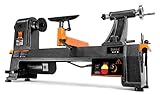
The WEN occupies a middle tier: a six-amp motor, fourteen-inch swing, and variable speed in a benchtop form factor. It lacks the cast-iron mass of the JET but offers a wider speed range and a tool rest that adjusts without removing hardware. Owners frequently mention its solid value proposition, though a few note that the headstock spindle threading can be inconsistent, requiring careful chuck alignment.
- Fourteen-inch swing handles large bowl blanks that smaller benchtops reject
- Variable-speed dial with a wide RPM spread covers roughing through polishing
- Included tool rest is adequate but not heavy-duty for out-of-round green stock
Skip this if you primarily work with unseasoned or highly irregular blanks that demand a more rigid tool rest and heavier construction.
WM101A-Plus Mini Lathe
This is a pen and micro-turning machine, not a general-purpose lathe. The 24VDC ninety-six-watt motor drives a short bed through infinite variable speed, and the included tool kit covers common small-format operations. Its compact footprint suits apartments, classrooms, or a bench dedicated entirely to pen making. The power ceiling means larger spindle work is not possible, but within its intended niche owners report reliable, quiet operation.
- Runs on low-voltage DC, keeping heat and noise minimal during long sessions
- Includes a turning tool kit that handles pen, stylus, and small-craft work out of the box
- Swing and bed length restrict it to stock under roughly two inches in diameter
Skip this if you want a single lathe for all woodworking; buy it alongside a full-size machine for dedicated pen turning.
JET JWL-1015VS
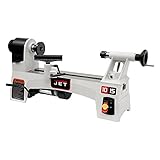
A smaller sibling to the JWL-1221VS, the 1015 pairs a half-horsepower motor with ten-inch swing and fifteen-inch bed. It suits turners with limited bench space or those who mostly produce pens, bottle stoppers, and small bowls. The variable-speed control and reverse function carry over from the larger model, and build quality tracks JET’s usual standards. Price, however, approaches full-size territory, so the value question centers on whether the compact footprint justifies the premium over mid-range competitors.
- Reverse switch and variable speed at a size that fits a narrow shelf
- Build and finish quality exceed machines in the three-hundred-dollar bracket
- At over seven hundred dollars, it costs more than twice the VEVOR brushless with only a slightly longer bed
Consider the VEVOR 1 HP Brushless instead if your shop space is not severely limited and you want a better power-to-dollar ratio.
12×18 Digital Display
This machine leans toward high-speed applications. A three-quarter-horsepower motor spins up to 3800 RPM, and the digital readout lets you dial in precise speeds for sanding, polishing, or fine finishing passes. The twelve-inch swing and eighteen-inch bed handle typical bowl and spindle work, though the motor is less suited to aggressive roughing of large green stock. Owners appreciate the clarity of the display compared to analog dials that drift over time.
- Digital RPM display removes guesswork when matching speed to diameter and tool pressure
- Top speed of 3800 RPM supports polishing and sanding without a separate buffer
- Three-quarter horsepower can stall under heavy roughing cuts on dense hardwood
Skip this if roughing out large, unseasoned blanks is your primary task; the motor will overwork and shorten its lifespan.
Buying Guide
Motor Power and Speed Control
Horsepower dictates whether the lathe can push through a roughing gouge on dense or green wood without stalling. Under half a horsepower works for pens and small spindles; half to one horsepower handles most hobby bowl and spindle turning; above one horsepower suits production and large-diameter work. Speed range matters as much as power. A lathe that tops out near 2500 RPM limits finishing options, while variable-speed models reaching 3800 RPM can double as sanding and polishing stations. If your work spans roughing and finishing, prioritize variable speed over raw horsepower.
Bed Length and Swing Capacity
Swing is the maximum diameter of stock you can turn; it is measured from the bed centerline to the highest point the tool can reach. Bed length determines how long a spindle or table leg you can support between centers. Match these numbers to your realistic project sizes, not your aspirational ones. A forty-inch bed is wasted if you only turn bowls under ten inches, and a short bed will force awkward support setups if you occasionally turn longer spindles.
Construction, Vibration, and Accessories
Cast-iron heads and beds damp vibration far better than aluminum or stamped steel, which translates directly to surface finish and tool control. Look for a tool rest that locks without flex, a tailstock that does not drift under pressure, and spindle threads that accept standard chucks. Included accessories such as faceplates, wrenches, and a starter tool set save modest money but rarely replace dedicated turning chisels. Prioritize the core mechanical build over the accessory count.
Our Verdict
The top pick is the VEVOR 1 HP Brushless for its cast-iron body, wide variable-speed range, and accessories at a price under four hundred dollars. The budget pick goes to the VEVOR 14×40 Half-HP Benchtop, which bundles a tool rest, faceplate, and wrenches near two hundred and ten dollars for beginners who want to start turning immediately. If your shop space is extremely tight and you value brand reputation with dealer support, the JET JWL-1015VS wins despite costing more, because its build quality and reverse function justify the premium for a compact dedicated setup.
FAQ
What size wood turning lathe do I need for bowls?
A bowl over twelve inches in diameter requires at least a fourteen-inch swing to leave room for your tool to reach the center. If you plan to turn bowls up to sixteen inches, choose a machine with an eighteen-inch swing or more to maintain clearance and avoid the lathe body interfering with the workpiece.
Is variable speed worth it over fixed-speed models?
Yes for most users. Variable speed lets you match RPM to the workpiece diameter, reducing the risk of catastrophic failure on large or out-of-round blanks. Fixed-speed lathes are simpler and cheaper but force compromises between roughing power and finishing control, making them better suited to dedicated spindle work at one size range.
Can I use a wood lathe for metal turning?
Not safely for most operations. Wood lathes lack the rigidity, lower RPM ceiling for cutting steel, and the coolant provisions of a metal lathe. Some small brass or aluminum work is possible on a variable-speed model running in its lower range, but you will exceed the machine’s design limits quickly and risk injury.
How important is the tool rest quality?
Critical. A tool rest that flexes or vibrates introduces chatter into every cut, ruining your surface finish and making it harder to control gouge pressure. Look for a rest that locks firmly with a single lever and stays rigid even when you apply moderate downward force with a bowl gouge.