What's inside
As an Amazon Associate I earn from qualifying purchases. This post may contain affiliate links at no extra cost to you.
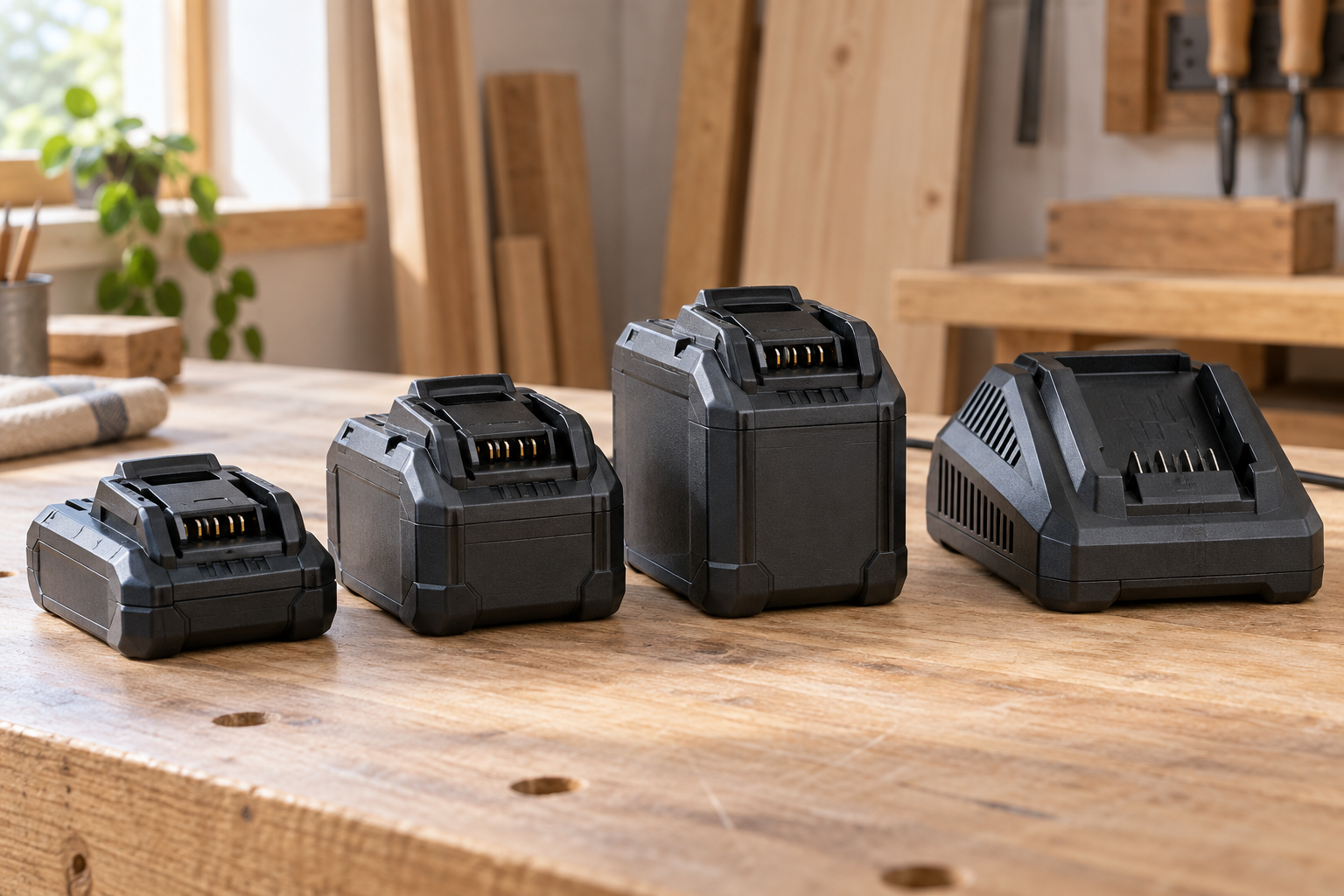
Charging batteries with different capacities is straightforward when each pack has its own charger, but it becomes a planning problem when you have one charger, a dual-port charger, or a limited power supply. The key is to match the charging order to your work schedule—not simply to charge the largest battery first every time.
Understand Capacity and Charge Time
Battery capacity is usually listed in amp-hours (Ah). A 2.0Ah battery stores roughly half as much energy as a 4.0Ah battery of the same voltage. It does not necessarily charge in exactly half the time, because chargers reduce current near the end of the cycle and may use different charging rates for different packs.
As a practical estimate, a standard charger may take about 30 to 60 minutes to charge a 2.0Ah pack and 60 to 120 minutes for a 4.0Ah or 5.0Ah pack. High-speed chargers can be much faster, while compact USB-style chargers may take several hours. The charger’s specifications matter more than the battery’s Ah rating alone.
| Battery capacity | Typical use | Approximate standard-charge time | Best charging priority |
|---|---|---|---|
| 1.5–2.0Ah | Drills, impact drivers, light fastening | 30–60 minutes | Charge first when a short task is coming up |
| 3.0–4.0Ah | General saws, sanders, and mixed work | 60–100 minutes | Charge first for medium-length work |
| 5.0–6.0Ah | High-draw tools and extended runtime | 90–150 minutes | Start early; do not leave it until the last minute |
| 8.0Ah and larger | Mowers, chainsaws, blowers, heavy cutting | 2–4 hours or more | Charge overnight only if the manufacturer permits it |
These are broad ranges, not guarantees. A charger rated for a particular platform may charge a 5.0Ah battery much faster than another charger from the same brand.
Choose the Charging Order
If you have one charger and batteries of different capacities, charge according to the next job. Put the battery needed soonest on the charger first. A 2.0Ah battery that will run an impact driver in 20 minutes is more useful than a 6.0Ah pack that will not be needed until the afternoon.
If you are preparing for a long job and need all batteries ready, start with the largest pack. Large batteries take the longest, so charging them first reduces the chance that one will still be sitting at 30 percent when you need to leave. After that, charge the medium packs and finish with the smaller batteries. The smaller packs are usually the quickest to complete and are easier to fit into a short gap.
For a full day of work, a useful sequence is:
- Charge the largest battery first.
- Charge the next-highest-capacity pack while the large pack cools.
- Charge small packs last, unless one is needed for an immediate task.
- Label batteries or keep a simple rotation so the same pack is not repeatedly used while another sits idle.
Use Dual-Port and Multi-Bay Chargers Correctly
Some dual-port chargers charge both batteries at once. Others charge one battery and then automatically switch to the second. Do not assume that two slots mean twice the charging speed. Read the charger’s instructions and look for its total output or charge sequence.
On a sequential charger, place the battery you need first in the priority slot if the charger identifies one. If both ports are equal, put the larger battery on first. On a genuinely simultaneous charger, install the batteries together and let the charger manage the current. There is no benefit to repeatedly removing one pack to “help” the other unless the manual specifically says the charger prioritizes one slot.
A dual-port battery charger is worthwhile for people who regularly use two batteries in a day. A second single-bay charger can be cheaper and may be more flexible, especially if it lets you charge batteries in separate rooms or from separate circuits.
Avoid Mixing Incompatible Systems
Voltage is not the only compatibility issue. A 20V battery from one tool brand generally cannot be charged safely on another brand’s charger, even if the nominal voltage appears similar. The charger communicates with the battery’s protection electronics and must use the correct charging profile.
Use only the manufacturer’s charger or a reputable charger explicitly designed for that battery platform. Avoid adapters that change the physical connection unless the adapter maker clearly explains its protection and compatibility requirements. An adapter may make a battery fit, but it does not automatically make charging safe.
If you need another charger, search for the exact platform and charger type, such as a platform-compatible 18V battery charger. Check the listing against the battery label and the tool manufacturer’s compatibility chart before buying.
Manage Heat and Common Failure Modes
Do not charge a battery immediately after heavy use if it is hot to the touch. Many chargers will refuse a hot pack, but cooling it first is still good practice. Let it sit in a dry, shaded area until it reaches room temperature. Charging in direct sun, inside a hot vehicle, or near a heater can trigger a temperature fault or shorten battery life.
Do not charge a swollen, cracked, leaking, wet, or physically damaged pack. A battery that repeatedly flashes an error light may have a failed cell, a bad connection, or a temperature-sensor problem. Stop using it rather than repeatedly removing and reinstalling it. Replacing a suspicious pack is cheaper than risking a fire or damaging the charger.
Keep charger vents clear and place the charger on a hard, nonflammable surface. Avoid extension cords with damaged insulation or very light-gauge wire, especially when several chargers share one circuit. Never connect batteries directly in parallel to make a larger pack unless the system was designed for that purpose.
When to Buy More Capacity
A larger battery is not always the best purchase. High-capacity packs add weight and can make a drill or impact driver tiring during overhead work. For fastening, cabinet installation, and short repair jobs, two small batteries may be more useful than one heavy pack because one can charge while the other is in use.
For a circular saw, recip saw, grinder, mower, or blower, a 5.0Ah or larger battery usually provides better runtime and less frequent swapping. If your work regularly stops because every battery is charging, add a second charger or another battery before buying the biggest available pack. A battery starter kit with a charger can be economical when the included pack matches tools you already own.
The cheapest workable approach is often one standard charger, one small battery for light tools, and one larger battery for high-draw tools. Sequence the larger pack first when preparing for a full day, but let the job—not battery size alone—decide what gets charged next.
Related guides
- Longest Lasting Lawn Mower Battery: AGM vs Lithium vs Flooded Lifespan and Cost per Season
- Duralast Gold Lawn Mower Battery Review: U1 Fit, CCA and When to Pay for AGM
- Greenworks Pro 80V 21-Inch Mower Review: Runtime Math, Push vs Self-Propelled and Yard Fit
- Bosch High Pressure Washer Gun Replacement: Fittings, Adapters and What Fits Your Model