What's inside
As an Amazon Associate I earn from qualifying purchases. This post may contain affiliate links at no extra cost to you.
Fit the tool to the job
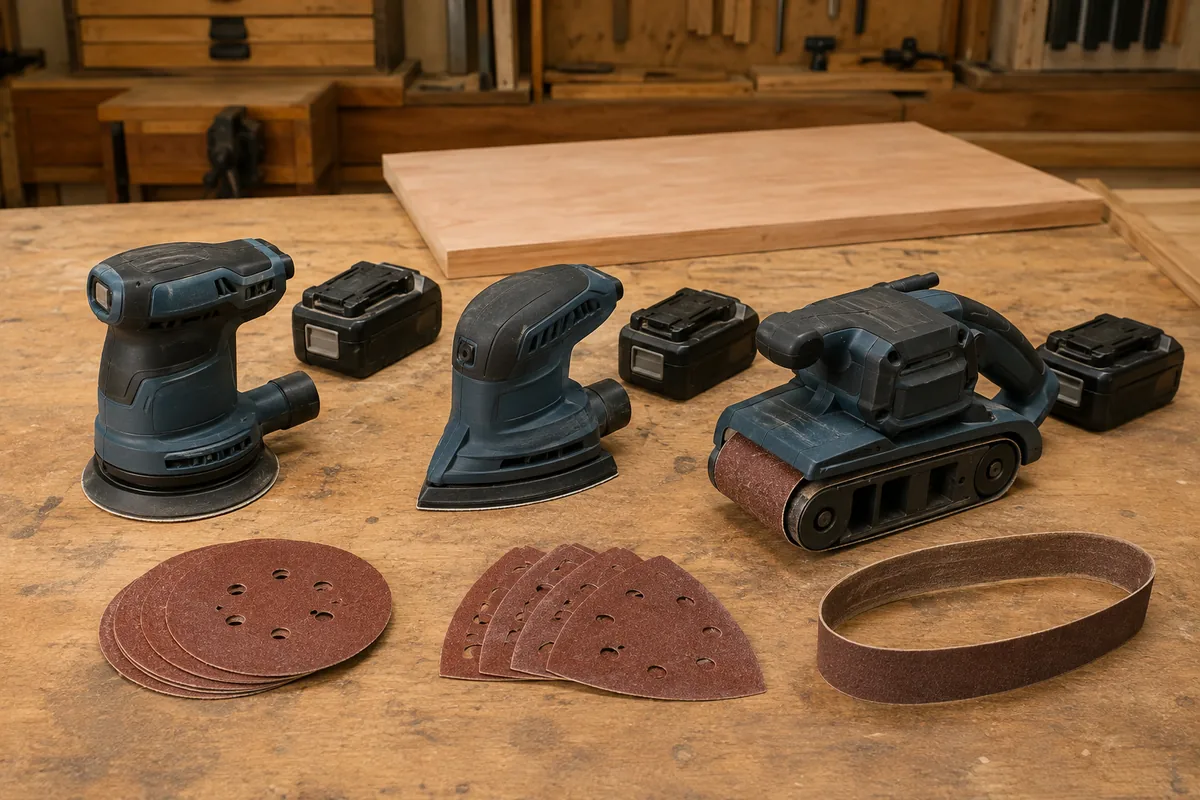
A cordless belt sander can strip paint, varnish, or weathered finish from broad, flat timber quickly. It is a poor choice for profiled trim, narrow boards, and delicate furniture: the moving belt removes material fast, and a brief pause can leave a hollow or rounded edge. For small pieces or occasional touch-ups, a cordless random-orbit sander is usually easier to control and cheaper to feed with abrasives.
Choose a belt sander when you have a substantial flat area and can keep the tool moving. For removing coatings from timber, a common starting point is 60- or 80-grit belt abrasive; start with 80 if the finish is thin or the wood is soft. Coarser belts cut faster but leave deeper scratches and can expose unevenness you then have to sand out.
As an Amazon Associate we earn from qualifying purchases at no extra cost to you.


What cordless changes
Cordless is useful where there is no convenient outlet, on exterior work, or when a cable would snag on a long board. The trade-off is battery weight, runtime, and cost. A belt sander draws heavily under load, so a small compact battery may run down quickly or limit sustained cutting. A higher-capacity pack generally lasts longer but makes an already top-heavy tool heavier.
If you own batteries from a platform already, buying a bare tool can make sense. Check that the platform actually offers a belt sander and that your existing packs are compatible; battery ecosystems do not make tools interchangeable across brands. If you need a charger and batteries as well, compare the full kit price against a corded sander. For occasional indoor stripping near an outlet, corded is often the better-value choice.
Which type makes sense?
| Option | Best for | Main trade-off |
|---|---|---|
| Cordless belt sander | Large, flat timber away from outlets | Fast removal, but heavy and easy to gouge wood |
| Corded belt sander | Long sessions near reliable power | Lower running-cost pressure, but cable management matters |
| Cordless random-orbit sander | Smaller jobs, edges, and finish sanding | More controllable, but slower at stripping thick coatings |
| Scraper or chemical stripper | Profiles, corners, and heat-sensitive situations | Less risk of sanding shapes flat, but often slower or messier |
For a battery-platform owner who needs mobility, compare cordless belt sanders available in that ecosystem. Do not choose by advertised belt speed alone. Compare belt width and length, dust-bag or extractor connection, grip and balance, and whether the tool has a usable tracking adjustment. A wider belt covers more area but can be harder to control on narrow stock.
What to check before buying
Dust collection: Sanding old coatings creates fine dust, and the tool’s bag will not capture everything. A vacuum connection is preferable for repeated work, but check the port size and whether an adapter is needed. Do not assume a dust bag makes sanding lead paint safe. If the building may contain lead-based paint, follow local rules for testing and containment rather than dry-sanding it casually.
Belt tracking and control: A belt that drifts off-center can rub against the tool or damage its edge. Adjust tracking as directed, with the sander held securely and clear of the work. A lock-on switch is convenient for broad boards but can make stopping less immediate. The tool should have a clear way to release the switch and a front grip that lets you guide it without pressing down hard.
Battery and kit cost: For a one-off project, a kit may be cheaper than buying a bare tool, battery, and charger separately. If you already own several compatible packs, a bare tool is more sensible. Compare cordless random-orbit sanders too if the work includes small panels or final smoothing; a belt sander usually needs a second tool to remove its scratch pattern.
Strip coatings without wrecking the timber
Secure the board so it cannot shift. Wear eye protection, hearing protection, and a properly fitted respirator suited to the dust and coating; read the coating guidance before disturbing old paint. Keep the cord-free advantage from becoming an excuse to sand in an enclosed, dusty room without extraction.
Lay the belt flat before starting the cut, then move in the direction of the grain with light, even pressure. Keep the tool moving through the whole pass and lift it clear before stopping. Do not lean on the machine to make it cut faster: pressure can slow the belt, heat the work, load the abrasive, and create a low spot. Inspect after each pass. Stop once the coating is gone rather than continuing to remove sound timber.
Use a scraper or hand sanding for corners and edges the belt cannot reach. Replace a belt that is glazed, clogged, torn, or cutting poorly; forcing a worn belt often produces heat and uneven results rather than useful progress. After stripping, move to finer abrasives as needed, commonly 100- or 120-grit before a finer finish, while checking the surface in raking light. The belt sander is the fast removal tool, not usually the last step.
When the cheaper choice is fine
If you have one small tabletop, a few shutters, or a short length of trim, buying a premium cordless belt sander is hard to justify. A scraper for thick or fragile finish, followed by a basic random-orbit sander, may leave more timber intact and cost less. Choose a belt sander when the area is large enough to reward its speed, the surface is broad and flat, and you can control the tool for repeated, moving passes.
Related guides
- Longest Lasting Lawn Mower Battery: AGM vs Lithium vs Flooded Lifespan and Cost per Season
- Duralast Gold Lawn Mower Battery Review: U1 Fit, CCA and When to Pay for AGM
- Greenworks Pro 80V 21-Inch Mower Review: Runtime Math, Push vs Self-Propelled and Yard Fit
- Bosch High Pressure Washer Gun Replacement: Fittings, Adapters and What Fits Your Model