What's inside
As an Amazon Associate I earn from qualifying purchases. This post may contain affiliate links at no extra cost to you.
Moving shallow floodwater without running an extension cord is where cordless transfer pumps earn their keep. They are useful for emptying a basement corner, trench, crawl space, stock tank, rain barrel, or jobsite excavation. They are not a replacement for a full-size trash pump, and they should not be treated as a safe way to remove sewage or chemically contaminated water.
As an Amazon Associate we earn from qualifying purchases at no extra cost to you.


Choose the Right Pump Type
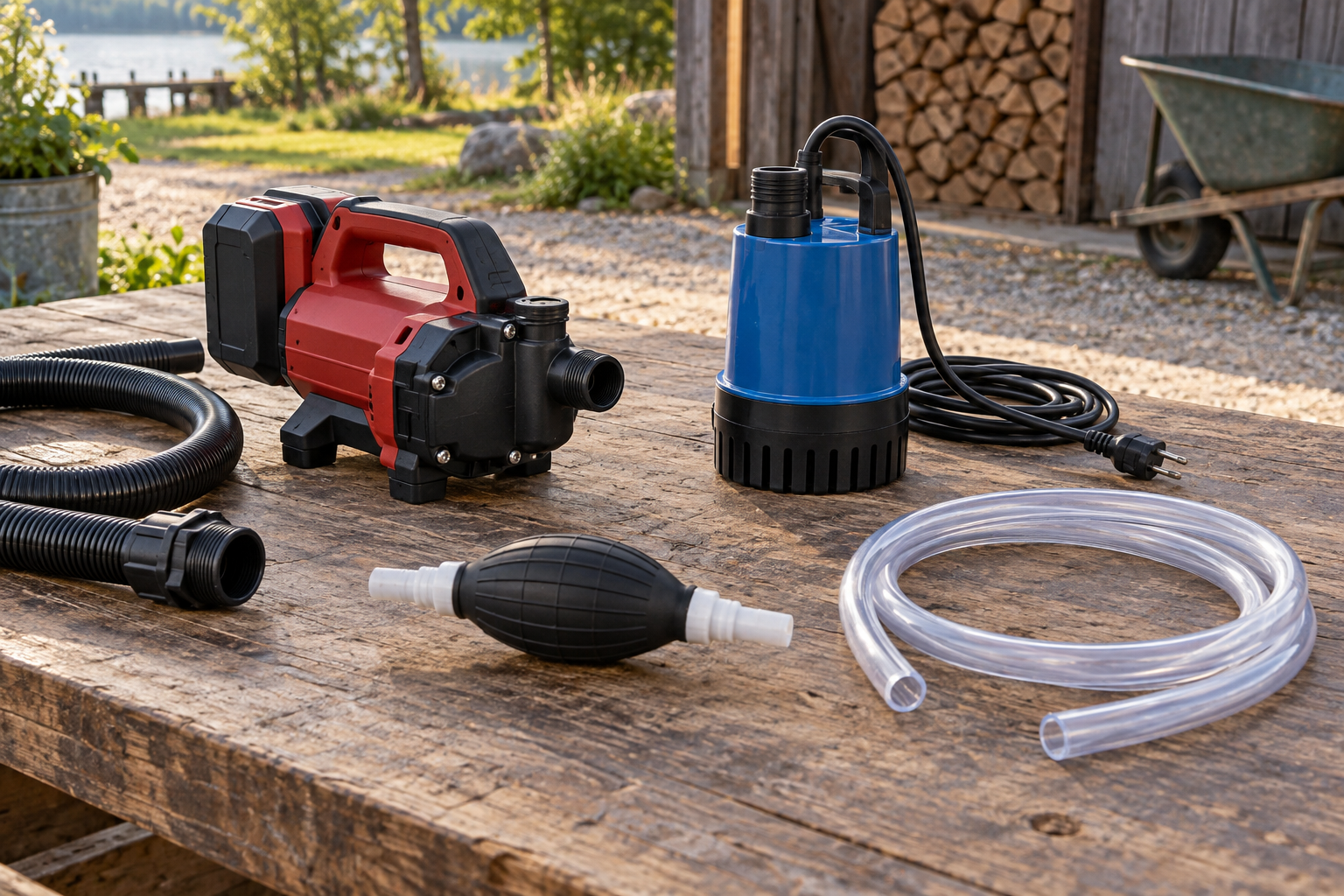
Most cordless water-transfer tools fall into three groups: small transfer pumps, submersible utility pumps, and cordless trash pumps. The right choice depends more on water depth and debris than on the battery brand.
| Pump type | Best use | Main limitation | Typical performance |
|---|---|---|---|
| Transfer pump | Shallow standing water, tanks, barrels, and hoses | Usually must be kept dry or primed; clogs easily | About 10–20 gallons per minute |
| Submersible utility pump | Basements, pits, and areas with several inches of water | Needs enough water to cover the pump; limited debris handling | About 15–30 gallons per minute |
| Trash pump | Dirty water, mud, leaves, and outdoor work | Heavier, more expensive, and harder on batteries | About 20–40 gallons per minute |
For clean or lightly dirty water, a cordless water transfer pump is usually the least expensive option. A submersible model is easier to use because you place it in the water and run a discharge hose. For leaves, grit, and small outdoor debris, shop for a cordless submersible utility pump with a screened intake.
Battery Platform and Runtime
Battery compatibility is the main buying decision. A pump that accepts batteries you already own is often a better purchase than a higher-output pump that forces you into a new charger and battery system.
Small pumps commonly use compact 18V or 20V-class packs. A 5.0Ah battery contains roughly 90 to 100 watt-hours before losses. Pump runtime varies widely, but 15 to 30 minutes of continuous pumping is a realistic planning range for many portable models. Larger pumps may drain a high-capacity battery in well under 20 minutes.
That sounds short, but it can still move a useful amount of water. A pump moving 20 gallons per minute for 15 minutes theoretically handles 300 gallons. Real output drops with hose length, lift height, narrow fittings, a dirty screen, and a nearly empty battery.
Keep two charged packs available and rotate them rather than running one battery until its protection circuit shuts the pump off. Battery tools often stop abruptly under heavy load. Cold packs also deliver less runtime, so do not leave spare batteries in an unheated vehicle during winter work.
Head Height and Hose Size Matter
Manufacturers advertise maximum flow with little or no lift. The maximum head rating is the height the pump can push water vertically before flow approaches zero. If the outlet must rise 8 feet and travel 40 feet across a basement, the actual flow may be less than half the headline rating.
Use the largest hose the pump fittings support. A narrow garden hose creates substantial resistance, especially over long runs. For emergency draining, a short 1-inch discharge hose is generally more effective than a long 5/8-inch hose, provided the pump has a compatible outlet.
Keep the discharge end downhill when possible. Avoid sharp bends and do not place the hose end higher than necessary. If the pump has an automatic float, confirm that the float has room to move; a wall or pile of debris can hold it down or prevent it from starting.
Floodwater Safety and Common Failure Modes
Disconnect power to the flooded area before entering it. Water can hide damaged wiring, energized appliances, or submerged outlets. A cordless pump avoids an extension cord in the water, but it does not make the work area electrically safe. Use a ground-fault-protected source for any nearby equipment, and follow local emergency guidance if the water may contain sewage or fuel.
Do not use a normal utility pump on water containing solvents, gasoline, strong chemicals, or unknown industrial liquids. Most consumer pumps are intended for water only. Contaminated floodwater also requires appropriate gloves, eye protection, footwear, and disposal procedures.
The most common pump failure is a blocked intake. Mud, hair, insulation, and leaves can stop a small impeller quickly. Set the pump on a plastic crate or paver if the manufacturer permits it, keeping the intake above heavy sediment. Check and clean the screen every few minutes during dirty-water work.
Another common failure is dry running. Some transfer pumps need water in the housing for priming and lubrication. Others have electronic dry-run protection, but that feature is not universal. Shut the pump off as soon as the water level drops below its minimum operating depth.
When the Cheaper Pump Is Enough
A basic transfer pump is fine for emptying a rain barrel, draining a water heater, or removing clean water from a shallow garage puddle. It is also easier to store and usually costs less than a high-volume pump. Buy the cheaper option when the water is clean, the lift is low, and you can monitor it continuously.
Spend more on a screened submersible pump when the water contains grit or when you need hands-off operation. Look for a replaceable intake screen, a float switch that can be disabled, a clear priming procedure, and readily available hose adapters. A pump with a poor proprietary connector can be frustrating during an emergency.
For outdoor trenches, muddy yards, or water with small stones, a cordless trash pump is the appropriate category. It still has limits: “trash” normally means small soft debris, not rocks, rags, or large wood chips. If the area is deeply flooded or the water must be moved hundreds of feet, rent a gasoline trash pump or hire a water-removal service instead.
Cordless Pump Buying Checklist
Before ordering, verify the battery voltage and connector, maximum flow, maximum head, minimum water depth, hose diameter, debris-passage size, and whether the pump is submersible. Check whether the package includes a battery, charger, hose adapter, and float switch; many tool-only listings do not.
Also check the discharge direction and switch placement. A pump that requires you to reach across a wet area to operate it is harder to use safely. Store the pump dry, rinse it with clean water after dirty work, and remove the battery before cleaning or clearing a jam. Those simple habits matter more than a small difference in advertised gallons per minute.
Related guides
- Longest Lasting Lawn Mower Battery: AGM vs Lithium vs Flooded Lifespan and Cost per Season
- Duralast Gold Lawn Mower Battery Review: U1 Fit, CCA and When to Pay for AGM
- Greenworks Pro 80V 21-Inch Mower Review: Runtime Math, Push vs Self-Propelled and Yard Fit
- Bosch High Pressure Washer Gun Replacement: Fittings, Adapters and What Fits Your Model