What's inside
As an Amazon Associate I earn from qualifying purchases. This post may contain affiliate links at no extra cost to you.
What a Cordless Transfer Pump Actually Does
A cordless transfer pump is not a trash pump and it is not a sump pump. It is a small, battery-powered impeller pump designed to move relatively clean water from one place to another through a garden hose. On a jobsite that usually means draining a flooded trench, emptying a water heater, clearing standing water from a flat roof, pulling rainwater out of a window well, or transferring water from a rain barrel or IBC tote to where you need it.
Most cordless models run on the same 18V or 20V batteries you already use for drills and impacts. Flow rates are typically 300 to 750 gallons per hour (GPH) under ideal conditions, with lift heights of 6 to 12 feet and discharge heads of 30 to 75 feet. That sounds like a lot until you add hose length, lift, and a 3/4-inch garden hose restriction. In real use, expect about 50-70% of the rated GPH.
As an Amazon Associate we earn from qualifying purchases at no extra cost to you.


If you need to move mud, gravel, or debris-laden water, you want a corded submersible trash pump with a 1-1/4 inch or larger discharge. Cordless transfer pumps clog quickly on anything thicker than sandy water. Their inlet screens are small and the impellers have tight tolerances.
Your Battery Platform Matters Most
For jobsite water removal, buying into the right battery ecosystem beats chasing the best pump on paper. A transfer pump pulls sustained high current for 10 to 20 minutes at a time, which is harder on batteries than a drill or impact.
A 5.0Ah 18V/20V battery will typically run a cordless transfer pump for 12 to 25 minutes of continuous pumping, moving 60 to 150 gallons depending on head pressure and hose size. A compact 2.0Ah battery will work, but runtime drops to 5 to 8 minutes and voltage sag under load can trigger early shutoff. If you only have compact batteries, plan to swap often.
Stick with the platform you already charge every day. If you run Makita LXT, Milwaukee M18, DeWalt 20V MAX, or Ryobi ONE+ HP, that is the pump to get. Cross-platform adapters exist but they add resistance, often lack proper battery communication, and can void warranties. You are also carrying a separate charger to the site for one tool. For a pump you might need at 6 a.m. in a flooded crawlspace, that is a bad trade.
Chargers matter too. A standard 2-amp charger takes 60 to 90 minutes to refill a 5.0Ah pack. A rapid charger in the same system will do it in 35 to 45 minutes. If water removal is part of your regular work, keep two 5.0Ah or 6.0Ah packs charged and rotate them. Pumps do not have fuel to spill, but they do have dead batteries at the worst moment.
Flow Rate vs. Head Pressure: The Numbers That Count
Manufacturers advertise max flow at zero head. You will never see that. Two specs tell you what you will actually get:
Self-priming lift: How high the pump can suck water up before it is primed. Most cordless transfer pumps are rated for 6 feet of suction lift. Past that they air-lock and run dry. Place the pump as close to the water surface as possible and keep the inlet hose short, straight, and below water.
Discharge head: How high and far it can push water. A pump rated for 75 feet of head can push water up about 25 vertical feet through a garden hose in practice. Every 25 feet of 5/8-inch hose costs you roughly 10-15% flow compared to 3/4-inch hose. If you need to push water up and out of a basement, use the shortest, widest discharge hose you can.
Look for pumps with 3/4-inch GHT (garden hose thread) fittings on both inlet and outlet. Models with proprietary quick-connect fittings often leak under suction and make it harder to replace a burst hose on the fly.
Types of Cordless Pumps Compared
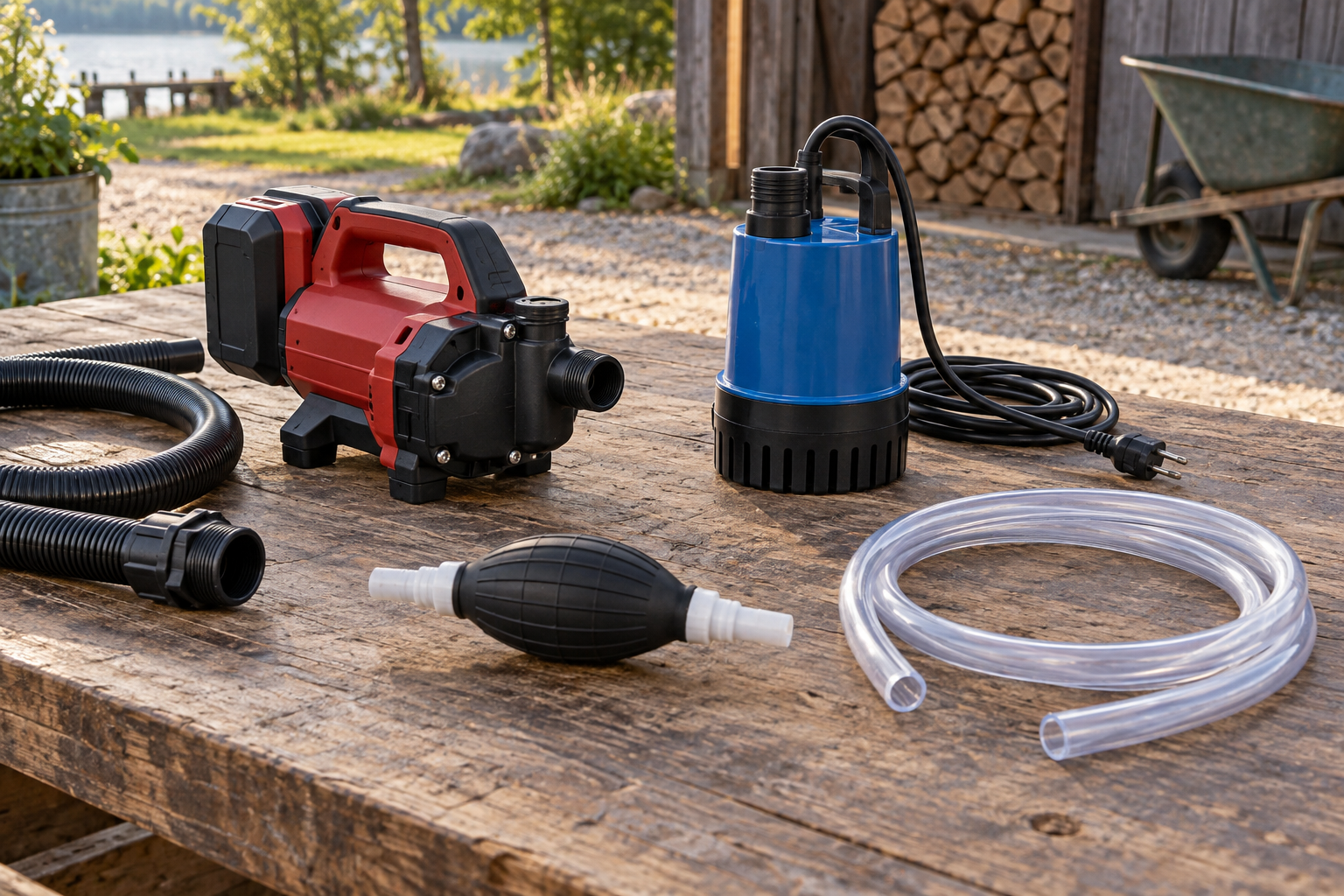
Not all battery-powered pumps are the same. For jobsite water removal, these are the three you will see:
| Type | Best For | Typical Flow | Handles Debris? | Limitation |
|---|---|---|---|---|
| Inline Transfer Pump (impeller) | Draining water heaters, barrels, trenches with clean water | 400-750 GPH | No – screen clogs on leaves/grit | Needs priming, must stay dry |
| Submersible Stick / Utility Pump | Flat surfaces, flooded floors, window wells down to 1/8 inch | 300-500 GPH | Light grit only | Short discharge height, tethered to water |
| Drill-Powered Pump Attachment | Occasional light transfer if you own nothing else | 150-300 GPH | No | Burns up drills, poor seals, slow |
For general jobsite use, the inline transfer pump is the most versatile. It stays out of the water, you can move it quickly, and it works with standard hoses. A cordless transfer pump in the 18V class will handle 90% of clean-water moves faster than a drill pump and without dragging a cord.
Submersible stick pumps are better when you need to get a floor almost dry. They sit directly in the water and can pick up to about 1/16 to 1/8 inch if the floor is flat. Transfer pumps with an inlet hose always leave an inch or two behind. Many crews carry one of each if they do flood remediation.
What to Look For Before Buying
Housing and seals: Look for a brushless motor and a sealed battery compartment with a gasket. Brushed motors work but run hotter and die sooner when the pump runs dry. Any pump that will be near standing water needs that gasket. Check the battery door latch in person if you can; thin plastic doors crack in cold weather.
Run-dry protection: Good pumps have an auto-shutoff when the inlet runs dry. Without it, an impeller can overheat and weld itself in under two minutes. If your pump does not have it, do not walk away while it is running.
Priming: Most cordless transfer pumps are not truly self-priming despite the marketing. You need to fill the inlet hose with water or pour water into the priming port before starting. Pumps that require full manual priming every time are slower on repeated moves. Check the manual for priming steps before you are standing in water.
Inlet strainer: A metal screen strainer with a tether is far more durable than a plastic snap-on. It also keeps small stones out of the impeller. Clean it every tank. A clogged strainer is the number one cause of low flow and burned motors.
Hose connections: Brass garden hose threads outlast plastic. If the pump uses plastic threads, use brass hose adapters and do not overtighten. Cross-threading a plastic inlet on a cold morning will end your day.
When the Cheaper Option Is Fine
You do not need the most expensive platform pump for occasional use. If you only drain a water heater twice a year or clear a 30-gallon trench after rain, a budget 18V pump on the battery system you already own is plenty. Performance differences between $99 and $179 pumps in the same voltage class are small — usually 10-15% flow and slightly better seals on the pricier unit.
Where spending more helps is if you use the pump weekly, need to push water more than 40 feet, or work in cold or dirty conditions. Then the brushless motor, better head pressure, and metal fittings are worth it. A 18V cordless water pump for garden hose use with a 6.0Ah High Output battery will maintain voltage longer under load and give you 30-40% more runtime than a standard pack.
Avoid drill-powered pump heads as a primary solution. They are cheap for a reason. They leak at the drill chuck, they void drill warranties if water reaches the bearings, and they move water at half the speed. Keep one in the truck as a backup, not as your plan A.
Field Tips and Failure Modes
Most cordless pump failures on site are user errors, not defects.
Running dry is the fastest killer. Even 60 seconds dry can score the impeller housing. Never start the pump and go get the hose. Prime first, start second, and shut down the instant the water sputters.
Air leaks on the inlet side cause 80% of priming complaints. If the pump runs but does not move water, check the inlet hose washer and the strainer connection before you blame the pump. A cracked washer or loose hose clamp will let air in and prevent suction. Teflon tape does not fix suction leaks — a flat rubber washer does.
Do not use a transfer pump to move chemicals, fuel, or hot water over 120°F. Seals swell and impellers warp. If you need to move diesel or fertilizer, buy a pump rated for that fluid.
For winter work, drain the pump and both hoses immediately after use. Water left in the impeller housing freezes, cracks the volute, and locks the impeller. Store batteries above 40°F. A cold 5.0Ah pack can lose 20-30% usable capacity until it warms up.
If you are building a dedicated water removal kit, keep it together: pump, two charged high-capacity batteries, a rapid charger, a 25-foot 3/4-inch discharge hose, a 6-foot reinforced inlet hose with strainer, spare washers, and a small bucket for priming. A cordless submersible utility pump makes a good second piece for that kit when you need to get floors dry after the transfer pump has done the bulk work.
Related guides
- Longest Lasting Lawn Mower Battery: AGM vs Lithium vs Flooded Lifespan and Cost per Season
- Duralast Gold Lawn Mower Battery Review: U1 Fit, CCA and When to Pay for AGM
- Greenworks Pro 80V 21-Inch Mower Review: Runtime Math, Push vs Self-Propelled and Yard Fit
- Bosch High Pressure Washer Gun Replacement: Fittings, Adapters and What Fits Your Model