What's inside
As an Amazon Associate I earn from qualifying purchases. This post may contain affiliate links at no extra cost to you.
What “Continuous Heating” Really Means
A cordless heat gun can draw far more power than most cordless hand tools. A drill may run intermittently, but a heat gun can pull several hundred watts for minutes at a time. That makes the battery—not just the heat gun—the main limit during continuous heating.
For this article, continuous heating means holding the tool on for repeated, extended runs rather than using it for a few short bursts. Removing labels, softening adhesive, bending plastic, shrinking tubing, thawing pipes, and stripping paint all have different duty cycles. A battery that works well for five-minute jobs may become frustrating during a larger project.
Start by checking the heat gun’s battery platform and recommended battery size. A battery from the same nominal voltage family is not automatically compatible. The mechanical fit, electronic communication, discharge limits, and charger all matter. Do not modify the battery or use an adapter unless the tool maker specifically supports it.
Calculate Runtime Before Buying
Battery capacity is listed in amp-hours (Ah), but watt-hours (Wh) are more useful for comparing platforms. Multiply nominal battery voltage by amp-hours:
Watt-hours = volts × amp-hours
A 20-volt, 5-Ah pack contains roughly 100 Wh before accounting for conversion losses and the tool’s operating behavior. A 18-volt, 5-Ah pack contains about 90 Wh. The actual usable energy will be lower because the battery voltage changes under load, the tool may shut down early, and heat reduces efficiency.
For a rough estimate, divide battery watt-hours by the heat gun’s input power. A 100-Wh battery running a 500-watt heat gun would theoretically last 12 minutes. In practice, expect less—often around 8 to 10 minutes at maximum heat, depending on the pack, airflow setting, temperature, and cutoff controls.
| Battery size | Approximate energy at 20 volts | Typical use | Trade-off |
|---|---|---|---|
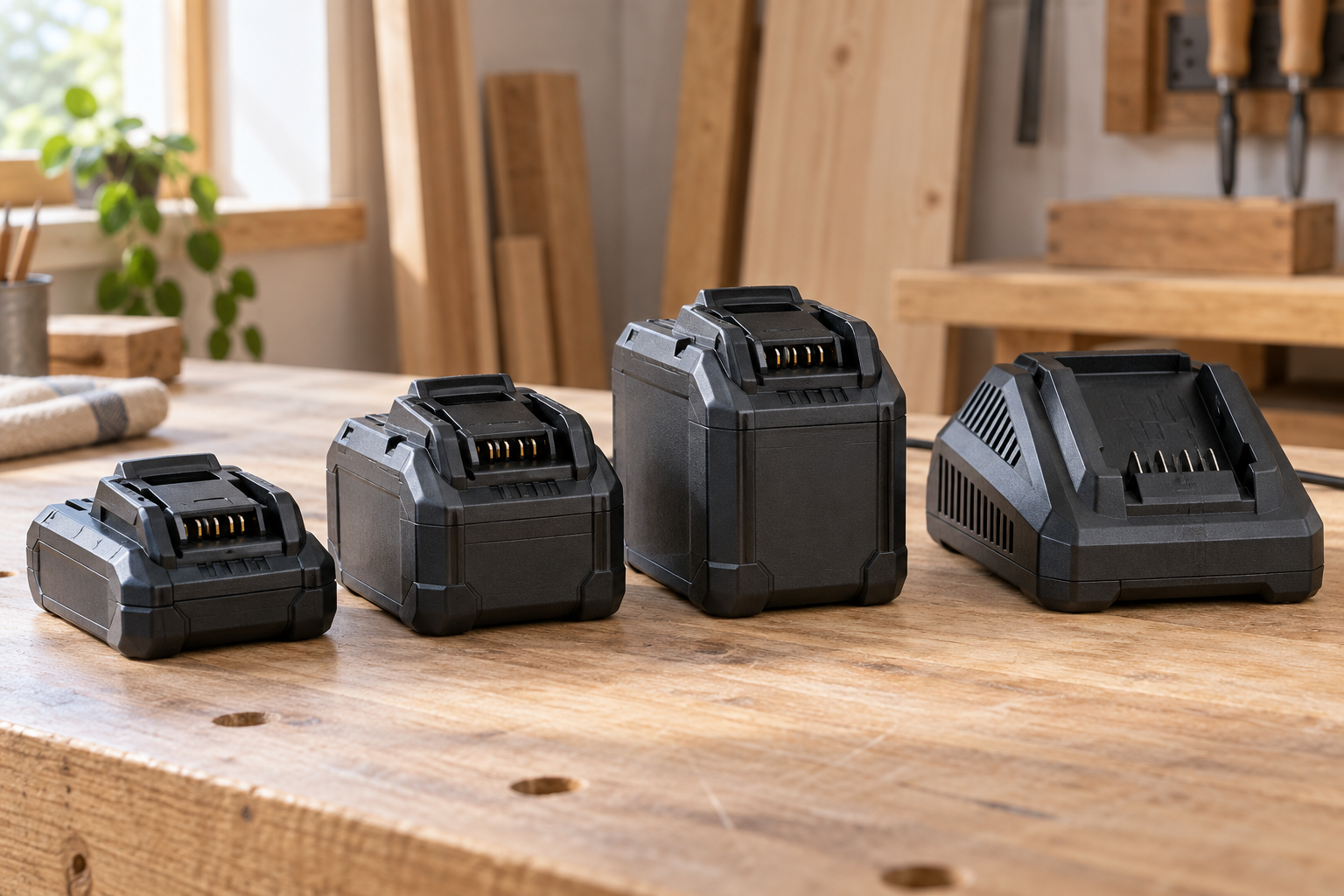
| 2 Ah | 40 Wh | Short repairs, tubing, labels | Light and inexpensive, but limited runtime |
| 4 Ah | 80 Wh | General cordless heat-gun work | Good balance of runtime and weight |
| 5 Ah | 100 Wh | Repeated heating and larger jobs | Longer runtime, heavier in the hand |
| 8 Ah | 160 Wh | Maximum runtime and high-load work | Expensive and noticeably bulky |
These figures are energy estimates, not guaranteed run times. A heat gun rated at 400 watts may cycle its heater to maintain temperature, while a lower setting may use substantially less power. Fan speed also affects consumption.
Choose Battery Capacity for the Job
A 2-Ah pack is fine when the heat gun is an occasional tool. It keeps the tool relatively light and may be all you need for shrinking a handful of wire connectors or softening one adhesive-backed part. It is usually the cheapest way to get started, especially if you already own the platform’s charger.
For continuous heating, a 4-Ah or 5-Ah pack is the practical starting point. The extra cells reduce the chance of an early low-voltage shutdown and provide more usable energy without the extreme weight of the largest packs. If you already have several batteries, buying another mid-size pack may be cheaper and more useful than buying one oversized battery.
An 8-Ah pack makes sense when runtime matters more than balance, such as repeated heat-shrink work, roofing repairs, or jobs away from mains power. However, the battery can make a compact heat gun top-heavy. The tool may also become uncomfortable before the battery is empty. Consider a cordless heat gun compatible with your battery platform and test its balance with your largest pack before committing.
High-Output Batteries and Heat Management
Capacity alone does not tell you how well a battery will run a heat gun. High-output battery packs use cells and electronics designed to deliver more current with less voltage sag. This matters when the heater starts, when the tool is set to maximum temperature, or when the battery is partly discharged.
A battery that is too small for the load may trigger protection even when its charge gauge still shows several bars. Common symptoms include the heater cutting out, the fan stopping, pulsing heat, or the tool restarting only after the battery cools. These are usually protection events, not necessarily a defective tool.
Heat is another limitation. Do not cover the battery vents, leave the pack in direct sun, or place a hot battery straight onto a charger. Let it cool naturally. Charging a pack while it is hot can prolong charging and, over time, reduce battery life. Use the manufacturer’s charger rather than a cheap universal substitute.
For demanding work, look for the platform’s high-output 5-Ah tool battery category rather than choosing only by Ah rating. Check that the heat gun maker lists that battery class as supported. Some tools limit output with smaller packs, and some batteries are physically incompatible despite sharing a voltage label.
Plan for Charging and Battery Swapping
If you need more than one battery’s worth of heating, a second pack is often better than buying the largest available battery. Swapping a 4-Ah pack takes seconds, avoids excessive tool weight, and lets one battery cool while the other runs. This approach works best with a fast charger and at least two packs.
Fast charging is useful, but do not assume the charger can refill a pack as quickly as the heat gun uses it. A 5-Ah battery contains roughly 90 to 100 Wh, while a fast charger may need 45 minutes or more to replenish it, depending on its output and the battery’s temperature. For uninterrupted work, plan on two or three batteries or use a corded heat gun.
A spare battery is also valuable because heat guns often have poor runtime compared with drills or lights. If your project requires 30 minutes of actual full-power heating, expect to need multiple mid-size packs. Buy a battery and charger kit only if the included charger and battery fit tools you already own or plan to buy.
When a Corded Heat Gun Is the Better Choice
For long, stationary heating—such as stripping paint from several doors, warming large plastic sheets, or running a heat gun for an hour—a corded tool is usually cheaper and more capable. It provides steady power without carrying heavy batteries or stopping to recharge. The drawback is the extension cord and the need for a suitable outlet.
Choose cordless when access, portability, and quick setup matter more than maximum runtime. Choose corded when the job is heat-intensive and you can safely manage the cable. A cordless heat gun is not automatically the better tool just because the battery platform is convenient.
Before buying, confirm the tool’s supported battery sizes, power or temperature settings, expected runtime, charger availability, and warranty. For most owners, a 4-Ah or 5-Ah pack plus a spare is the best compromise. Use a 2-Ah battery for short jobs, step up to a high-output pack for demanding loads, and reserve the largest batteries for situations where extra weight is acceptable.
Related guides
- Longest Lasting Lawn Mower Battery: AGM vs Lithium vs Flooded Lifespan and Cost per Season
- Duralast Gold Lawn Mower Battery Review: U1 Fit, CCA and When to Pay for AGM
- Greenworks Pro 80V 21-Inch Mower Review: Runtime Math, Push vs Self-Propelled and Yard Fit
- Bosch High Pressure Washer Gun Replacement: Fittings, Adapters and What Fits Your Model