What's inside
As an Amazon Associate I earn from qualifying purchases. This post may contain affiliate links at no extra cost to you.
Repetitive assembly changes what matters in a cordless screwdriver. A tool that feels powerful for five minutes can become tiring, inconsistent, or damaging after several hundred fasteners. The right choice depends less on maximum torque and more on control, weight, bit retention, battery logistics, and how reliably the tool repeats the same result.
Start With the Fastener and Material
List the screws you install, their lengths and drive types, and the materials involved. Driving 1-inch wood screws into soft pine is a different job from installing small machine screws in sheet metal or assembling cabinet hardware into particleboard.
For small screws, excessive torque can strip the head, split plastic, or pull threads out of a tapped hole. For wood and construction fasteners, too little torque leaves the head proud or creates a loose joint. If you already use a cordless platform, a cordless screwdriver with an adjustable clutch is usually more useful than a basic drill with only a few broad clutch settings.
Run a simple test before buying: drive 10 to 20 of the actual fasteners into scrap material. Check whether the tool can seat them consistently without needing to finish every screw by hand. Repetitive work exposes small inconsistencies quickly.
Choose the Right Tool Type
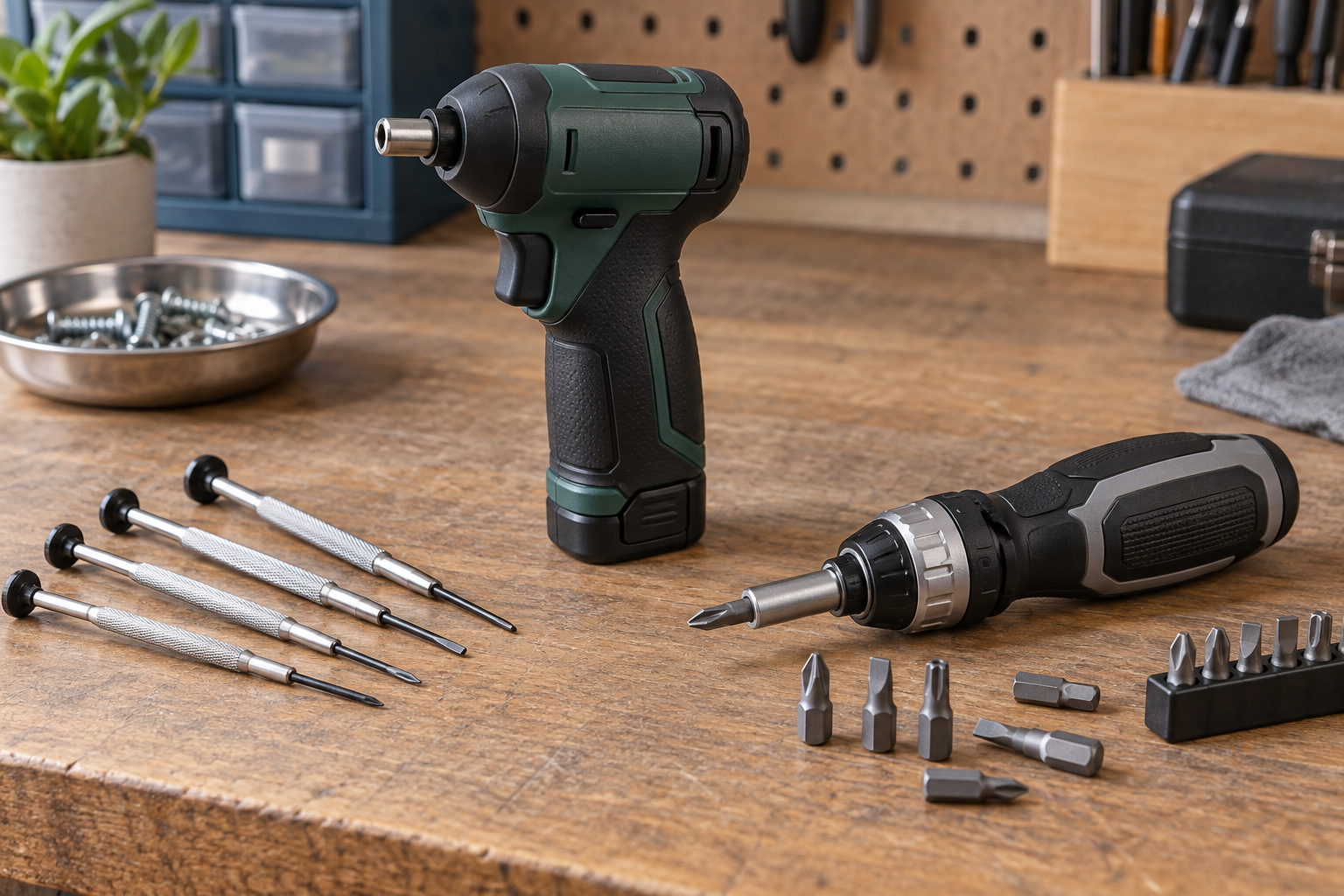
A compact cordless screwdriver is best for light assembly, furniture hardware, electrical boxes, and small machine screws. It is easy to hold in line with the fastener and usually has a sensitive trigger. Some models use a pistol grip; others have a straight or swiveling grip that works well in confined spaces.
A cordless drill-driver is the flexible choice when you also need to drill holes or drive larger screws. It generally offers more torque and a larger battery, but that extra capability means more weight and bulk. For hundreds of small fasteners, a drill-driver can be tiring unless it is a compact 12V or similar lightweight model.
An impact driver is fast and effective for long wood screws, but it is often a poor default for delicate assembly. The impact mechanism can overdrive screws, damage plastic, and make it harder to feel when threads have bottomed out. Choose one only when the fasteners regularly demand its extra torque and use low speed with care.
| Tool type | Best use | Main advantage | Main drawback |
|---|---|---|---|
| Compact cordless screwdriver | Small screws and light assembly | Low weight and good control | Limited torque and slower work on large fasteners |
| Compact drill-driver | Mixed drilling and screwdriving | Versatility and adjustable clutch | Heavier than a screwdriver |
| Impact driver | Long or large wood and construction screws | High driving speed and torque | Less refined control for delicate parts |
Prioritize Clutch Control
The clutch is the adjustable mechanism that stops or slips when resistance reaches a selected level. It is the most important feature for repetitive assembly because it limits variation between operators and prevents many stripped heads.
Look for a broad range of clutch settings, not just a high torque specification. A numbered collar with 15 to 20 settings is useful, but the numbers are not standardized between brands. Setting 8 on one tool may be weaker or stronger than setting 8 on another.
Start at a low setting and increase it until the screw seats fully in the test material. Then drive at least 20 fasteners and inspect the results. If some screws remain proud while others sink too far, the material, screw batch, bit condition, or tool speed may be the real problem.
For machine screws, a tool with an electronic shutoff or precise low-torque setting can be valuable. For wood screws, a mechanical clutch is normally sufficient. Keep the final tightening slow; full trigger speed gives the clutch less time to react and increases overshooting.
Speed and Trigger Control
Two mechanical speeds are more useful than an impressive no-load speed number. Low gear gives control for starting threads and seating fasteners. High gear speeds up repetitive work after the correct clutch setting is established.
A variable-speed trigger should start smoothly rather than jump from stopped to fast. This matters when the bit must engage a recessed Phillips or Torx head without camming out. A lock-on button can reduce finger fatigue during long runs, but it also removes an important safety control. Use it only where the workpiece is stable and the bit can be released quickly.
Brushless motors usually run cooler and may provide longer runtime, but they are not automatically the best value for light assembly. If you use the tool occasionally or drive only a few hundred small screws per year, a brushed compact screwdriver can be adequate. For daily production use, brushless construction and better electronics are easier to justify.
Weight, Balance, and Fatigue
Compare the tool with its battery installed. A bare-tool weight can hide a surprisingly large pack. For overhead or horizontal work, staying near 2 pounds is a meaningful target; heavier drill-drivers can become uncomfortable after 30 to 60 minutes of repeated use.
Balance matters as much as the scale reading. The bit should sit naturally in line with your forearm, and the grip should not force your wrist to bend. A narrow handle helps smaller hands, while a rubberized grip reduces the force needed to prevent rotation.
Check the light position, belt hook, bit storage, and chuck design. A single integrated LED is useful, but a shadow from the chuck can still hide the screw head. A 1/4-inch hex collet allows fast bit changes with one hand; a keyed or keyless drill chuck accepts more accessories but takes longer to change.
Battery Platform and Charging
If you already own cordless tools, staying within that battery ecosystem is often the cheapest and most convenient option. Buying a bare tool avoids another charger and battery, and shared packs may already be charged at the start of the day.
For light assembly, small packs are usually preferable. A 1.5Ah or 2.0Ah battery reduces wrist fatigue and can drive hundreds of small screws, depending on material, clutch setting, and screw size. Larger 4.0Ah and 5.0Ah packs provide more runtime but can make a compact tool feel top-heavy. Buy a 12V cordless screwdriver kit with an extra battery when the work is continuous and downtime costs more than the second pack.
Check charging time and battery availability before committing to a platform. Some ecosystems offer inexpensive replacement packs and compact USB-style chargers; others are built around larger packs intended for drills, saws, and outdoor tools. Do not choose a brand solely because its starter kit is cheap if replacement batteries are difficult to find.
Bits, Maintenance, and Failure Modes
Use the correct bit size and replace worn bits early. A rounded Phillips bit can cause more damage in one shift than a modestly powered screwdriver. Torx bits generally resist cam-out better, but they still need full engagement and straight pressure.
Common failures include stripped screw heads, screws driven below the surface, loose joints from an overly low clutch setting, and batteries that shut down under load. If the clutch slips before the screw seats, raise the setting one step at a time. If the tool smells hot or the housing becomes uncomfortable, stop and let it cool; repeated overheating shortens motor and battery life.
A cheaper compact screwdriver is fine for occasional furniture assembly, hobby projects, and a few dozen fasteners at a time. Spend more on brushless construction, extra batteries, electronic control, or a better clutch when the tool will run daily, work overhead, or determine the consistency of a production line. For mixed household work, a compact 12V cordless drill-driver kit usually offers the best balance of assembly control and general usefulness.
Related guides
- Longest Lasting Lawn Mower Battery: AGM vs Lithium vs Flooded Lifespan and Cost per Season
- Duralast Gold Lawn Mower Battery Review: U1 Fit, CCA and When to Pay for AGM
- Greenworks Pro 80V 21-Inch Mower Review: Runtime Math, Push vs Self-Propelled and Yard Fit
- Bosch High Pressure Washer Gun Replacement: Fittings, Adapters and What Fits Your Model