What's inside
As an Amazon Associate I earn from qualifying purchases. This post may contain affiliate links at no extra cost to you.
The right battery for a cordless nailer is usually the one the tool maker specifies—not the biggest pack you can fit. Nailer performance depends on the tool’s firing mechanism, battery electronics and pack condition, so voltage alone won’t tell you whether a battery will work. Check the manual and the tool’s battery label before buying, especially if you’re choosing a pack from a platform you already own.
Check compatibility first
Start with the nailer’s exact model number and approved battery platform. A pack must match the tool’s voltage and physical connector, but those aren’t the only requirements: some tools also rely on battery-management electronics that differ across a brand’s product generations. A battery from the same manufacturer may still be incompatible if it belongs to a different voltage platform.
Use the manual’s battery list or the manufacturer’s compatibility chart rather than judging by appearance. Don’t force a pack that doesn’t slide and latch smoothly, and don’t use an adapter unless both tool and battery manufacturers explicitly approve it. An adapter can defeat protection features, and it won’t make an incompatible voltage safe.
Understand capacity and runtime
Battery capacity is commonly given in amp-hours (Ah). Within a compatible platform, a 4.0 Ah pack nominally stores about twice the energy of a 2.0 Ah pack at the same voltage. That can mean fewer interruptions, but it doesn’t guarantee twice as many nails: material, nail length, firing rate, tool efficiency and battery age all affect consumption.
A larger battery is also heavier and bulkier. That matters when you’re holding a framing nailer above shoulder height or using a finish nailer at the end of a long workday. If the manufacturer offers different pack sizes, compare their listed weight as well as capacity. A compact pack is often the better choice for trim work; a larger one makes more sense when you’re driving nails continuously and can accept the added weight.
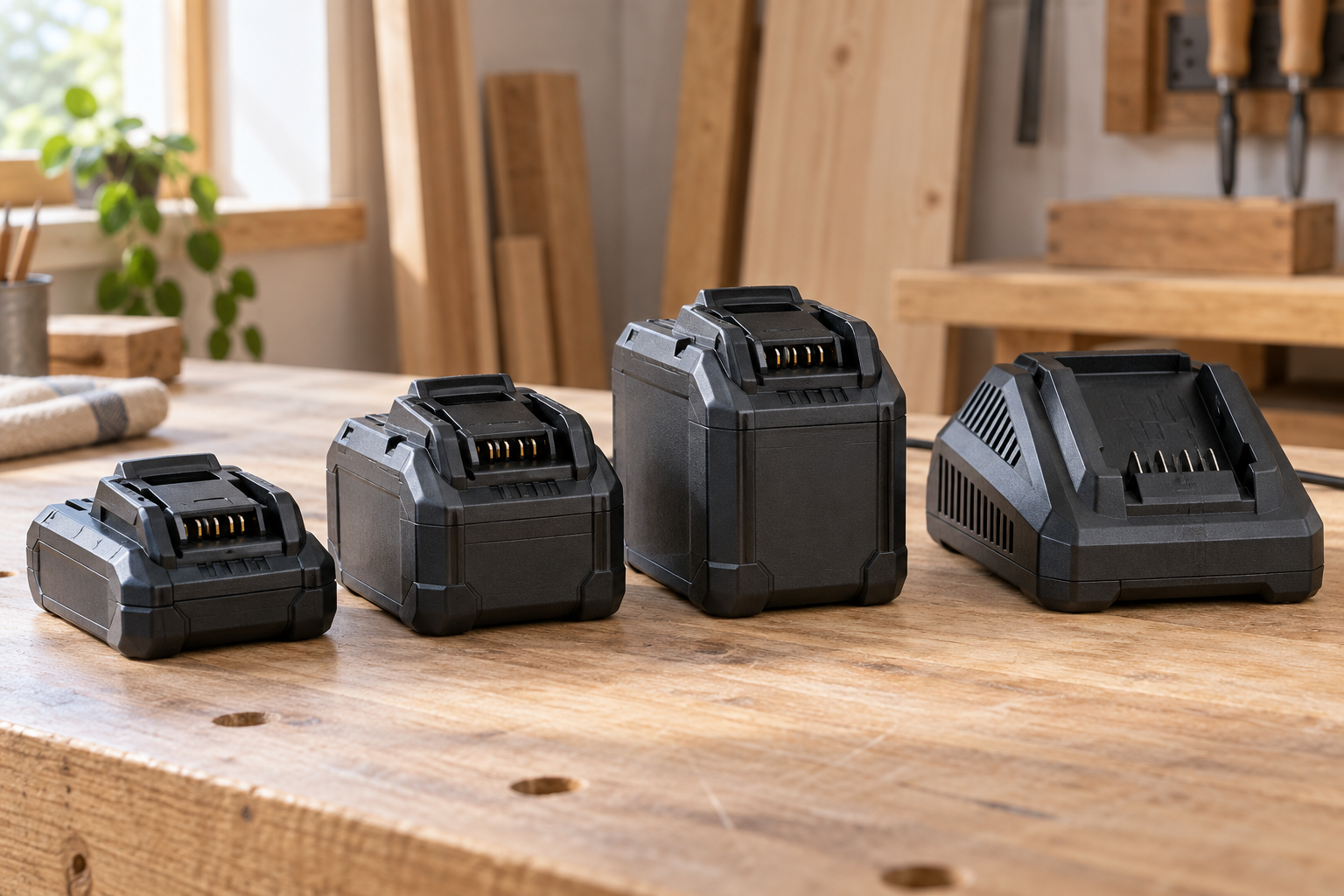
Compare battery sizes
These are practical trade-offs, not universal run-time guarantees. Pack weights and capacities vary by platform, and a nailer may accept only specific sizes.
| Pack size | Typical advantage | Typical drawback | Best fit |
|---|---|---|---|
| Compact, about 2.0 Ah | Lighter and less tiring to handle | More frequent charging on sustained work | Finish work, punch-list jobs, occasional use |
| Mid-size, about 4.0 Ah | Useful balance of runtime and weight | Heavier than a compact pack | General site work and mixed tasks |
| Large, about 5.0 Ah or more | Longer intervals between charges | More weight, bulk and cost | High-volume nailing where the tool permits it |
If you’re buying your first pack, a compatible 4.0 Ah battery is a sensible starting point for many general-purpose jobs, provided the nailer manufacturer approves that capacity. For light finish work, a compatible compact 2.0 Ah pack may be more comfortable. Confirm connector and platform before ordering; search results can include packs that look similar but won’t fit your tool.
Match the battery to the nailer
A framing nailer driving long nails into dense lumber generally demands more from its power system than a finish nailer placing smaller nails in trim. If the tool slows, fails to sink nails or pauses between shots, a depleted, cold or worn battery could be the cause—but so could an unsuitable nail, poor depth setting, jam or dirty tool. Don’t assume a bigger pack will fix a mechanical or setup problem.
Check the nailer manual for any minimum battery capacity or recommended pack. If the tool maker specifies one, follow it. If it doesn’t, start with a mid-size compatible pack and see how it performs on your actual materials. Buying the largest battery “just in case” costs more and can make a handheld tool noticeably less balanced.
Battery condition and charging
Runtime falls as lithium-ion batteries age. A pack that charges fully but runs out much sooner than it used to may be nearing the end of its useful life. A damaged case, cracked latch, unusual swelling, leaking or a pack that becomes abnormally hot during ordinary use is a reason to stop using it—not to try to revive it. Follow the manufacturer’s instructions for service or recycling.
Cold temperatures can temporarily reduce available power and runtime. If a pack has been stored in a cold vehicle, let it warm to the temperature range stated in its manual before charging or working. Use the correct platform charger; a fast charger can shorten downtime but may cost more, and it won’t make a worn battery healthy. For a busy job, a second compatible pack is often more useful than one oversized pack because you can swap batteries while the other charges.
When a cheaper pack is fine
For occasional home repairs, a manufacturer-approved compact pack may be all you need. You don’t need to pay for the highest-capacity battery if the nailer gets used for a few short sessions and you already have time to recharge. A two-pack bundle can also be a practical purchase when the batteries are genuine, compatible and priced well against buying packs separately.
Be cautious with unusually cheap third-party batteries. Some may work, but capacity claims, cell quality, protection circuits and warranty support can vary. A pack that triggers tool shutdowns, overheats or fails to latch securely can waste more time than its lower price saves. If you consider a third-party option, check whether the nailer manufacturer permits it and whether the seller provides a clear warranty and safety information. For a tool used daily, sticking to a battery approved by the maker is the safer bet.
Quick buying checklist
Before checkout, verify the nailer model, battery platform, approved voltage and physical fit. Choose capacity based on work duration and how much extra weight you’re willing to carry. Check the pack’s stated weight, charger compatibility and warranty, then decide whether one battery or a spare better suits your workflow. A correctly matched mid-size battery—or a lighter compact pack for intermittent finish work—is usually a more useful choice than simply buying the largest pack available.
Related guides
- Longest Lasting Lawn Mower Battery: AGM vs Lithium vs Flooded Lifespan and Cost per Season
- Duralast Gold Lawn Mower Battery Review: U1 Fit, CCA and When to Pay for AGM
- Greenworks Pro 80V 21-Inch Mower Review: Runtime Math, Push vs Self-Propelled and Yard Fit
- Bosch High Pressure Washer Gun Replacement: Fittings, Adapters and What Fits Your Model