What's inside
As an Amazon Associate I earn from qualifying purchases. This post may contain affiliate links at no extra cost to you.
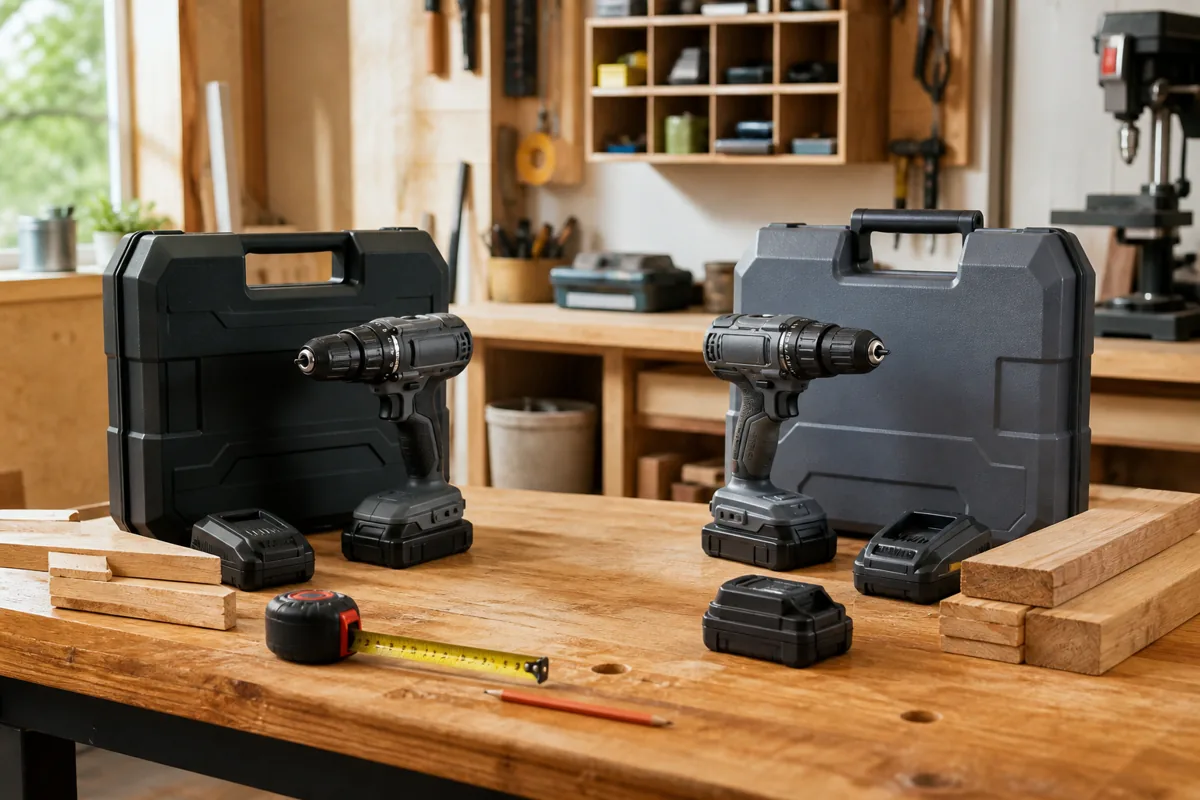
Buying into a cordless tool platform is less about one drill than about the next five tools you may buy. A starter kit usually gives you a battery, charger, and one core tool at a bundled price. An expansion pack adds tools or batteries to an ecosystem you already own. Compare them by total usable capacity, charging speed, tool coverage, and replacement cost—not just the number printed on the box.
Start With the Platform, Not the Tool
A battery platform is a shared electrical system. The battery shape, voltage range, charger, and communication electronics determine which tools will work together. Batteries from one platform generally do not fit another brand, even when the voltage label looks similar.
Before comparing kits, list the jobs you actually expect to do in the next two years. A homeowner might need a drill, impact driver, reciprocating saw, oscillating tool, and light. A remodeler may also need a circular saw, angle grinder, rotary hammer, vacuum, and several high-capacity batteries. A platform with 150 tools is not automatically better if the tools you need are expensive or unavailable locally.
Also check whether a brand sells multiple incompatible battery lines. “18V” and “20V MAX” systems are commonly marketed in similar voltage classes, but their packs and tools are not interchangeable. Some brands also have separate compact, high-voltage, or outdoor-tool systems.
Starter Kit Versus Expansion Pack
A starter kit is normally the best entry point because the charger and first battery are included. An expansion pack makes more sense when you already own a compatible charger and at least one battery, or when the discounted tool is sold without battery and charger.
Do not assume a two-tool starter kit is cheaper simply because it contains more items. Compare the kit price with the individual prices of the tools, battery, and charger. Bundles sometimes include a small battery that is adequate for a drill but frustrating in a saw.
| Purchase type | Usually includes | Best for | Main catch |
|---|---|---|---|
| Basic starter kit | Drill or impact driver, battery, charger | First-time platform buyers and light repairs | Often includes only a compact battery |
| Multi-tool starter kit | Two or more tools, one or two batteries, charger | Users starting several common jobs | One tool may be a compromise model |
| Tool-only expansion | One bare tool | Owners with compatible batteries and charger | Requires existing equipment |
| Battery expansion pack | One or more batteries, sometimes a charger | Users who regularly run out of power | Capacity may cost more than a complete kit |
Compare Battery Capacity Correctly
Amp-hours, or Ah, describe stored charge, not tool power by themselves. A 2.0Ah battery is lighter and charges quickly. A 5.0Ah pack can run a saw or grinder substantially longer, but it adds weight and can make a compact drill tiring overhead.
For a rough energy comparison, multiply nominal voltage by amp-hours. An 18V, 5.0Ah pack stores about 90 watt-hours; an 18V, 2.0Ah pack stores about 36 watt-hours. Real runtime varies with load, temperature, battery age, and the tool’s efficiency, so treat this as a comparison method rather than a runtime promise.
High-output batteries can improve performance in demanding tools, but they are not always necessary. A small battery is fine for driving cabinet screws, assembling furniture, or drilling occasional holes. Choose a larger pack for long cuts, masonry drilling, grinding, outdoor equipment, or repeated fastener work. If the kit includes only one battery, the battery size should match the hardest job, not the cheapest advertised price.
When you need a second battery, compare 5.0Ah cordless tool batteries with the cost of a complete tool kit. A kit sale may make the extra tool nearly free, especially during holiday promotions.
Check Chargers and Charging Time
Charging speed matters when you own only one or two batteries. A basic charger may take several hours to fill a high-capacity pack, while a rapid charger can cut that time substantially. Faster charging creates more heat, so the charger may slow near full capacity or pause while the battery cools. That is normal, not necessarily a fault.
Look for a battery gauge, charging-status indicators, and a charger that matches the pack chemistry and platform. Never use a damaged pack, a swollen battery, or a charger with a cracked housing. Do not leave batteries in a hot vehicle; excessive heat accelerates capacity loss. A battery that runs for only a few minutes, refuses to charge, or shuts down under modest load may be worn out rather than defective.
If your work is continuous, two medium batteries are often more useful than one very large battery. One can charge while the other works. For occasional DIY jobs, however, the cheaper single-battery kit is usually adequate.
Evaluate the Tools in the Bundle
Read the specifications for torque, speed range, blade or disc size, and tool weight. A drill’s headline torque does not tell you how well its clutch works for small screws. An impact driver is faster for structural screws but is easier to over-tighten delicate hardware. A reciprocating saw handles demolition well but leaves rougher cuts than a circular saw or jigsaw.
Check whether the included tool is brushless or brushed. Brushless tools generally run cooler, use energy more efficiently, and tend to offer better performance in demanding work. Brushed tools can still be a sensible bargain for occasional use, particularly when the price difference is large and replacement brushes are available.
For a first platform, a cordless drill and impact driver combo kit covers more common fastening work than a kit built around two similar drills. If you already have those tools, expand with a category that changes what you can do, such as an oscillating tool, circular saw, or compact vacuum.
Calculate the Cost of Ownership
Add the price of the kit, extra batteries, charger upgrades, blades or bits, and likely replacement batteries. A platform can be cheap at the register but costly if its batteries are unusually expensive. Also check warranty length, local service availability, and whether batteries are covered separately from tools.
Compare bare-tool pricing before committing. If a tool-only expansion costs nearly as much as a kit containing a battery and charger, buy the kit unless you already have a practical reason to avoid duplicates. Duplicate chargers are not worthless, though: keeping one in the workshop and one in a vehicle or job box can save time.
Finally, avoid mixing old and new battery generations without checking compatibility. Some newer high-output packs fit older tools but provide no special benefit; others may be physically incompatible or restricted by the manufacturer. The cheapest sound choice is often a basic starter kit with a compact battery, followed by larger expansion batteries only when your actual work proves you need them. For broader tool coverage, compare cordless power tool platform starter kits by the tools you will use—not by the number of pieces printed on the package.
Related guides
- Longest Lasting Lawn Mower Battery: AGM vs Lithium vs Flooded Lifespan and Cost per Season
- Duralast Gold Lawn Mower Battery Review: U1 Fit, CCA and When to Pay for AGM
- Greenworks Pro 80V 21-Inch Mower Review: Runtime Math, Push vs Self-Propelled and Yard Fit
- Bosch High Pressure Washer Gun Replacement: Fittings, Adapters and What Fits Your Model