What's inside
As an Amazon Associate I earn from qualifying purchases. This post may contain affiliate links at no extra cost to you.
The short answer
For a few small concrete anchors, a good cordless hammer drill is usually the better buy. It is lighter, cheaper, and already useful for drilling wood, metal, and masonry. Use a rotary hammer when you need many holes, holes larger than about 1/2 inch, deep holes, or consistently fast drilling in hard concrete.
The important distinction is the hammer mechanism. A hammer drill uses two toothed discs to produce a fast, shallow vibration. A rotary hammer uses a piston and air cushion to deliver much harder blows through an SDS-Plus bit. That difference matters more than the battery voltage printed on the tool.
As an Amazon Associate we earn from qualifying purchases at no extra cost to you.


Choosing for small concrete anchors
For common tasks such as mounting a shelf, electrical box, hose reel, or small handrail, most holes are 1/4 to 3/8 inch in diameter and 2 to 3 inches deep. A cordless hammer drill in the 18V or 20V class can handle this work, provided you use a sharp masonry bit and do not force the tool.
A rotary hammer becomes worthwhile when the holes are numerous, the concrete is unusually hard, or the anchor manufacturer calls for a hole larger than 3/8 or 1/2 inch. It also makes overhead drilling less tiring because the tool does more of the breaking work instead of relying on pressure from your arms.
| Factor | Cordless hammer drill | Cordless rotary hammer |
|---|---|---|
| Typical small-hole range | 1/4 to 3/8 inch | 1/4 to 1 inch or more, depending on the tool |
| Best use | A few anchor holes and general drilling | Repeated holes, hard concrete, larger anchors |
| Chuck and bits | Standard chuck; round or hex-shank masonry bits | SDS-Plus chuck; SDS-Plus bits |
| Weight and balance | Usually lighter and more compact | Heavier, but better impact performance |
| Other functions | Drilling and screwdriving; hammer mode can be switched off | Rotary hammering; many also offer rotation-only and chipping modes |
| Typical drawback | Slow in hard concrete; can overheat under prolonged use | Higher cost, more vibration, and less useful as a general-purpose drill |
When a hammer drill is enough
A hammer drill is the sensible choice if you have fewer than roughly 10 small holes to drill and the wall is ordinary poured concrete, block, or brick. It is also the economical choice if you already own batteries in a cordless platform. Buying a bare tool can keep the cost reasonable, while the same battery can run an impact driver, reciprocating saw, or light.
Expect a 1/4-inch hole in sound concrete to take perhaps 20 to 60 seconds, depending on depth and material. A 3/8-inch hole may take longer and can become frustrating in dense aggregate. Keep the bit moving, withdraw it occasionally to clear dust, and use moderate pressure. Excessive force does not make the small hammer mechanism hit harder; it can stall the motor, heat the gearbox, or glaze the bit.
Do not use hammer mode on tile, finished stone, or brittle block unless you know the material can tolerate it. The percussion can crack the surface. Drill through the finish with hammer mode off, then engage hammer mode once the bit is into the masonry if the anchor location allows it.
When a rotary hammer pays off
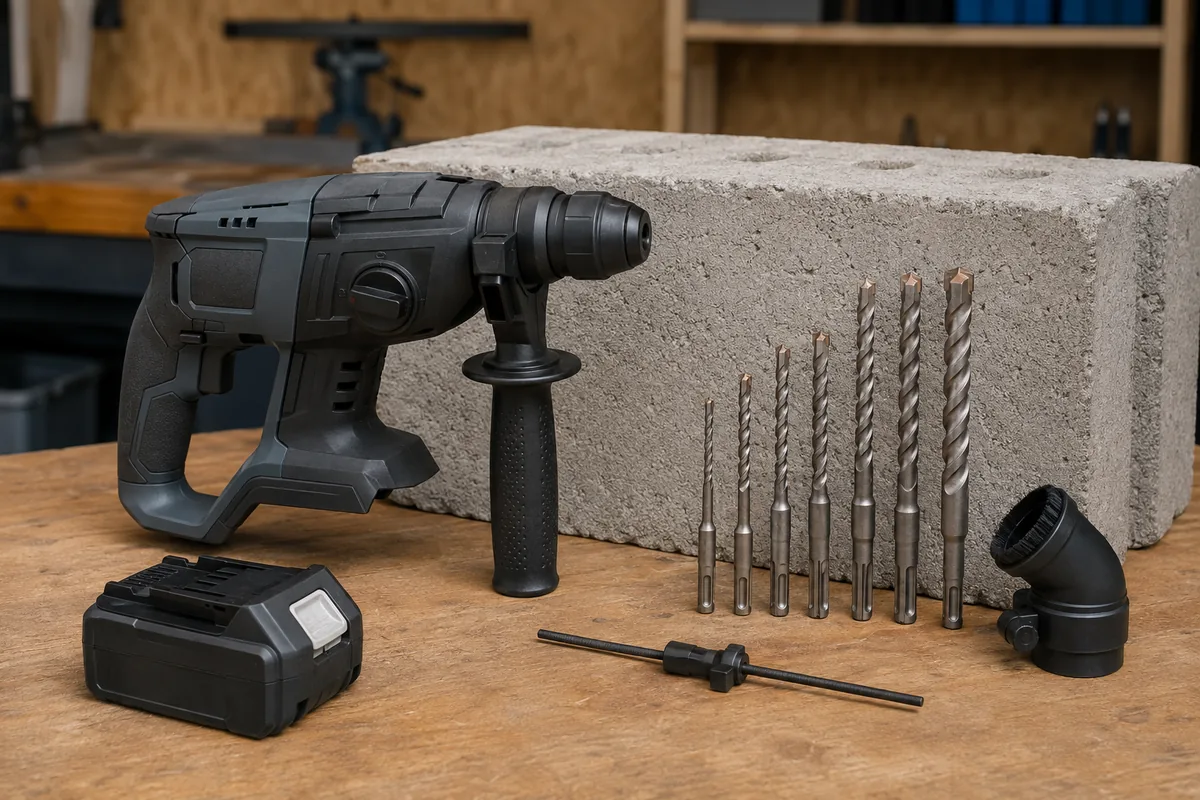
A rotary hammer is a major upgrade for repeated anchoring. Its SDS-Plus bits slide into the chuck without tightening, and the bit can move slightly as the piston strikes. The result is faster drilling with less hand pressure. A 5/8-inch hole that feels like a chore with a hammer drill is routine with a suitable rotary hammer.
Choose a cordless SDS-Plus rotary hammer if you expect to install concrete screws, sleeve anchors, or larger expansion anchors regularly. It is especially useful for basement work, masonry repair, installing fence posts into concrete, or drilling dozens of holes for framing and mechanical supports.
Its disadvantages are real. Rotary hammers are usually bulkier, louder, and more expensive. SDS bits cost more than basic masonry bits, although they generally drill faster and last longer in concrete. Rotary-hammer vibration can also be tiring, so use the auxiliary handle and take breaks during extended work.
Battery and platform costs
Do not compare tool prices without including the battery and charger. A bare rotary hammer may look affordable, but a high-capacity battery and charger can add substantially to the purchase. If you already own a compatible battery system, staying within that platform is often the best financial decision even if another brand has slightly better specifications.
For occasional small anchors, a compact battery keeps a hammer drill lighter. For a rotary hammer, a higher-capacity pack is more practical because hammering drains batteries quickly and the tool is often used for longer sessions. A second pack can be more useful than chasing a small increase in impact energy.
If you are starting a new system around masonry work, compare the available 18V or 20V cordless tool kits, battery prices, charger speed, and the platform’s other tools. Battery availability at local stores matters when a pack fails in the middle of a job.
How to drill the anchor hole correctly
Mark the location and check for wiring and plumbing before drilling. Set the depth stop, or wrap tape around the bit slightly deeper than the required hole. Drill at a steady 90-degree angle. A hole that is too shallow prevents the anchor from seating; a hole that is too large lets the anchor spin or pull out.
Clean the dust from the hole. For a small plastic anchor, vacuuming or blowing out the hole is usually enough. For expansion anchors and concrete screws, dust left in the hole can reduce holding strength. Follow the anchor maker’s specified diameter and depth rather than substituting a similar-looking bit.
The most common failure is a dull or cheap bit being pushed too hard. Another is hitting rebar. If progress stops suddenly, do not keep leaning on the trigger until the motor overheats. Move the hole if the installation permits, or switch to a bit and tool rated for reinforced concrete. Never defeat the tool’s side handle or clutch protection; a jammed bit can twist the drill violently.
A practical buying rule
Buy a hammer drill if the job is under 10 small holes, you value general-purpose use, and you already have a compatible battery platform. Buy a rotary hammer if the work involves repeated holes, larger than 3/8-inch anchors, hard concrete, or overhead drilling. For a homeowner who only occasionally mounts something to masonry, the cheaper hammer drill is fine. For maintenance work or frequent installation, the rotary hammer quickly earns its place.
Related guides
- Longest Lasting Lawn Mower Battery: AGM vs Lithium vs Flooded Lifespan and Cost per Season
- Duralast Gold Lawn Mower Battery Review: U1 Fit, CCA and When to Pay for AGM
- Greenworks Pro 80V 21-Inch Mower Review: Runtime Math, Push vs Self-Propelled and Yard Fit
- Bosch High Pressure Washer Gun Replacement: Fittings, Adapters and What Fits Your Model